
Art Galleries: From White Cubes to Digital Split-Flap Displays
July 13, 2026 · Captain
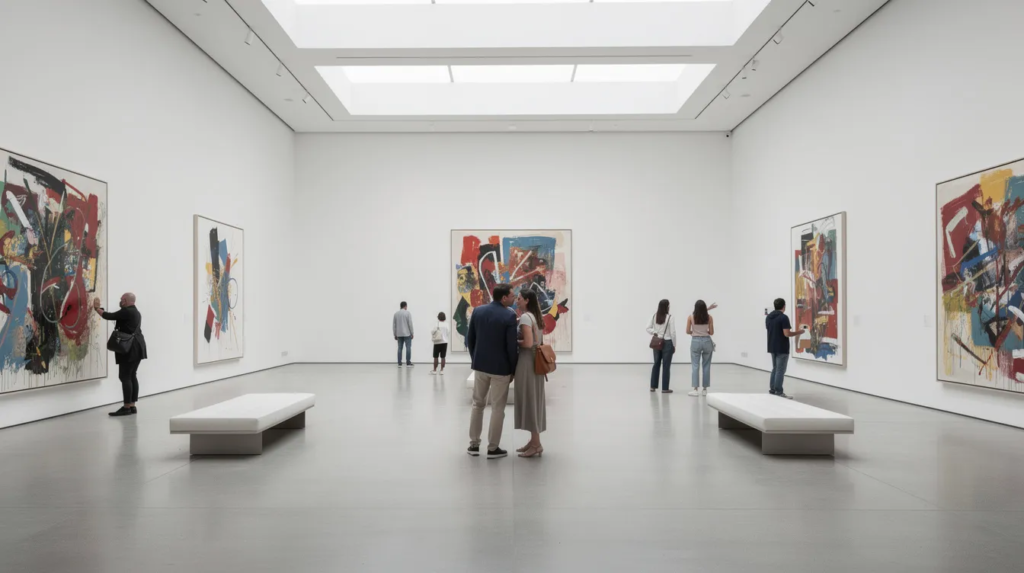
Art galleries have served as curated spaces presenting visual art to the public for centuries—from the prestigious 19th-century salons of Paris to the contemporary digital spaces emerging in 2026. An art gallery is a venue dedicated to the exhibition and promotion of visual art, typically focusing on living artists and contemporary works, and is distinct from a museum, which is primarily concerned with the preservation, study, and display of historical collections. These environments do far more than hang paintings on walls; they create experiences, shape narratives, and connect artists with audiences in ways that continue to evolve.
This guide is for gallery directors, curators, and cultural venue managers seeking to modernize visitor engagement. Understanding digital signage in galleries matters today because it enables institutions to communicate dynamically with visitors, streamline operations, and create memorable, accessible experiences that meet the expectations of contemporary audiences.
Today, digital signage—a technology that transforms any screen or TV into a dynamic platform for displaying information, announcements, and multimedia content—is transforming not just art galleries but also other industries, offering versatile solutions for offices, restaurants, hotels, and transportation hubs. These displays are used in various settings to engage customers and employees, making them a dynamic tool for communication and interaction.
Understanding what makes art galleries function—and how they communicate with visitors—matters whether you’re a curator planning your next exhibition, a gallery director managing daily operations, or a cultural venue seeking fresh ways to engage your community. This guide explores the landscape of modern galleries and how digital signage, particularly nostalgic split-flap style displays, is transforming the visitor experience. A split-flap display is a type of electromechanical sign that uses rotating flaps to display changing alphanumeric information, historically found in train stations and airports, and now emulated digitally for its distinctive retro aesthetic and engaging motion.
Key points this article covers:
- The distinction between commercial galleries and institutional museums
- Different gallery types and their unique business models
- How visitor experience shapes gallery design
- The rise of digital signage in art spaces
- Practical applications for split-flap style displays in galleries
- Case uses across various gallery contexts
Galleries differ from museums in several important ways. While museums typically focus on preservation, historical context, and institutional collections, commercial galleries emphasize living artists and sales. Commission rates in commercial galleries typically range from 30% to 50% of artwork sales, creating a business model that directly supports contemporary creators.
Related reading: Museums: Bringing Stories to Life on Split-Flap TV Displays
Well-known gallery hubs have emerged across the world’s major cities. Chelsea in New York became the dominant gallery district during the 1990s and 2000s as dealers migrated from SoHo seeking larger, more affordable spaces. London’s Mayfair maintains its status as a prestigious gallery destination, while Berlin’s Mitte neighborhood attracts experimental and mid-career artist representation.
Modern galleries also use screens and digital signage to communicate exhibitions, events, and narratives as soon as visitors enter the space. This integration of technology creates opportunities to deliver dynamic content that captures attention while maintaining the aesthetic standards galleries require. Digital signage transforms any screen or TV into a dynamic platform to engage customers and employees.
Types of Art Galleries
The gallery landscape encompasses far more variety than most visitors realize. Each type operates under different models, serves distinct purposes, and requires unique approaches to visitor communication.
Commercial Galleries
Commercial galleries form the backbone of the primary art market. These businesses represent artists, organize exhibitions, and facilitate sales to collectors. Prominent examples include:
- Gagosian (founded 1980): Now operating across 18 locations worldwide, representing blue-chip contemporary artists
- Hauser & Wirth (founded 1992): Known for combining historical and contemporary programs across major cities
- David Zwirner (founded 1993): Expanded from a single New York space to a global operation with robust online viewing rooms
These galleries typically take 50% commission on primary market sales, though established artists may negotiate lower rates.
Non-Profit and Artist-Run Spaces
These spaces prioritize experimentation over commerce. Funding comes from grants, donations, and community support rather than sales commissions. Examples include:
- The Drawing Center (New York, founded 1977): Focused exclusively on drawing as a medium
- Auto Italia (London, 2007): Artist-run space supporting emerging practitioners
Many artist-run spaces embrace a DIY approach, building their own display solutions or leveraging open-source digital signage tools to fit their unique needs.
Public and Institutional Galleries
Linked to city or national funding, these institutions support large-scale exhibitions that commercial spaces couldn’t sustain. Tate Modern’s Switch House (opened 2016) exemplifies how institutional galleries expand their architecture to accommodate growing audiences and ambitious programming.
University Galleries
These spaces serve education and research while providing students exposure to professional curatorial practices. The MIT List Visual Arts Center (founded 1985) demonstrates how university galleries can maintain rigorous contemporary programming while fulfilling educational missions.
Online Galleries and Viewing Rooms
Post-2020 growth in virtual exhibitions transformed how galleries reach global audiences. These digital spaces mimic the gallery experience through high-resolution imagery, 3D tours, and detailed artwork documentation. Many commercial galleries now maintain permanent online viewing rooms alongside physical locations.
Pop-Up and Hybrid Spaces
Short-term galleries in retail sites, hotels, or unconventional locations often use portable screens and projectors to display time-based work and digital art. These flexible arrangements allow galleries to test new neighborhoods or create community engagement without long-term lease commitments, mirroring installations of Split-Flap TV in diverse real-world spaces. Many pop-up and hybrid spaces also rely on DIY methods, customizing their own display technology or adopting open-source solutions to adapt quickly to different environments.
The Visitor Experience Inside an Art Gallery
Walking into a gallery involves a carefully orchestrated sequence of experiences. From the moment you approach the building, every element communicates something about what’s inside.
Arrival and Entrance
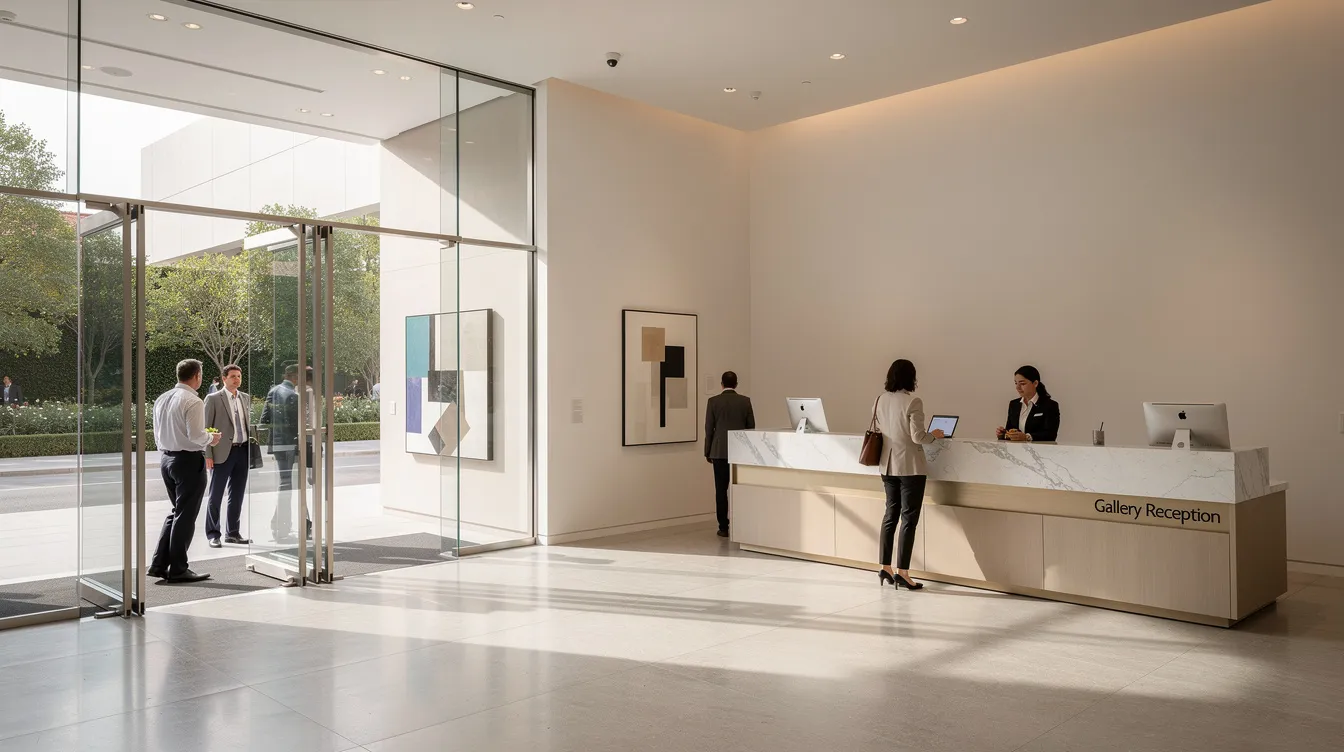
The journey typically begins on the sidewalk. Exterior signage announces the current exhibition, while window displays offer glimpses of works inside. At the entrance, a front desk or reception area sets expectations with show titles, wall vinyl, and increasingly, digital welcome screens that rotate information about events, artist talks, and exhibition hours. Digital signage can also be used to display dynamic menus for gallery cafés or event spaces, enhancing the visitor experience.
Wayfinding and Navigation
Key touchpoints in the visitor experience include:
- Wayfinding elements: Floor plans, wall labels, and room-by-room exhibition texts guide visitors through a narrative, often arranged chronologically or thematically
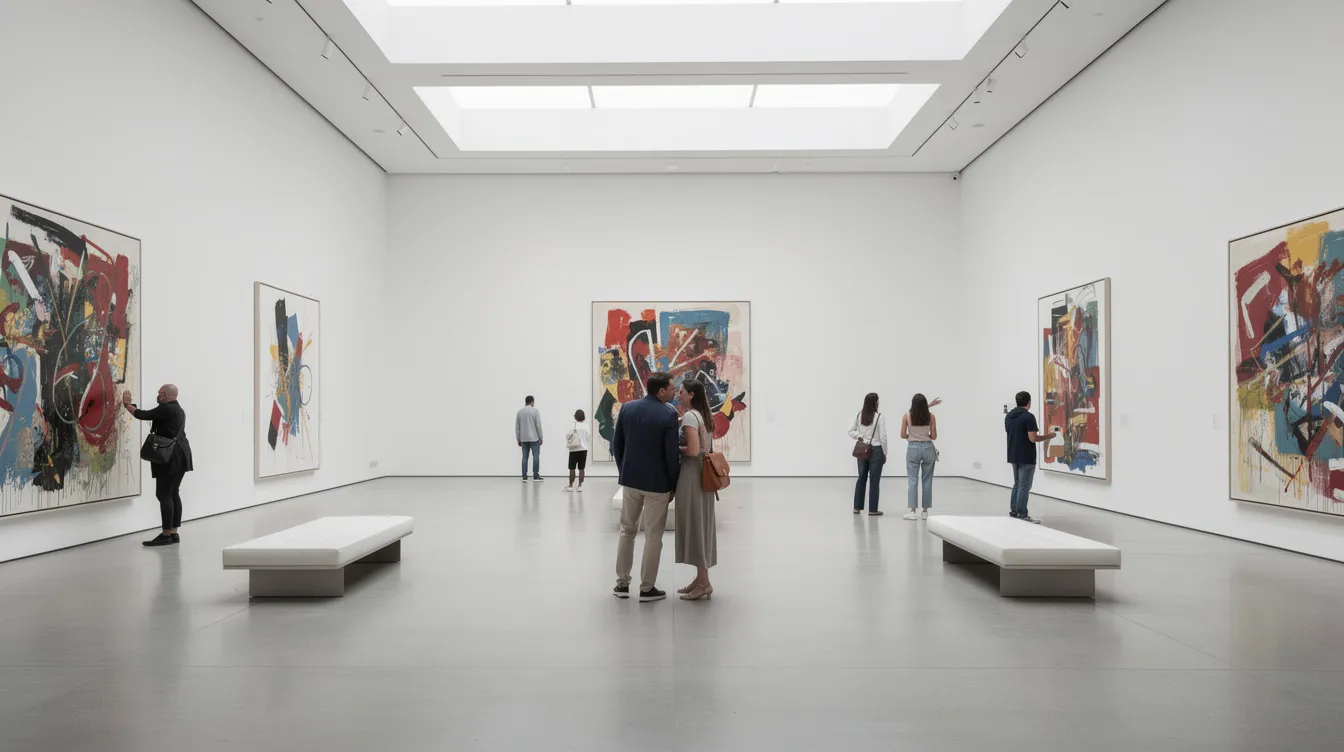
- White cube design: Neutral walls, controlled lighting, and minimal distractions evolved historically to foreground artwork—a practice that became standard in the mid-20th century
Events and Accessibility
- Opening events: Private views or vernissages (often Thursday evenings in major cities) bring together collectors, press, and the public to meet the artist
- Accessibility improvements: Since the 2010s, galleries have expanded large-print labels, audio descriptions accessible via visitors’ smartphones, and captioned video art
The salon hang, originating in France at the Louvre Palace in 1667, established aesthetic principles still visible in some contemporary galleries—though today’s minimalist approaches represent a dramatic departure from those wall-to-wall arrangements.
Some galleries now integrate digital displays modeled after classic split-flap boards to show rotating information. These screens can announce exhibition titles, starting times for artist talks, and scheduled screenings without disrupting the contemplative atmosphere visitors expect.
Accessibility and Inclusion: Making Art Galleries Accessible
Art galleries flourish when they become spaces where every visitor feels genuinely welcomed—where the magic of meaningful connection unfolds naturally. Digital signage, particularly when paired with thoughtfully chosen free software, transforms these spaces into something almost alive, breathing accessibility into every corner. Dynamic content flows like gentle conversation—rotating messages that speak personally, audio descriptions that guide with warmth, video elements that invite rather than instruct. This isn’t just information delivery; it’s the creation of an atmosphere where diverse needs are met with genuine care and artistic intention.
The beauty lies in the tactile quality of customizable displays—screens that respond, adapt, and evolve throughout the day. Real-time updates feel less like announcements and more like whispered secrets about hidden treasures. Step-by-step wayfinding becomes a gentle journey of discovery, while interactive modules invite participation with the kind of childlike enthusiasm that art should inspire. For visitors navigating visual or hearing challenges, these digital companions offer audio guides that feel like personal docents, captioned videos that include rather than accommodate, and tactile prompts that speak through intuitive software—technology that understands the human touch without demanding technical mastery.
What emerges is something rare in today’s digital landscape: a guest experience that feels both sophisticated and wonderfully approachable. The announcements about accessible tours carry warmth, the highlighting of sensory-friendly hours feels like an invitation to a special gathering, and multilingual support becomes a bridge between cultures rather than a checkbox feature. Digital signage empowers galleries to communicate with the kind of authenticity that mirrors great art itself—purposeful, beautiful, and deeply human. Even the smallest art spaces can embrace this digital artistry through free software, ensuring that accessibility becomes not just an aspiration but a lived, breathing reality that visitors feel in their bones.
In today’s evolving art world, creating accessible exhibitions transcends compliance—it’s about weaving connections that resonate long after visitors leave. Digital signage offers the tools to craft these moments of wonder, helping galleries fulfill their most sacred mission: to inspire hearts, enlighten minds, and embrace every soul that walks through their doors. This technology doesn’t just display information; it creates the kind of meaningful, tactile experiences that remind us why art matters—and why everyone deserves to feel its transformative power.
How Art Galleries Use Digital Signage and Split-Flap Style Displays
Galleries increasingly rely on digital signage to manage the complex information needs of contemporary programming. In 2024–2026, visitor engagement and flexible programming have become priorities that static signage simply cannot address. Digital signage solutions can integrate with over 140 apps and offer numerous integrations, enhancing content creation and dynamic display capabilities for galleries.
Why Digital Signage?
The challenge is clear: galleries host multiple events each week, from guided tours to film screenings to artist talks. Opening hours may vary by season. Exhibition closing dates create urgency that benefits from countdown displays. Traditional printed materials require constant updating and generate waste. Digital signage solves these problems while adding visual interest to transitional spaces. Users can create stunning presentations using a rich library of templates and intuitive drag-and-drop tools, and content management systems often include customizable templates for effortless design.
Typical Use Cases
|
Location |
Content Type |
Update Frequency |
|---|---|---|
|
Entrance |
Current and upcoming shows |
Weekly |
|
Reception |
Event schedules, artist talks |
Daily |
|
Staff areas |
Digital price lists, inventory |
Real-time |
|
Café/shop |
Hours, featured products |
Daily |
The Appeal of Retro Split-Flap Aesthetics
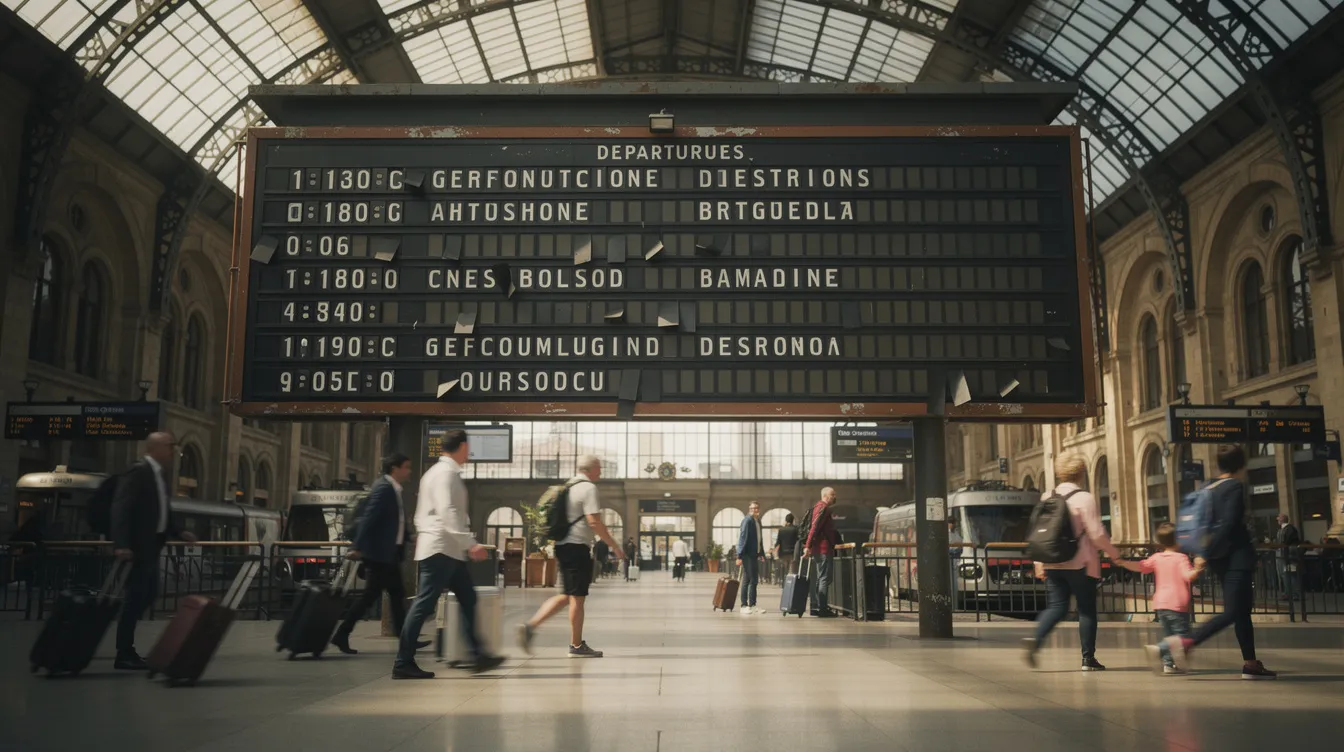
Classic train station boards from the 1960s—like those at Paris-Gare de Lyon or Zürich Hauptbahnhof—possess a mechanical charm that resonates with art audiences. The rhythmic flipping of letters and numbers creates movement without distraction, typography without gimmickry. This aesthetic connects to the Bauhaus principle of merging form with function, making it naturally suited to art environments. Split-flap displays are a modern take on the classic departure boards historically found in airports, and their unique movement and sound attract attention and create memorable experiences. The sensory impact of their sound, combined with motion, enhances the overall visitor experience. Split-flap displays are energy-efficient, built with sustainable materials, and customizable in size and color to fit specific branding needs. They are often used in experiential marketing to create interactive and immersive customer experiences, and their sustainable design can contribute to LEED certification, as highlighted in recent resources on innovative digital and mechanical signage systems.
Split-Flap TV offers a software solution specifically suited to galleries that already have screens or can add slim displays behind reception desks, in stairwells, or near elevators. Rather than investing in expensive mechanical hardware, galleries can achieve the same nostalgic visual effect through customizable digital displays. Split-Flap TV mimics the nostalgic design of classic split-flap boards.
Content galleries can show with Split-Flap TV:
- Daily opening hours with automatic weekday/weekend switching
- Countdown to the closing date of an exhibition
- Social media follower counters for Instagram engagement
- Live weather as subtle ambient information
- Rotating curatorial quotes or artist statements
- Upcoming event schedules with dates and times
- Users can easily upload their own content and create designs with built-in tools
Split-Flap TV offers multiple subscription tiers (Economy, Business, Cockpit) and a 7-day free trial, so even small artist-run spaces can test the system during a week-long pop-up exhibition before committing. There are no limitations or restrictions on the usage or functionality when using the free plan; users can access all features without restrictions. The software runs on smart TVs, Android and Apple devices, and media players, mirroring the flexibility galleries need when installing screens in historical buildings with limited infrastructure. Digital signage systems can be deployed across various hardware platforms, including smart TVs, tablets, and media players, without needing to reformat content. Users can design content once and deploy it across any screen or device without reformatting. Presentations can be created on a PC or phone and sent as dynamic content to any screen, with content managed remotely via a user-friendly CMS. Users can manage their digital signage content remotely through phone or computer, allowing for real-time updates and content management from any location. Digital signage can be set up in under five minutes by connecting a media player to a screen via HDMI and registering with a Player ID. Installation typically requires connecting the display to a local network via Wi-Fi or wired connections, and comprehensive installation guidelines are provided, with tools such as a level, pencil, and power drill sometimes needed. 24/7 support is available to assist users with their needs.
Designing a Gallery With Screens: Curating Space and Information
Gallery directors, curators, and exhibition designers planning screens in physical spaces must balance information delivery with aesthetic sensitivity. Screens should support the visitor experience without competing with the art for attention.
Practical Placement Guidelines
The placement question matters enormously. Digital displays work best at thresholds—entrance areas, stairwells, elevator lobbies, and café spaces—rather than directly adjacent to delicate works. A screen showing event schedules near a 16th-century painting creates visual competition; the same screen in a transitional hallway provides welcome utility.
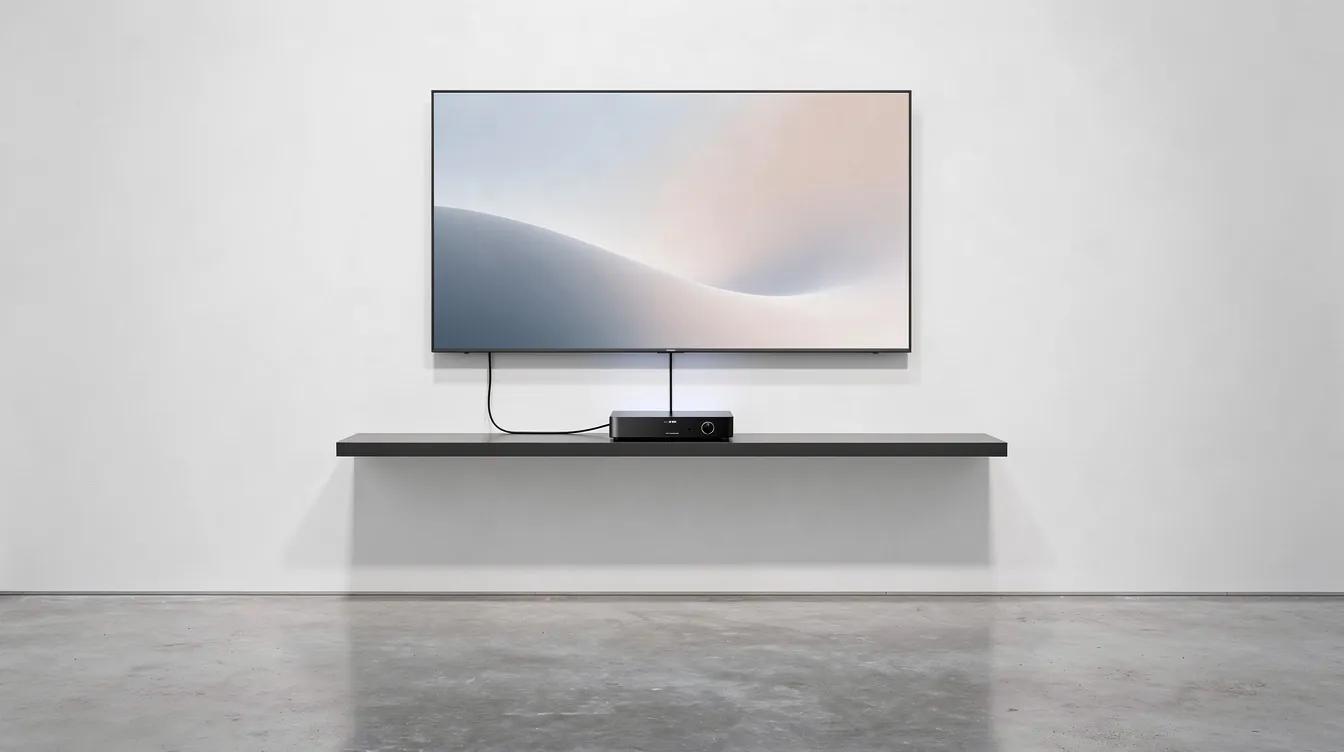
- Reception area: Primary location for show information, hours, and welcome messages
- Near bookshop/café: Event listings, ticketed tours, merchandise highlights
- Elevator lobbies: Floor directory with gallery names
- Stairwells: Wayfinding and accessibility information
- Staff-only areas: Price lists, inventory status, team communications
When setting up digital signage hardware, modular display systems allow galleries to assemble split-flap display boards from individual modules, such as sensor PCBs and flap units, enabling scalable and customizable configurations. Sensors, like hall-effect sensors, are used for calibration and position detection, ensuring accurate operation of the display. Connecting the display hardware to a computer via USB provides control and data transfer capabilities. Firmware is essential for managing device operation, calibration, and communication between components. Right-angle pin headers are important for PCB assembly and reliable hardware connections. During the initial setup, users may need to enter a code to pair the media device or player with the platform.
Keeping Content Minimal and Typographic
Split-flap-inspired boards encourage restraint. The format naturally limits text length, preventing the cluttered messaging that makes conventional digital signage feel like advertising. With Split-Flap TV, galleries can create messages that feel architectural rather than promotional.
A possible layout: a 55” screen behind reception running Split-Flap TV with show titles and hours, another narrow portrait-mode screen near the bookshop listing today’s events and ticketed tours. The intuitive interface allows staff to manage updates without technical expertise, while scheduling features let morning screens emphasize school visits and family tours while evening screens highlight openings and members-only previews.
Using Split-Flap Style for Wayfinding
Consider how wayfinding messages might appear:
|
Display |
Message |
|---|---|
|
Row 1 |
GALLERY 1 – PAINTING |
|
Row 2 |
GALLERY 2 – VIDEO ROOM |
|
Row 3 |
TERRACE – SCULPTURE GARDEN |
|
Row 4 |
CAFÉ – LEVEL B |
|
This approach echoes the rhythm and charm of mechanical flip boards while providing clear navigation. The flipping animation draws the eye without demanding sustained attention. |
|
Split-Flap TV can also bring data-driven elements into the gallery: real-time visitor counts, live social feeds, images, and animations during a performance evening, or countdowns to the next scheduled projection. These features connect galleries to their audiences while maintaining the retro aesthetic that distinguishes the platform from generic digital signage.
Case Uses: How Different Galleries Could Implement Split-Flap TV
Different gallery contexts call for different approaches. The following sketches illustrate how various spaces might deploy split-flap style displays.
Mid-Size Contemporary Gallery
A 400 m² gallery in Berlin or Brooklyn could position a Split-Flap TV screen at the entrance displaying:
- Current exhibition title and artist name
- Rotating curatorial quotes (3-4 rotating every 30 seconds)
- Exhibition closing date countdown
- Instagram handle with follower count
The display creates immediate engagement while visitors wait for coat check, establishing the exhibition’s tone before they enter gallery rooms.
Artist-Run Project Space
A volunteer-run space operating on minimal budget can install an affordable smart TV running the Economy plan. Content priorities:
- Daily opening hours
- Next residency event with date and time
- Supporter and funder acknowledgments rotating in columns
- Simple wayfinding for multi-room spaces
This approach requires no specialized hardware—just download the Split-Flap TV app, connect to the local network, and configure through any browser. The setup process is convenient and streamlines connection and configuration, making it accessible even for users with minimal technical expertise.
Museum-Affiliated Gallery
An institutional project space could sync Split-Flap TV screens to central schedules, broadcasting:
- Start times of guided tours across multiple rooms
- Film screening schedules with runtime information
- Accessibility service availability
- Current exhibition attendance status
The digital signage network capabilities allow coordinated messaging across locations while individual screens can display room-specific information.
Hotel Gallery or Lobby Exhibition
A hotel in Lisbon or Chicago featuring rotating exhibitions might use Split-Flap TV behind the concierge desk to present:
- Featured artist names and exhibition floors
- Local cultural tips and museum recommendations
- Check-in/check-out information during high-traffic hours
- Weather and local time for international guests
The nostalgic split-flap style enhances guest experience while providing practical information in a format that complements hospitality aesthetics.
Retail-Adjacent Gallery
A gallery inside a department store could alternate between:
- Current exhibition information
- Brand collaboration announcements
- Live social-media hashtags tied to the art on display
- Store hours and special event notifications
In each scenario, Split-Flap TV’s retro-inspired motion and typography act as a bridge between classic train-station signage and contemporary art environments. The familiar aesthetic builds trust while the digital delivery provides flexibility that galleries need to manage their complex programming schedules.
Bridging Nostalgia and Innovation in Art Spaces
Art galleries have evolved dramatically from the salon walls of 17th-century France to today’s screen-enhanced environments. The Paris Salon’s dense, wall-to-wall arrangements gave way to the white cube’s minimalism, and now digital integration adds another layer to how galleries communicate with visitors.
The key lies in balance: digital signage should deepen visitor engagement without overwhelming the artwork that remains the gallery’s core purpose.
Carefully implemented displays—especially nostalgic split-flap style boards—create moments of connection that feel both contemporary and timeless. The mechanical rhythm of flipping letters carries associations with travel, anticipation, and cultural experience that align naturally with gallery visits.
Split-Flap TV offers galleries a subscription-based SaaS that transforms existing TVs into retro-inspired information boards in minutes. With control over rows, columns, and components through a simple interface, galleries can customize displays to match their specific needs. The 7-day free trial provides ample opportunity to test the system before an upcoming opening or pop-up exhibition—no commitment required to explore whether the aesthetic fits your space.
For gallery managers, curators, and cultural venues ready to bring the charm of 1960s departure boards into today’s art spaces, the path forward is straightforward: plug in a screen, download the app, and create your first display. Your next vernissage could feature information delivery that honors both the history of visual communication and the innovative spirit that defines contemporary art.