
How Much Does a Split-Flap Display Cost? Real Prices Compared
August 24, 2026 · Captain
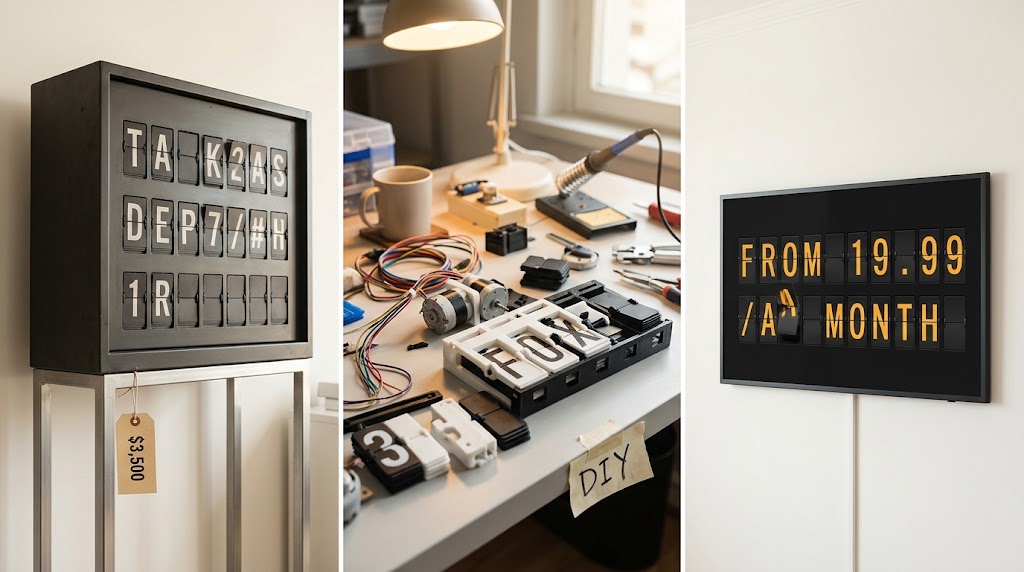
Fall in love with the airport departure board look, start pricing one, and the numbers get confusing fast. One company quotes thousands of dollars, a DIY forum says a few hundred, and an app store says a few dollars a month. All of them are talking about a split-flap display, and all of the prices are real. They are just three different ways of getting the same thing on your wall.
This guide walks through what each route actually costs, including the costs that do not show up on the price tag, so you can decide which one fits your space and your budget.
The short answer
A mechanical split-flap board costs roughly $3,500 for a small consumer unit and can pass $15,000 for a custom installation. A DIY build lands somewhere in the hundreds, plus a lot of weekends. A software split-flap display running on a TV you already own starts at €19.99 a month, plus about $30 for a streaming stick if the TV does not already have apps.
Option 1: mechanical boards, the premium route
The best-known consumer option is the Vestaboard, at around $3,500 for a board that shows 132 characters. It is beautiful hardware, and the price reflects it: thousands of physical flaps, motors to drive them, and the engineering to keep it all clicking reliably.
Above that sit the custom builders, who make the large boards you see in hotel lobbies and flagship stores. A commissioned piece from a specialist shop is typically a five-figure project once you include design, fabrication, shipping and professional installation.
The price tag is only part of the cost, though. Mechanical boards come with things the brochure does not mention:
- Installation. A heavy board needs proper mounting, and often an electrician.
- Maintenance. Thousands of moving parts eventually means stuck flaps and service calls.
- A fixed size. The character count you buy is the character count you keep. Growing means buying another board.
- One location. The board lives where you bolt it.
None of that makes mechanical boards a bad buy. If the physical clatter of real flaps is the point, nothing else is the same thing. But it is a considered purchase, not an impulse one. We compare the main makers in detail in our split-flap competitors guide.
Option 2: building one yourself
The DIY route is genuinely fun if you are handy with a 3D printer and a soldering iron. Open-source designs exist, and builders typically spend a few hundred dollars on printed parts, motors, controllers and electronics for a modest board.
The honest cost is time. A multi-character board means printing, assembling and calibrating each module, then writing or adapting the software that drives it. Builders who love the process describe it as months of tinkering. If that sounds like a hobby, it is a rewarding one. If you just want the board on the wall for your cafe or office, it is the slowest and least predictable route there.
Option 3: a software split-flap display on your TV
The third route skips the hardware entirely. Split-Flap TV turns any TV into an animated split-flap board: the same look and the same satisfying flip, rendered on a screen you already own. It runs on Fire TV Stick, Apple TV, Android TV and Chromecast, so the only hardware you might need is a roughly $30 streaming stick if your TV does not already run apps.
The cost structure is a subscription per screen:
- Economy, €19.99 a month. Text boards, menus, price lists, colors, countdowns and counters.
- Business, €36.99 a month. Adds photos on the flaps and image overlays.
- Cockpit, €49.99 a month. Adds live data feeds, news and weather, flight boards, QR menus and quotes.
There is a 7-day free trial with no card, so you can see it on your own screen before paying anything. Full details are on the pricing page.
What you give up is the physical mechanism: the flaps are animated, not motorized. What you gain is everything hardware cannot do. The board is any size your TV is, it updates from your phone in seconds, it can show menus at breakfast and cocktails at six on a schedule, and if you open a second location, that is another subscription instead of another $3,500 machine.
The three routes side by side
| Mechanical board | DIY build | Split-Flap TV | |
|---|---|---|---|
| Upfront cost | $3,500 to $15,000+ | A few hundred dollars | $0 to about $30 for a stick |
| Ongoing cost | Maintenance and repairs | Your time | From €19.99/month |
| Time to a working board | Weeks to months | Months | About 5 minutes |
| Size | Fixed at purchase | Fixed by your build | Any TV you own |
| Updates | App or panel | Your own software | Phone, tablet or desktop |
| Real moving flaps | Yes | Yes | No, animated |
So which one should you buy?
Buy mechanical if the physical mechanism itself is the point and the budget is comfortable. A lobby centerpiece that guests can hear flipping is a legitimate reason to spend $3,500 or more, and we say so plainly in our Vestaboard comparison.
Build it yourself if the building is the fun part. Nobody who finishes one regrets it, but nobody finishes one quickly either.
Use software if what you want is the look, working today, at a price a small business can shrug at. For a cafe deciding between reprinting menus and putting a live board on the wall, €19.99 a month is usually less than the printing budget it replaces. Our menu board savings calculator does that math for your own numbers.
The comfortable truth is that this is not really one product at three prices. It is a piece of kinetic sculpture, a hobby project, and a business tool that happen to share a look. Price the one you actually want, and the confusing spread of numbers sorts itself out.