
A Practical Guide to Dayparted Signage Content
July 21, 2026 · Captain
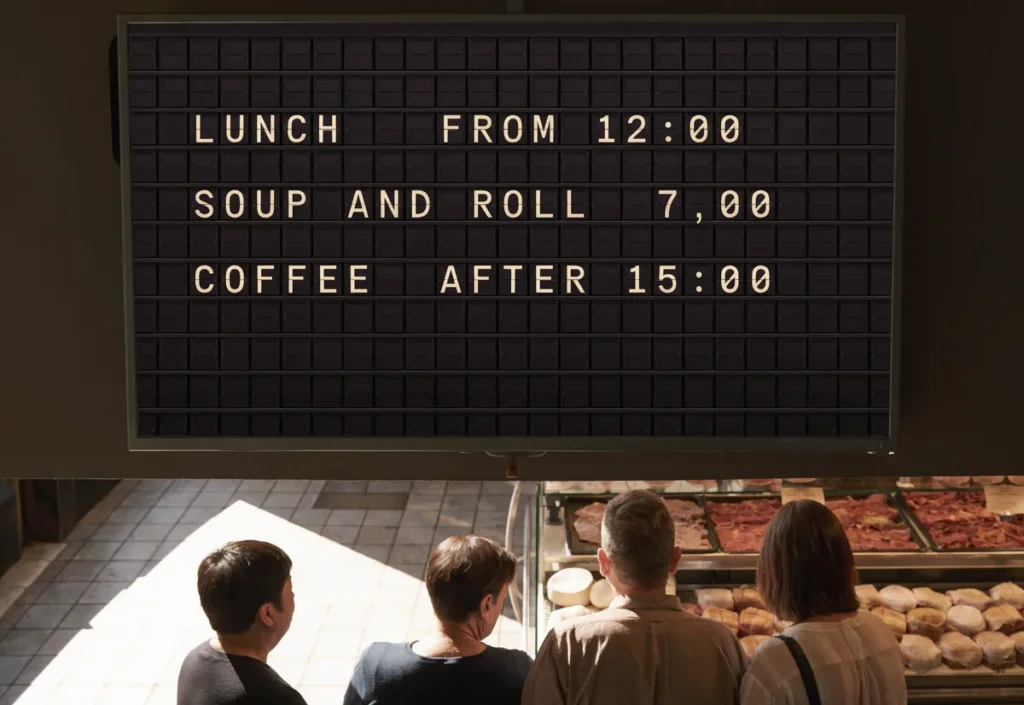
The breakfast crowd is not looking for the same information as the late-afternoon regulars. Yet many businesses leave one message on display all day: a special that ended at 11, a happy hour reminder shown too early, or an event announcement after the event has started. A guide to dayparted signage content starts with a simple idea: let your display change when your customers, questions, and priorities change.
For a split-flap-style display, this is especially effective. The click-clack motion gives each new message a small moment of theater, but the message itself stays clear and text-led. Rather than trying to fill the screen with busy visuals, you can use a few well-timed lines to direct attention exactly where it is needed.
What Dayparted Signage Content Actually Does
Dayparting means scheduling different content for different parts of the day. It is common in radio and advertising, but it is just as useful at a cafe counter, hotel lobby, bar entrance, boutique checkout, or office reception desk.
The goal is not to make your sign change constantly. It is to make each change feel useful. Morning content can answer practical questions for people arriving with limited time. Midday content can move a lunch special or reduce congestion. Evening content can set a more social tone, promote a reservation window, or point guests toward an event.
For customer-facing businesses, dayparting also removes a familiar operational burden: remembering to swap handwritten boards during a rush. Once a schedule is set, the right information appears at the right time without another task added to the shift.
A Guide to Dayparted Signage Content by Business Rhythm
Start with the rhythm of your actual location, not a generic schedule. A neighborhood coffee shop may have a sharp morning peak, a quiet reset after lunch, and a short afternoon pickup window. A hotel lobby may need arrival information in the afternoon, dining updates in the evening, and practical guest guidance overnight. An office may need visitor instructions in the morning and meeting or event details later in the day.
Look at the questions your team hears repeatedly. Those questions reveal the content your display should carry. If guests ask for Wi-Fi details every morning, show them before the first rush. If shoppers ask when new arrivals are put out, schedule that message when foot traffic is highest. If bar guests ask when happy hour ends, the answer belongs on screen before and during the relevant window, not after it.
Morning: Remove Friction
Morning signage should be direct and calming. This is the time for opening hours, breakfast features, pickup instructions, a daily greeting, or simple wayfinding. People are often making decisions quickly, so avoid stacking several promotions into one board.
A cafe might show TODAY’S BREAKFAST, ORDER AT THE COUNTER, and WIFI: [NETWORK]. A boutique hotel may rotate CHECK-IN BEGINS AT 3 PM, BREAKFAST UNTIL 10 AM, and ASK US ABOUT LOCAL RESERVATIONS. The content does not need to be clever to be valuable. It needs to be easy to read from several feet away.
Midday: Help People Choose
At midday, your display can do more commercial work. This is often the best window for lunch features, limited inventory, counter-service reminders, and fast answers to common questions. If your space becomes crowded, prioritize messages that keep the line moving.
For restaurants, that might mean a concise daily special and a reminder about ordering or pickup. For shops, it could be NEW ARRIVALS TODAY or GIFT WRAP AVAILABLE. For offices, it may be a meeting room schedule or a welcome message for visitors. Keep the page sequence intentional: practical information first, promotional information second.
Afternoon: Create a Reason to Return
Afternoon can be an awkward period for static signage because the morning message has expired but the evening offer is still too far away. Dayparting gives this window a job. Use it to preview what is next.
A restaurant can introduce dinner service or an upcoming tasting. A bar can begin building anticipation for happy hour. A retailer can spotlight an in-store event, seasonal collection, or new service. This is where a small sense of anticipation works well, especially when the split-flap animation gives the new message a satisfying arrival.
Evening: Set the Scene and Protect Service
Evening messaging should match the energy of the room. A dinner service may need reservation guidance, a featured cocktail, or a note about the evening’s menu. A hotel can show lounge hours, event locations, or a quiet prompt for late arrivals. An office hosting an event can shift from visitor instructions to a clean welcome board.
This is also a good time to replace operational clutter with atmosphere. Your display can still be useful without reading like a checklist. A line such as KITCHEN OPEN UNTIL 10 PM or LIVE MUSIC AT 8 creates clarity while supporting the experience of the space.
Write for the Split-Flap Format
A split-flap-inspired screen is not a miniature billboard. Its strength is the tension between movement and restraint: letters flip, a message lands, and the room notices. That makes short, confident copy more effective than dense copy.
Give each page one job. A guest should understand it in a glance, even if they only catch part of the flip sequence. Favor familiar words, strong verbs, clear times, and simple directions. TODAY’S SOUP, HAPPY HOUR 4-6, or ASK ABOUT PRIVATE EVENTS will usually outperform a sentence full of qualifiers.
Think carefully about line length and page duration. If your display is placed near a queue, people may have several seconds to read. If it is across a busy lobby, the message needs to be understood much faster. It depends on viewing distance, traffic flow, and how many pages are rotating. A beautiful schedule that moves too quickly becomes decoration; a schedule that lingers too long can feel stale.
Color, layout, and timing should support legibility rather than compete with it. The retro character is already doing the attention-grabbing work. Let the words carry the operational value.
Build a Schedule Your Team Can Maintain
The most effective dayparted schedules are built around repeatable content. Begin with the messages that recur every day: hours, ordering guidance, Wi-Fi, service windows, and regular specials. Then reserve a smaller number of pages for changes such as events, sold-out items, weather-related updates, or a weekend feature.
This approach keeps content management realistic. If every page requires a new idea every day, the system will eventually be ignored. If the schedule has a dependable foundation, your team only needs to update the information that truly changes.
With Split Flap TV, that control can live in one app rather than in a stack of printed signs or a marker board behind the counter. Build layouts that fit the display, schedule pages for the right moments, and make a quick update from wherever the workday takes you. The screen stays polished even when the day gets unpredictable.
It is wise to assign ownership, too. One person can own the weekly schedule, while shift leads can handle immediate edits such as SOLD OUT, DELAYED OPENING, or EVENT MOVED UPSTAIRS. Clear ownership prevents the common problem of a perfectly planned sign carrying yesterday’s message.
Avoid the Most Common Dayparting Mistakes
The first mistake is scheduling by the clock alone. A 4 PM happy hour message may be correct on paper, but if your guests start arriving at 3:30, the message should be visible before they walk in. Watch your room for a week and adjust around behavior.
Related reading: A Guide to Scheduled Business Announcements
The second is trying to say everything. Your display does not need to carry every policy, offer, social handle, and menu category. When information matters all day, choose a recurring page. When it matters only during a certain window, make it part of that daypart. When it is not useful to the person standing in front of the screen, remove it.
The third is forgetting the transition. A morning-to-lunch change is an opportunity to refresh the room. Schedule it deliberately, and give the new content enough time to earn attention. The click-clack is part of the experience, but relevance is what makes people act on it.
A well-timed sign feels less like advertising and more like a host who knows what guests need before they ask. Start with one or two meaningful daypart changes, watch what customers respond to, and let your display become more useful with every shift.