
Discover the History and Mechanics of Split Flap Display Board
August 17, 2022 · Captain
If you’re searching for information about the split flap display board, you’re in the right place. This article is designed for business owners, designers, technology enthusiasts, and anyone curious about the unique blend of nostalgia and innovation that split-flap displays bring to modern spaces. Here, you’ll discover the origins, evolution, and enduring appeal of split-flap display boards, as well as a detailed look at how they work—both in their classic mechanical form and in today’s digital adaptations.
A split-flap display board is a captivating signage solution that uses a series of rotating flaps to present changeable alphanumeric text and graphics. Split-flap displays are a blend of analog and digital technologies that present changeable alphanumeric text and graphics. Whether you’re considering a split-flap display for your business, want to understand the technology behind them, or are simply drawn to their retro charm, this guide will provide the insights you need to appreciate why these boards continue to matter in a digital world.
History of Split Flap
Origins in Transportation
The story of the split flap display begins in the bustling airports and train stations of the 1960s, where these innovative boards first made their mark as the go-to solution for sharing real-time information. With their distinctive flipping sound and ever-changing messages, split flap displays quickly became a focal point in transportation hubs, captivating travelers and passersby alike. The unique combination of art and technology—where each flap physically flips to reveal a new letter or number—brought a sense of movement and anticipation to public spaces, making every update feel like a small moment of magic.
Expansion to New Venues
As display technology advanced, the use of split flap displays expanded beyond airports and train stations. Offices, restaurants, bars, and retail shops began to embrace the split flap’s retro charm, using these boards to send messages, display schedules, or simply add a touch of vintage style to their décor. The enduring popularity of split flap displays can be traced to their ability to inspire nostalgia while still feeling fresh and dynamic. The iconic sound of the flaps flipping has become synonymous with the spirit of travel, discovery, and the excitement of seeing information come to life.
Modern Custom and Digital Solutions
In recent years, there’s been a resurgence in custom split flap displays, with companies like Oat Foundry leading the way in creating bespoke boards tailored to a business’s unique needs. These custom displays have become a sought-after feature in trendy restaurants, creative offices, and boutique shops, allowing brands to connect with customers in a memorable and visually engaging way. The artistry of the split flap form, combined with modern engineering, has made these boards a true statement piece wherever they’re installed.
The evolution of split flap technology hasn’t stopped at physical boards. Digital solutions, such as Split-Flap TV, have brought the magic of split flap displays into the digital age. By mimicking the look, feel, and even the sound of classic split flap boards, digital split flap displays offer businesses a cost-effective and flexible way to create eye-catching signage on any screen. With features like real-time messaging, scheduling, weather updates, and social media counters, Split-Flap TV makes it easy to create custom displays that capture the spirit of the original boards—at a fraction of the cost and complexity.
Pricing and Accessibility
Pricing for split flap displays varies widely. Traditional, mechanical boards—especially custom or large-scale installations—can be a significant investment, both in terms of initial cost and ongoing maintenance. Digital split flap displays, on the other hand, offer a range of pricing options to fit different budgets, making it possible for businesses of all sizes to enjoy the timeless appeal of split flap technology.
Enduring Appeal and Applications
From their historic roots in transportation to their modern-day revival in hospitality, retail, and office spaces, split flap displays have proven to be more than just a way to share information—they’re a source of inspiration and a testament to the enduring magic of analog art in a digital world. Whether you’re looking to create a focal point in your business, send messages that stand out, or simply bring a bit of retro flair to your space, split flap displays continue to delight and engage audiences everywhere. For businesses interested in modern options, split flap display alternatives can provide the perfect blend of retro charm and contemporary technology.
Now that we’ve explored the history and evolution of split-flap displays, let’s take a closer look at how these fascinating boards work.
Split-Flap Display Board Module: How it Works
Split-flap displays are a blend of analog and digital technologies that present changeable alphanumeric text and graphics. This section will break down the mechanics and electronics behind these iconic boards, from the individual modules to the latest digital simulators.
Overview of the Split-Flap Module
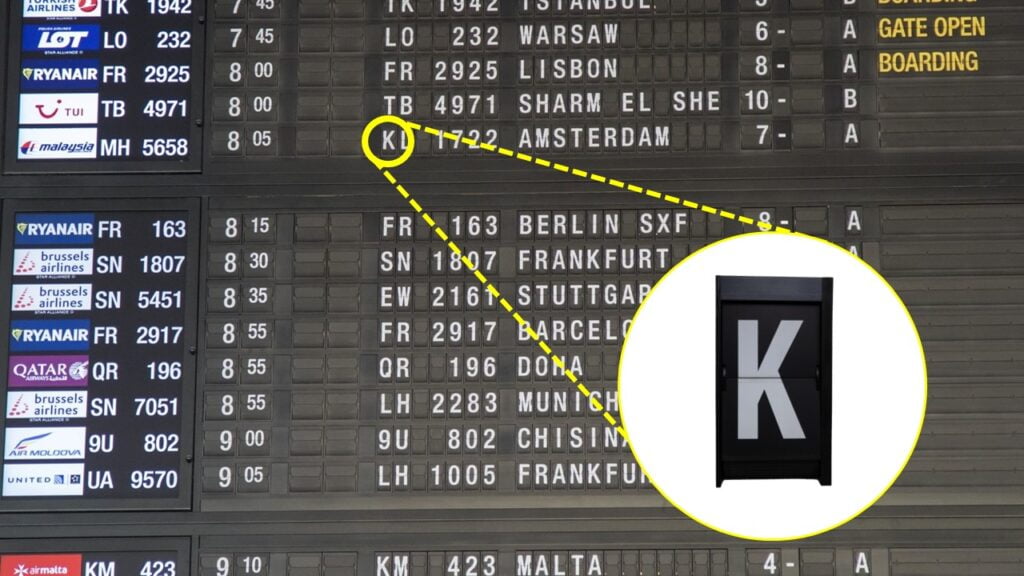
This is a split-flap board from an airport. Split-flap boards were a common way to display changing information before the advent of digital signage. For more information on the history of split-flap boards, check out our Split-Flap boards history article.
At the heart of the board is the split-flap display board module.
Every character is controlled by a physical split-flap display board module capable of displaying only one pre-defined character or symbol. See the yellow circle for a single character on the board.
Mechanical and Electronic Components
Let’s break down the process of examining a single split-flap module:
- Zoom in on a single module so you can see the split flaps. Each module contains electronics, including a motor and driver circuit, to control the movement of the flaps.
- Rotate the module 45 degrees to start seeing the mechanical parts behind the characters and how the flaps are driven.
- Rotate further to give you a look at a side view of a split-flap board’s display module.
- Zoom in for a closer look so you can see the electromechanical module that moves each letter. A microcontroller or computer drives the motors and sends updates via serial communication or Wi-Fi.
Position Detection and Calibration
Look at all the moving parts for a single character! The system must determine the position of each letter, often using inexpensive sensors such as:
- Optical rotary encoders
- Reed switches
- Hall effect sensors
A magnet on the spool and a Hall effect sensor can be used to detect the home position (usually a blank space) to calibrate which letter is currently displayed. The control system ensures each page or letter stops at the correct position.
Durability and Maintenance
Durability is important, and some split-flap modules are tested for millions of cycles to ensure long-term reliability.
Electromechanical split-flap boards have thousands of individual split-flap display board modules. This makes them expensive to purchase and complex to maintain.
Digital Split-Flap Simulators
We have built a Split-Flap simulator platform where you can display your messages and promotions in split-flap format on smart TVs.
Split-Flap TV recreates the nostalgia and uniqueness of vintage split-flap display boards on modern television screens so you get the best of both worlds – affordability and ease of use.
You can purchase one of our Split-Flap TVs or bring Split-Flap TV functionality to your own devices such as smart TVs or TVs running Android media players such as the Google Chromecase.
The Practical Trade-offs of Mechanical Boards
Mechanical split-flap displays are engineering marvels, but owning one is a different matter from admiring one. Because every character slot relies on its own set of moving parts, the costs and constraints add up quickly.
- High cost of entry: a custom board large enough to anchor a restaurant or lobby can run into the tens of thousands of dollars, and manufacturing typically takes months.
- Wear and tear: dust, humidity and general use can make flaps stick or motors fail. When a flap jams, the message stays garbled until a technician fixes it, and the specialized knowledge needed for repairs is becoming rare.
- A fixed layout: once built, the grid never changes. A board with 4 rows of 20 characters will always be 4 rows of 20 characters. Changing flap colors or the font means physically replacing components.
- Dedicated control: a mechanical board usually needs its own controller or software just to send messages.
For a museum curator who needs a specific historical artifact, none of that matters; the mechanical board is irreplaceable. For most businesses, though, the goal is the look and the usefulness of the display, not the machinery behind it.
How a Digital Split-Flap Display Works
A digital split-flap display virtualizes the mechanism. Instead of motors and plastic flaps, software renders each character and animates the flip on a standard screen. With Split-Flap TV, that screen can be a smart TV, a tablet, or a display connected to a media player such as a Google TV Streamer or Chromecast, running the app for Android or Apple.
Everything a mechanical board fixes at the factory becomes a setting:
- Grid size: choose the number of rows and columns, from a few rows of large text to a dense board full of data.
- Pages and timing: create multiple pages and set how long each one stays on screen.
- Colors: pick text and flap colors to match a brand palette, down to individual lines.
- Scheduling: plan which messages appear, and when.
- Graphics: add picture overlays, such as a colored logo banner along the bottom of the board.
Hardware reliability changes too. A TV screen has no motors to burn out and no flaps to clean. If it does fail, replacing it is a trip to an electronics store rather than a long wait for custom parts.
Recreating the Sound
The clatter is half the appeal, and purists often argue it cannot be replicated. Split-Flap TV uses high-quality audio samples of real mechanical flaps, played through the TV speakers and synchronized with the animation of each character turning. The result keeps the auditory cue that makes people look up.
There is one thing a mechanical board never had: a volume control. The clicking can be turned up, turned down, or switched off entirely for spaces that need silent updates.
Connecting Live Data
A mechanical board shows whatever someone types into its controller. A cloud-based digital board can pull content automatically, so it stays current without manual updates. Common sources include:
- Upcoming calendar events and meeting room bookings in an office
- Live “Now Playing” tracks from Spotify in a bar
- Menu specials, opening hours and Wi-Fi passwords in restaurants and shops
- News, weather, and the current time and date
- Social media follower counts or live crypto prices
- Flight information and other real-time updates in transport settings
The software handles the logic of when and what to display. When the data changes, the board runs the flip animation and sound, which draws attention to the new information the same way the old departure boards did.