
Best Announcement Screens for Boutique Hotels
July 19, 2026 · Captain
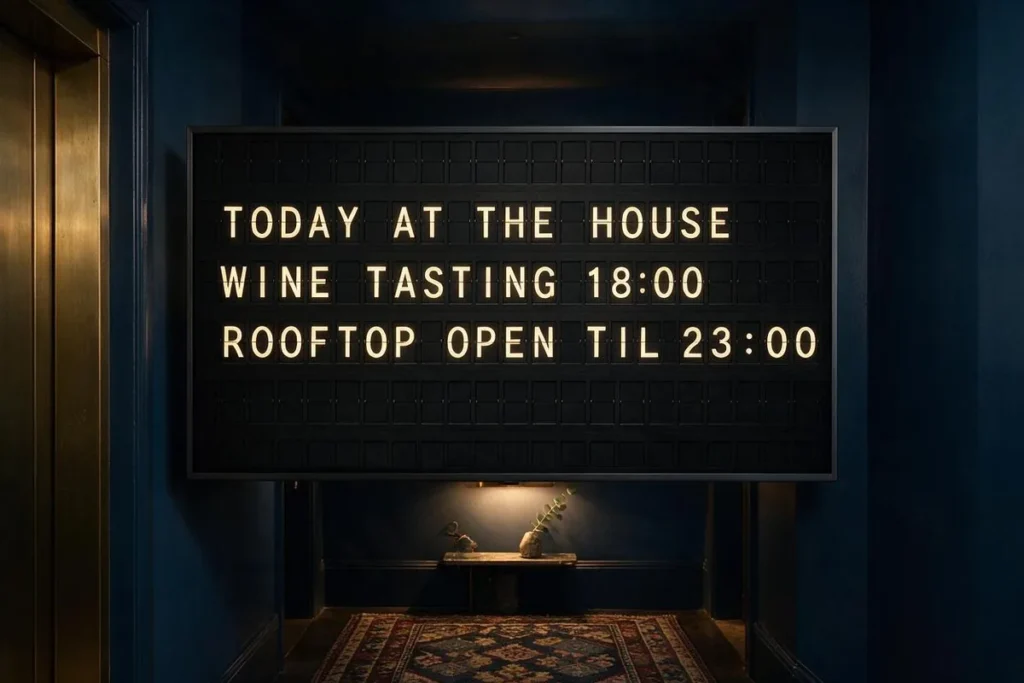
A guest steps into the lobby after a long flight, looks up for the Wi-Fi code, and catches the soft click-clack of a board changing from breakfast hours to tonight’s jazz set. That moment does more than answer a question. It tells them they have arrived somewhere considered. The best announcement screens for boutique hotels make changing information feel like part of the property’s character, rather than an afterthought taped beside the front desk.
Boutique hotels have a particular challenge. Guests expect the polish of a larger property but choose independent stays for the details: a distinctive lobby, a local recommendation, a bar worth lingering in, and a sense that someone has thought about the experience. Your announcement display has to work hard operationally while looking as though it belongs in the room.
What boutique hotel announcement screens need to do
A hotel display is not just a digital replacement for a printed notice. It is a quiet concierge, an event board, a wayfinding cue, and, in the right setting, a piece of visual theater. It must be easy for a busy team to update when brunch moves, a private event takes over the courtyard, or checkout instructions change for a holiday weekend.
The strongest screens also respect the guest’s attention. A lobby visitor should be able to read the essentials while walking past. A guest waiting for an elevator should find useful information in seconds. That calls for disciplined messaging, excellent contrast, and a format that favors a few clear lines over a crowded wall of content.
For many boutique properties, the ideal choice is not a screen trying to do everything. It is a text-first announcement screen with a recognizable visual language. A split-flap style display brings the familiar rhythm of rail stations and classic departure boards into hospitality, where its changing letters make even practical details feel intentional.
The best announcement screens for boutique hotels by location
The right screen depends on what guests need at that exact point in their stay. One large board in the lobby can be valuable, but several well-chosen touchpoints often communicate better than a single overstuffed display.
The lobby arrival board
The lobby is the natural home for a larger announcement screen. This is where guests look for breakfast hours, the day’s weather, a welcome message, upcoming programming, and a quick orientation to the property. A split-flap layout is especially effective here because the content reads like a living hotel schedule rather than a generic slideshow.
Keep the arrival board curated. Show the information that changes often and earns a guest’s glance: today’s breakfast service, the bar’s feature, a rooftop event, a local neighborhood note, or a warm welcome for a wedding party. Static information such as a long list of amenities is better handled elsewhere, where guests can take their time.
The front desk information screen
At the desk, the display should reduce repeated questions without competing with the welcome from your staff. Think Wi-Fi network details, checkout time, luggage storage guidance, valet timing, and a concise note about where to find coffee.
A smaller screen works well here because it supports the conversation. It can also save the team from rewriting the same details on a chalkboard each time a password or service schedule changes. The key is to use large type and leave breathing room. Guests should not need to stand inches away to read it.
The elevator or corridor board
Waiting time is prime attention time. An elevator landing display can promote a happy hour, point guests toward a gallery opening, remind them about a yoga class, or highlight a local partner recommendation. Unlike the lobby board, this screen should deliver one useful thought at a time.
This placement works best when the message is short and scheduled around the day. Morning might feature coffee and breakfast. Late afternoon can shift to aperitifs or evening plans. After dinner, a simple next-day reminder is more useful than a busy stream of announcements.
The restaurant, bar, or breakfast room display
Food and beverage spaces change fast. A text-based screen can announce service hours, today’s pastry, a sold-out item, a live music start time, or a menu adjustment without handwritten corrections and reprinted inserts.
There is a trade-off: a split-flap style board is built for words, timing, and atmosphere, not detailed food photography or a full visual menu. That limitation can be a strength in an elegant bar or breakfast room. Let the board communicate the moment, and let the physical menu or staff handle the deeper details.
The event and meeting area board
For properties hosting weddings, offsites, or intimate brand events, an announcement screen outside the room creates a polished first impression. It can welcome a group by name, show the day’s agenda, direct attendees to refreshments, and update a room change instantly.
This is also where scheduled content matters most. An event board should move automatically from setup notes to welcome messaging, then to the next session, without requiring a staff member to remember every transition.
Choose a screen for readability, not just size
Bigger is not automatically better. Screen size should follow viewing distance, wall scale, and the number of characters you expect to show. A lobby board viewed from across the room needs larger letters and fewer words. A screen beside an elevator can be smaller because people naturally stand closer to it.
Brightness matters as much as dimensions. A sunlit lobby with street-facing windows needs a display that remains legible during the brightest part of the afternoon. In a moody cocktail bar, an overly bright screen can spoil the room’s atmosphere. Test the location at the actual time guests will use it.
Also consider orientation. Wide, horizontal layouts feel natural for schedules, welcome lines, and rotating hotel updates. Taller formats can suit tight wall space or wayfinding, but they can tempt teams to stack too much text. The goal is not to publish every detail. It is to make the next action obvious.
Build content around a guest’s day
The best hotel announcements follow the guest journey instead of repeating the same message all day. Start with what a person is likely to need in the morning, afternoon, and evening, then create a light schedule that shifts accordingly.
In the morning, prioritize breakfast hours, coffee, weather, and checkout reminders. During the afternoon, show local suggestions, housekeeping notes when relevant, or details for a planned event. Evenings are the moment for bar hours, live programming, dining availability, and a memorable line that gives the property a little personality.
A useful rule is one primary message per page. If you need to communicate three things, rotate them in a calm sequence and give each message enough time to land. Fast changes may demonstrate the click-clack effect, but they can frustrate a guest trying to catch a time or location.
Write for people who have just arrived, not for people who already know your operations. “Breakfast 7-11 AM, Garden Room” is clearer than “Breakfast Service.” “Jazz Trio 8 PM, Lobby Bar” beats “Live Music Tonight.” Specificity is hospitality.
Content control is part of the guest experience
An elegant screen quickly loses its effect when it displays yesterday’s event, an old Wi-Fi code, or a message that is no longer relevant. The system behind the display should make changes simple enough for the front desk, restaurant manager, or events lead to handle from wherever they are working.
Look for cloud-based publishing, editable layouts, page scheduling, and the ability to set different messages for different screens. These features are not technical extras. They are what prevent the familiar hotel scramble of finding the right marker, updating a sign, and hoping everyone has seen the change.
With Split Flap TV, teams can tailor rows, columns, colors, timing, pages, and optional sound to the space, then publish updates through an app. That flexibility lets one property create a calm, understated lobby board while giving its bar a faster, more playful rhythm.
Make the screen feel native to the property
The most effective announcement screen does not look dropped into the hotel from another business. Its language, cadence, colors, and placement should support your identity. A design-forward urban hotel may use concise, witty local notes. A coastal retreat may favor slower transitions and simple daily rituals. A historic property can lean into the nostalgia of the split-flap form itself.
Avoid treating the display as an advertising channel that has to fill every minute. Empty space, shorter messages, and a restrained publishing rhythm make each update more visible. The click-clack animation already earns attention. Your words should reward it.
Place the screen where people naturally pause, give it a clear job, and keep its content current. Done well, it becomes one of those small hotel details guests remember – not because it demanded attention, but because it made the stay feel effortlessly well run.