
The history of split-flap displays
You remember the sound before you remember the board. That soft avalanche of flaps as a whole hall of destinations reshuffled at once, and everyone in the room looked up. It began with a 231 year old Italian clock company, a Belgian inventor, and a single railway station in Liège in 1956. Here is how the split-flap display took over the world, why it vanished, and why it is back on the walls of cafes and bars that have no departures to announce.
A clock company from an alpine village
The story starts a long way from any airport. Solari was founded in 1725 in Pesariis, a village in the Val Pesarina, one of the eight valleys of Carnia in the mountains of northeastern Italy. For more than two centuries it built tower clocks, the kind mounted on churches and town halls and designed to be read from right across a public square. That single discipline, making something legible at a distance to people who only glance at it, turned out to be exactly the skill a departures board needs.
The architect who redesigned the clock
After the Second World War, Solari began working with Gino Valle, an architect and designer from Udine who had studied city and regional planning at Harvard. Valle rethought what a clock could be when the numbers moved instead of the hands. The early Solari designs used four flaps carrying ten digits each, enough to show the time and nothing else. It was a narrow machine with an unusually clear idea inside it, and in 1956 it won the Compasso d'Oro, Italy's most serious design award.
The Belgian inventor who added the alphabet
Numbers alone could show a time, but not a destination. The real jump came with the help of John Myer, a Belgian inventor, who worked with Solari on a mechanism carrying forty flaps instead of four. Forty flaps meant letters as well as digits, and letters meant a board could say Paris, or delayed, or platform nine. That one change turned a clock into an information system, and it is the reason the format spread out of the home and into nearly every large public building in Europe.
1956, and the first board goes to Belgium
In the same year the Cifra 5 clock won its Compasso d'Oro, Solari sold its first moving sign to the railway station in Liège, Belgium. It is the detail most people get wrong about this technology. The split-flap board is Italian by design and manufacture, but the first one went up in Belgium, and a Belgian inventor helped make it possible. From that single installation Solari went on to sell thousands of boards to airports and railway stations around the world.
Why everyone calls them Solari boards
Solari sold so many boards, to so many countries, that the company name became the name of the object, the way a vacuum flask became a thermos. Across most of the world a split-flap display is simply a Solari board. In Central Europe the same thing happened with a different company: there the boards are called Pragotron, after the Czech manufacturer that supplied the region. Two names for one machine, and a good measure of how completely those two firms owned the format.
What made the mechanism so hard to beat
A split-flap board has three advantages that were not fully appreciated until the replacements arrived. It stays highly visible across a wide viewing angle in almost any lighting, because the characters are physical objects catching real light rather than pixels competing with the sun. It draws little or no power while it sits still, since electricity is only needed to change a flap (here is how a character is actually selected). And it announces its own updates with a distinctive metallic clatter, so a hall full of people looks up at the exact moment the information changes.
The sound was never a side effect
That clatter did more work than anyone credited at the time. It was an audio notification decades before the phrase existed, telling a crowded concourse that something had changed without a word being announced. The proof arrived later. When the Massachusetts Bay Transportation Authority replaced its aging Solari boards at North Station and South Station in Boston, the new screens were silent and passengers stopped noticing updates. So the MBTA generated an artificial flapping noise to cue people to boarding changes. The picture turned out to be replaceable. The sound did not.
The same machine, shrunk for the living room
The flap mechanism did not stay in public buildings. Scaled down, it became the flip clock, the bedside object that turned the hour with a small mechanical snap and helped define a certain kind of mid-century interior. Valle's Cifra 3 is the best known of them, and it sits today in the permanent collection of the Museum of Modern Art in New York. He won a second Compasso d'Oro in 1962. Plenty of people who never stood under a departures board have still owned a piece of this technology.
Game shows, buses and a brief British fashion
Once the format existed it turned up in places with nothing to do with travel. Many American game shows of the 1970s used split-flap units as contestant scoreboards, flipping left to right on a vertical axis, and the Nickelodeon show Make the Grade built its entire game board from a seven by seven split-flap grid. In Italy the displays were fitted to transit vehicles as destination signs, and in Britain they enjoyed a short vogue in the mid 1980s before the fashion moved on again.
The golden age, roughly 1960 to 1990
For about three decades the split-flap board was simply what public information looked like. If you passed through a major airport or railway station in Europe, and much of the rest of the world, you read your departure off flaps. It was the default rather than a style choice, and that is precisely why it now carries so much feeling. Nobody picked it for charm. It was picked because it was the most legible way to show changing information to a thousand people at once.
Why the boards came down
LED and LCD panels did one thing far better: they changed instantly. A split-flap board has to cycle mechanically through its flaps to reach the character it wants, which is slow, and with hundreds of moving assemblies in a single board there is a great deal that can jam or wear out. Screens updated digitally, cost less to run at scale, and could show anything at all. What they gave up was readability at a distance and in difficult light, and the sound. Through the 2000s, operator after operator made that trade.
The famous last boards
The retirements were noticed. New York's Penn Station ran a Solari board from 1967 to 1985, and its removal genuinely upset the public, enough that later displays were designed to imitate parts of it. Philadelphia's 30th Street Station kept its board from the 1970s until 2018, the last one operating in an Amtrak station, and it went to the Railroad Museum of Pennsylvania rather than to a scrapyard. In Japan, Keikyu Kawasaki Station ran the final board in the Kanto region until February 2022.
The board that was saved and restored
One survivor stands out. When the old TWA Flight Center at John F. Kennedy International Airport was converted into the TWA Hotel, which opened in 2019, the restoration included its original Solari message board, manufactured in Italy in 1962 and returned to authentic mechanical operation rather than imitated with a screen. It is now one of the few places where you can stand in front of a working board of that era and hear it run, which is most of the reason people line up to film it.
Solari is still there
The company did not disappear along with the boards. Solari relaunched in the 1990s and still designs and manufactures public information displays from Udine. In December 2025 it marked its three hundredth anniversary, and the Italian postal service issued a commemorative stamp featuring Valle's Cifra 3 clock. Three centuries from tower clocks in an alpine valley to a stamp on an envelope is an unusual run for any manufacturer, and it is a reminder that this format was never a novelty.
The revival started in hospitality
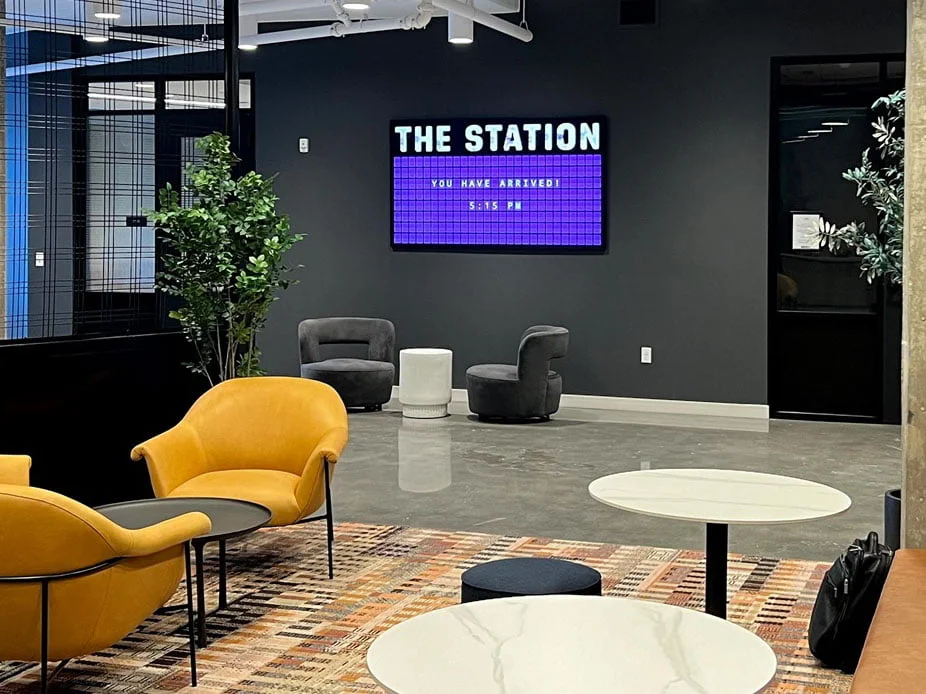
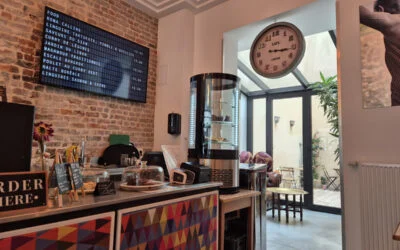
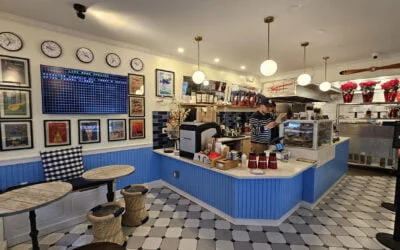
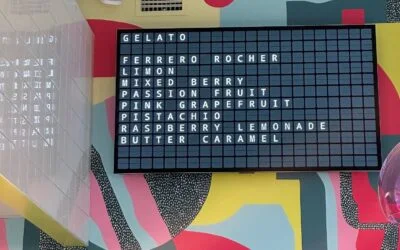
The comeback did not begin in homes. It began in rooms that wanted to feel like somewhere in particular. Starbucks Reserve Roasteries installed genuine Solari split-flap boards to show which coffee is currently roasting, using the format for exactly what it is best at: a small amount of information that changes through the day and rewards being watched. Independent cafes, bars and food halls followed, because a board that moves holds attention in a way a static printed menu never has.
The makers who brought it back
Two names lead the modern mechanical revival. Oat Foundry, an American engineering and product design shop, built its first split-flap as a one-off commission for a restaurant, realized the format had far wider appeal than its original use, and made it the core of the business. Vestaboard, founded by Dorrian Porter, took the opposite route and built a consumer product: a wall mounted board controlled from a phone. Between them they turned a retired piece of transport infrastructure into something you can simply order.
The same look, without the hardware
A real mechanical board is a beautiful object and a serious purchase, running from around a thousand dollars for the smallest consumer model to well over fifteen thousand for a custom build, before installation and lead time. Split-Flap TV takes the other path. It renders the flip on a television you already own, so the look arrives in minutes instead of months, at any screen size, with live menus and data the original boards could never show. The clatter is included, and it is optional. The format has a cousin, too: the felt letter board still hanging in cafes and hallways. Here's how the two relate, and where each one still makes sense. See the plans.
What is a split-flap display?
The plain explanation of the format, the mechanism and where the name came from.
View →How split-flap displays work
Inside the mechanism: the flaps, the drum and how a single character is selected.
View →Split-Flap TV vs Vestaboard
An honest comparison of the modern boards on price, size and what each can show.
View →See real installations
Boards running today in cafes, bars, offices and food halls around the world.
View →See it flip on your own TV
Try Split-Flap TV free for 7 days, no card. Or buy a plan straight away.