Best Bar Special Announcement Boards
June 15, 2026 · Captain
Friday at 5:30 is not the time to wrestle with chalk dust, smeared marker ink, or a taped-up sign that still says last week’s IPA special. The best bar special announcement boards do one job extremely well – they make changing information look intentional, on-brand, and impossible to miss. In a busy bar, that matters more than most operators admit.
A special board is not just a place to post happy hour times. It sets the tone before a guest orders a drink. It answers questions without forcing staff to repeat themselves all night. And when it looks sharp, it quietly signals that the rest of the operation is just as dialed in.
What makes the best bar special announcement boards work
The strongest boards balance visibility, speed, and style. If a board looks great but takes too long to update, staff will avoid using it. If it is easy to change but visually forgettable, guests will walk right past it. The sweet spot is a board that attracts attention, fits the room, and can be updated in seconds.
That last point is where many bars get stuck. Specials change fast. Draft lines rotate. Events get added. A handwritten board can feel charming for about ten minutes, right up until someone misspells a spirit brand, writes too small, or forgets to erase yesterday’s promo. What starts as personality can quickly read as clutter.
The best systems reduce that friction. They give you a consistent look every day, whether you are promoting martini night, live music, late-night bites, or a one-off whiskey flight.
The main types of best bar special announcement boards
There is no single right format for every bar. A neighborhood tavern, a cocktail bar, and a hotel rooftop all have different needs. Still, most options fall into a few clear categories.
Chalkboards and letter boards
These still have a place, especially in bars that lean heavily into a casual or handmade atmosphere. They are familiar, low-tech, and can work well for static messaging that does not change often.
The trade-off is labor and consistency. Someone has to write neatly. Someone has to remember updates. And once the room gets dim, readability drops fast unless the board is large and placed well. For bars that update specials throughout the day, chalk often becomes more work than charm.
Printed posters and menu inserts
Printed signage looks cleaner than handwriting and can suit bars with fixed weekly promotions. If Taco Tuesday is always the same and your wine Wednesday offer never changes, print can be perfectly adequate.
But print struggles when timing matters. Last-minute edits mean reprints, wasted material, and a lag between decision and display. It also tends to feel static. Guests notice that. A specials board should feel alive, not like a forgotten flyer.
Generic digital screens
Conventional digital signage gives bars flexibility, especially for rotating slides and visual promotions. But in many hospitality spaces, bright motion-heavy screens can feel out of step with the room. A sports bar may welcome that energy. A moody cocktail space may not.
This is where context matters. Not every bar wants a modern ad-screen look above the back bar. Sometimes the goal is not more visual noise. It is clearer communication with more character.
Split-flap style digital boards
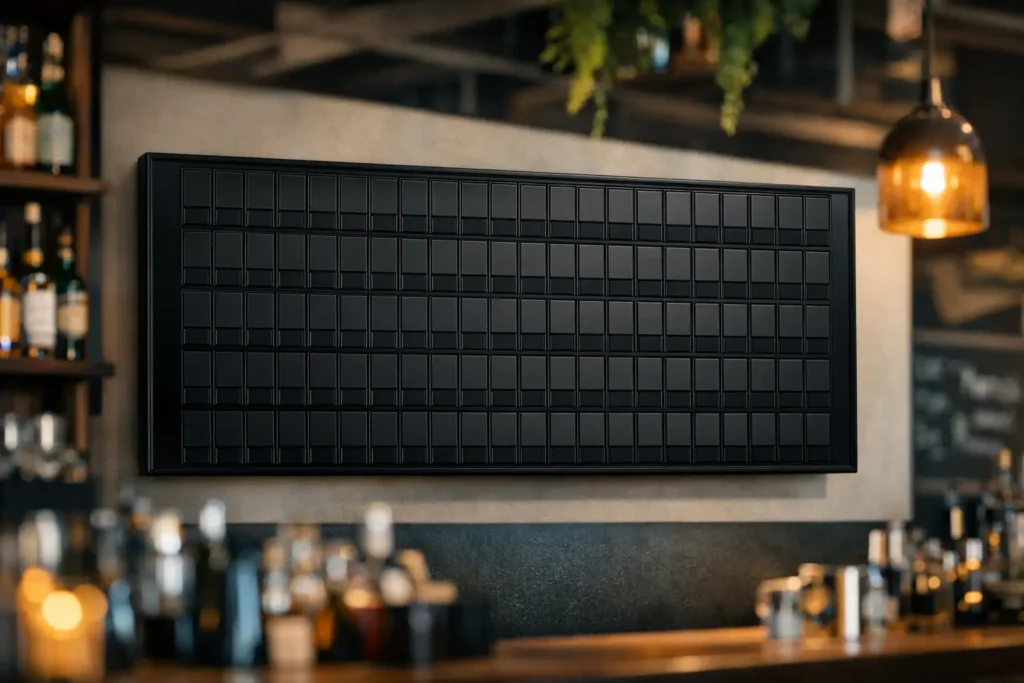
For many bars, this is where the category gets interesting. A split-flap style board brings the nostalgic presence of old transit and departure displays into a hospitality setting, but without the headaches of mechanical hardware. You get that unmistakable click-clack rhythm, strong text-based messaging, and a look that feels both retro and refined.
For bar specials, that combination works unusually well. Text is the point. You are announcing a happy hour, a featured pour, a trivia start time, or a kitchen special. You do not need a hyper-animated sales screen. You need something guests can read quickly and remember.
Why split-flap displays fit bars so well
Bars are sensory spaces. Lighting, music, glassware, menu design, even the way a room sounds when it fills up – it all shapes perception. A specials board should belong in that environment.
Split-flap style displays do because they feel public, theatrical, and tactile even when powered by a modern screen. They catch attention without shouting. They look intentional in dim interiors. And because the format is text-forward, they force clarity. That is good discipline for any operator trying to communicate quickly.
There is also a practical edge. If your team can update content from an app, schedule messaging by time of day, and switch from brunch promos to late-night specials without redoing a sign by hand, the board stops being décor and starts being infrastructure.
That matters during service. The fewer manual tasks your staff has to remember, the more likely your messaging stays accurate.
How to choose the best bar special announcement boards for your space
Start with the pace of your updates. If specials rarely change, a simple board may do the job. If your offers shift daily, by shift, or in response to inventory, choose something digital and easy to control.
Then think about visibility. Is the board meant to stop people at the door, guide ordering at the bar, or support table service from across the room? Distance changes everything. A board above the entrance can carry fewer words in larger text. A board near the register can include more detail. Trying to do both with one layout usually weakens both.
Style matters too, but not in a superficial way. Your board should match the atmosphere you are building. A polished wine bar does not want signage that feels improvised. A design-forward cocktail bar should not settle for generic templates that look like an office lobby. The board is part of the brand experience.
Ease of management is where many buying decisions are won or lost. If updating the board requires too many steps, a laptop in the back office, or a staff member who actually likes fiddling with settings, it will not get used consistently. The best bar special announcement boards are the ones your team can run during a real shift, not just in a demo.
Content that actually works on a bar specials board
A better board does not fix bad messaging. Keep copy tight. Lead with the offer, then the timing, then any detail that helps a guest decide.
“Happy Hour 4-6 PM” works better than a clever headline nobody understands at a glance. “Old Fashioned Feature Tonight” is stronger than a paragraph about bourbon craftsmanship. The board should answer immediate questions, not act like a brochure.
Rotation helps, but too much rotation becomes wallpaper. If every message flips every few seconds, guests will miss the one they care about. It is usually smarter to feature a handful of high-value messages and let them breathe. Specials, events, featured pours, and house reminders are enough for most bars.
This is one reason split-flap style boards perform well. They encourage concise messaging. They are built around the power of a few well-chosen words, presented with rhythm and presence.
Operational benefits owners feel right away
The visual side gets attention first, but the operational benefit is what makes a board worth keeping. A good special announcement system cuts down on repeated questions, reduces out-of-date promotions, and gives managers more control over what guests see.
If the kitchen 86s a featured item, you should be able to pull it instantly. If rain shifts patio traffic and you want to push indoor happy hour seating, the message should change in moments. If brunch ends and the evening crowd starts rolling in, your signage should move with the day.
That is where a cloud-managed split-flap system stands out. It keeps the old-school appeal while solving a very current bar problem: information changes constantly, and nobody has time to rebuild signage from scratch.
For operators who care about aesthetics, there is another benefit. A polished board reduces the temptation to clutter the room with backup signs, taped notes, and temporary fixes. The space feels calmer. Cleaner. More confident.
When the best choice is not the flashiest one
A board does not need to be loud to perform. In fact, bars often benefit from signage that feels integrated rather than attention-hungry. Guests are already processing bottles, menus, TVs, lighting, and people. More motion is not always better.
The best bar special announcement boards respect that. They create a focal point without hijacking the room. They support service instead of competing with it. And when the format has some history and texture behind it, the display becomes part of the experience guests remember.
That is the appeal of the split-flap look. It revives a familiar public-display language and gives it a practical job inside modern hospitality. With a system like Split Flap TV, bars can keep that analog soul while gaining instant updates, scheduling control, and a cleaner way to communicate what is happening right now.
The right board should make your specials easier to run and your bar easier to read. When it also adds a little click-clack theater to the room, that is not a gimmick. That is good hospitality design doing its job.