
Clear, accurate pricing builds customer trust. Whether you run a petrol station, manage a supermarket chain, or operate a quick-service restaurant, the way you display prices directly affects how customers perceive your business and make purchase decisions. Professional price display boards are commonly found in both business and academic settings.
This guide walks you through everything you need to know about price display boards—from basic definitions and types to implementation strategies that actually work in 2024 and beyond.
What is a price display board?
Display boards are used for exhibiting information in visual or text form. Display boards are used in various settings where displaying information is crucial for communication or engagement.
A price display board is any physical or digital system used to communicate product or service prices to customers at the point of sale. You’ll find them everywhere—supermarkets, car showrooms, pharmacies, petrol stations, hotels, and restaurants. The fundamental purpose is simple: present pricing information in a way that customers can easily read and trust.
The market divides between traditional and modern approaches. Traditional printed price boards include chalkboards, paper-based inserts, acrylic holders, and display rack systems with number cards. These remain common in small businesses due to low upfront cost. Modern digital price display boards use LCD, LED, or e-paper technology to show prices that can be updated remotely in seconds rather than manually over hours.
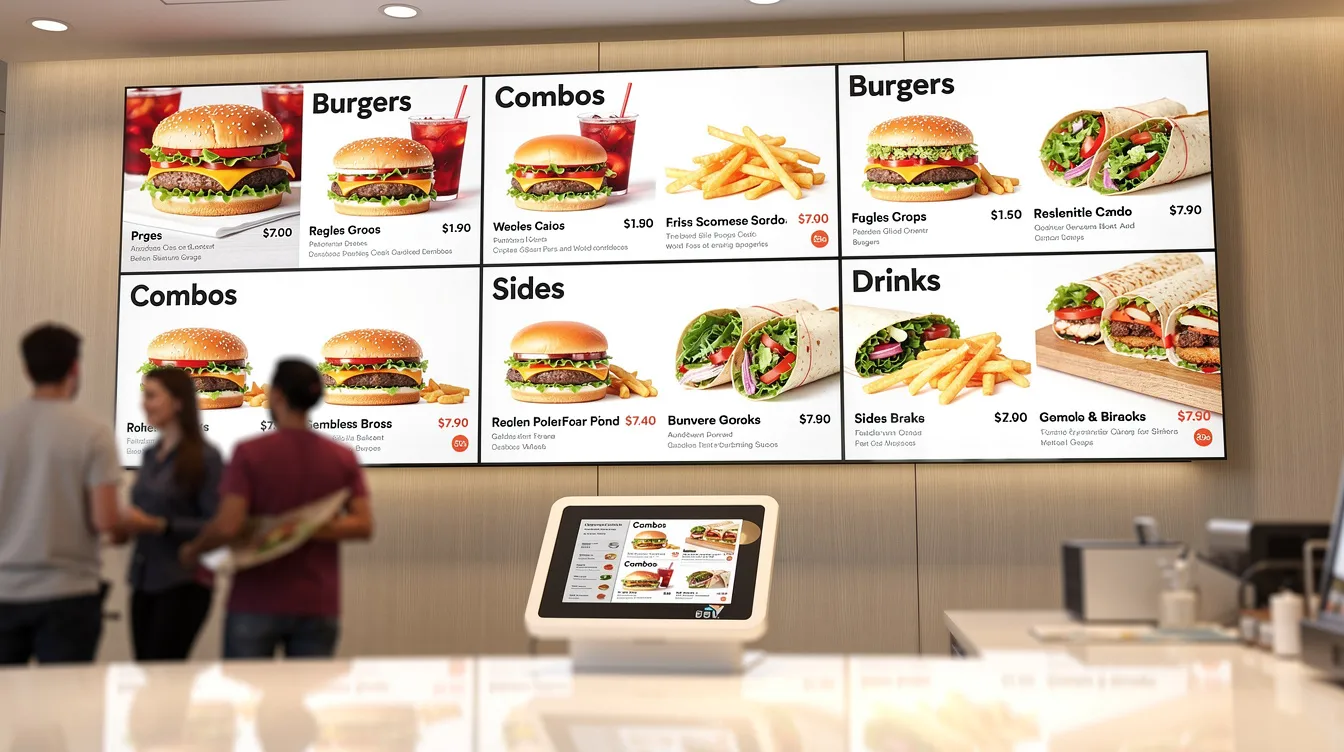
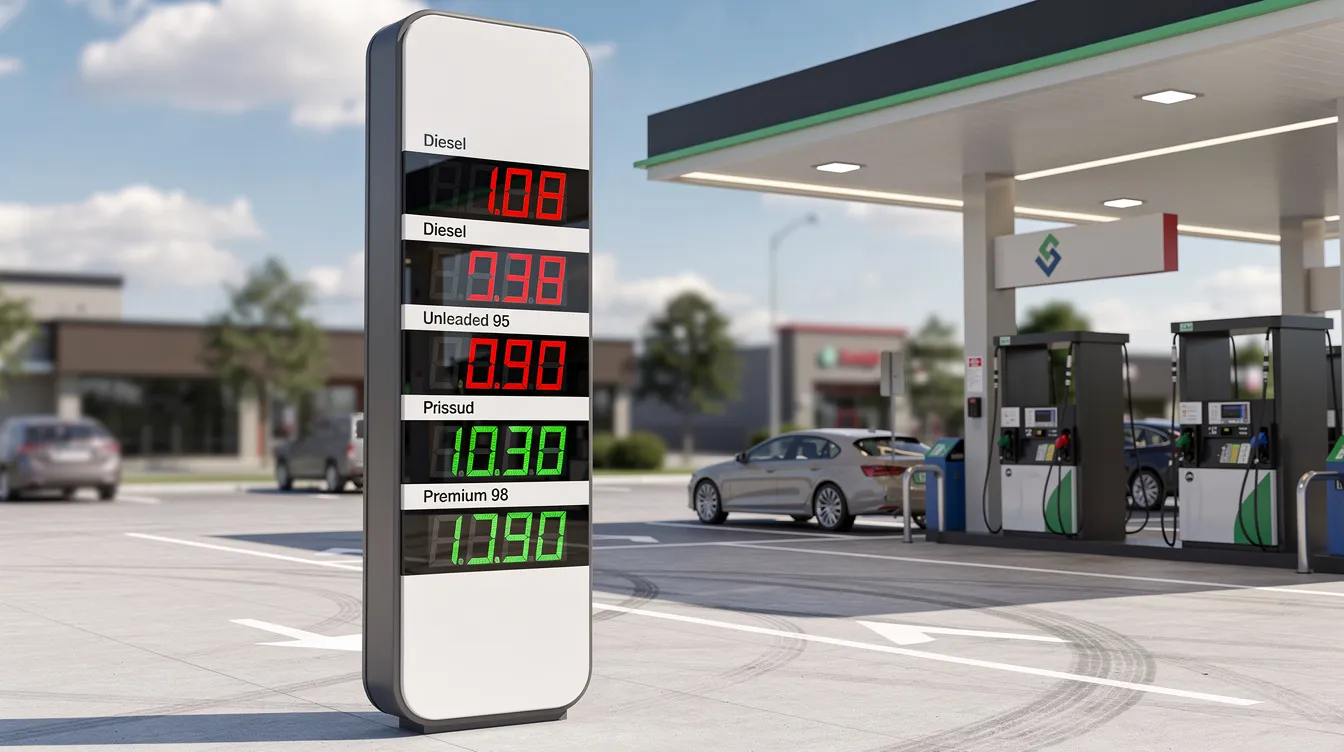
Concrete examples help illustrate the variety. Fuel price pylons on highways stand 3-6 meters tall with LED digits visible from 200+ meters away. Electronic shelf labels in supermarkets replace paper tags with small digital screens updated wirelessly. Digital menu boards in quick-service restaurants show breakfast, lunch, and dinner menus that change automatically throughout the day, and digital split-flap-style menu screens can significantly cut recurring menu printing costs. Car dealership price boards showcase vehicle models with pricing, specs, and financing options on 55-inch screens.
Common use cases include:
- Supermarket shelf labels and departmental signage
- Fuel station highway pylons and pump-top displays
- Restaurant and café menu boards
- Automotive showroom vehicle pricing
- Hotel lobby rate boards
- Pharmacy medication pricing
- Electronics and specialty retail pricing
Types of price display boards
There’s no one-size-fits-all solution. The right type depends on viewing distance, update frequency, and whether the board will be located indoors or outdoors.
Static printed boards are the traditional foundation of price communication. These include rigid acrylic frames with printed inserts, laminated paper sign holders, and mounted poster boards. Small acrylic holders cost $0.50-$0.80 per unit at 500+ volume, while larger framed options with LED backlighting run $18-$20 each. They work well for businesses where prices remain stable for weeks or months—luxury boutiques, fixed-price establishments, or small independent shops. Updates require physically removing and replacing the insert material.
Manual changeable boards include flip-number systems, chalkboards, and whiteboard displays where staff modify pricing without replacing the entire board. Handwritten advertising boards for coffee shops or catering cost around $6.70-$6.80 each. These suit businesses needing weekly updates but lacking digital infrastructure. You’ll find them on sidewalk sandwich boards, coffee shop counters, and farmers’ market stalls. The simple change process makes them accessible for any staff member.
Digital indoor screens represent the primary modern alternative. Typical sizes range from 32-55 inch LCD or OLED commercial-grade displays mounted on walls, stands, or ceiling suspensions. Entry-level 32-inch displays start around $250-$500. These require a media player or system-on-chip device to receive and render content. Note: Ensure your hardware is compatible with your chosen content management system, and some providers may offer a free initial screen as part of a package. Fast-food chains use them above service counters; pharmacies mount them on walls; supermarkets position them at department headers, and many businesses now use Split-Flap TV for attention-grabbing airport and store signage. Updates happen entirely through software—no physical intervention needed.
Outdoor LED price pylons represent the highest-visibility segment, particularly in fuel distribution. Small digital displays range from $118-$138, while 24-inch LED display boards run $300-$570. Professional-grade 6-meter tall pylons often exceed $5,000-$20,000 depending on height and specifications. These achieve 3,000+ nits brightness for sunlight readability and include weather-sealed housings with UV-resistant coatings. Fuel stations update them multiple times daily via wireless connection to pricing systems.
Electronic shelf labels (ESL) are specialized small-format digital displays mounted directly on retail shelves, typically 1-3 inches diagonal. They use e-ink or LCD micro-display technology to show product name, price, and promotional tags. Updates are entirely wireless via centralized retail management systems. Supermarkets with 10,000+ items find them essential for managing pricing at scale—manual changes at that quantity become logistically impossible, and some retailers complement ESLs with split-flap boards for unique, eye-catching price lists.
Key features of modern digital price display boards
Digital price display boards let businesses change prices instantly across one location or hundreds of geographically distributed sites. This represents a fundamental shift from manual operations where staff must physically visit each display to make updates, and modern split flap display boards controlled via apps combine that flexibility with a distinctive visual aesthetic.
Core capabilities include:
- Multi-format content support: Display static images, video loops, animated transitions, and scheduled playlists. A restaurant might show food photography during peak hours and promotional content during slower periods.
- Real-time data integration: Connect to fuel price APIs, inventory feeds, or hotel occupancy systems for automatic price adjustments. Petrol stations can link displays directly to wholesale commodity pricing for near-instant synchronization, and platforms like the Split-Flap TV App Marketplace simplify feeding live data into your digital price boards without heavy IT work.
- Scheduling and automation: Program time-based playlists so breakfast menus display from 6:00 AM-11:00 AM, lunch from 11:00 AM-4:00 PM, and dinner from 4:00 PM onwards—all switching automatically without staff intervention.
- Brightness optimization: Indoor displays typically offer 250-700 nits, suitable for retail environments. Outdoor displays require 3,000+ nits to remain visible in direct sunlight.
- Anti-glare coatings: Higher-end models reduce reflection in glossy storefronts or window displays where ambient light competes with screen content.
- Orientation flexibility: Both portrait and landscape modes are standard. Restaurants often use portrait orientation for menu variety; fuel pylons use landscape for large, readable numerals.
- Hardware compatibility: Works with commercial-grade TV displays from Samsung or LG, system-on-chip (SoC) displays with built-in media players, and dedicated media players connected via HDMI.
Branding and design customization
A well-designed price board doubles as a branding surface. It reinforces company identity while communicating prices—customers receive both information and brand impression simultaneously.
Design elements to consider:
- Logo placement: Position company logo in the top-left header bar or centered in a prominent header section. This establishes immediate brand recognition.
- Brand colors: Apply primary brand colors to headers and section dividers; use secondary colors for category labels and supporting information. Consistent color use across all displays maintains visual coherence.
- Typography hierarchy: Use large sans-serif fonts (24-40 points) for product category headers, medium fonts (16-24 points) for product names, and appropriately sized numerals (30-50 points) for prices. Consistent font selection across displays keeps the brand professional.
- Layout templates: Create different templates for different departments. Fresh produce displays might emphasize product photography and origin information; electronics displays might highlight specifications alongside pricing.
Example layout: A 55-inch screen in a car showroom might use a 3-column layout—vehicle model and image on the left, key specs (engine type, fuel efficiency, transmission) in the center, and price with optional monthly finance calculation on the right.
Recommended visual style:
- Clean, spaced layouts with high contrast ensure readability.
- Dark text on light backgrounds (or vice versa) with sufficient margins allows customers to read prices from 2-5 meters away.
- Professional designs include substantial white space to prevent visual clutter.
Content management and price updates
Digital price display boards are typically managed via cloud-based software or an on-premises content management system (CMS). Staff access through a web browser—no specialized software installation required, and marketplaces such as the Split-Flap TV App Marketplace for digital signage let non-technical teams plug in real-time data sources with minimal setup.
The workflow is straightforward. Staff log in via browser, upload a price list (CSV format or direct integration with POS/ERP systems), and push updates to one screen or hundreds of screens in seconds. The system validates data for errors before deployment, catching issues like missing decimal points or anomalous values.
Example workflows in practice:
- A restaurant programs daily happy hour changes at 16:00, reverting to standard menu at 18:00
- A petrol station adjusts fuel prices multiple times per day based on wholesale market feeds
- A hotel updates room rates hourly based on occupancy management system data
- A grocery store implements weekend promotional pricing that activates Friday evening and reverts Monday morning
Scheduling handles time-based programming automatically. Set breakfast, lunch, and dinner playlists to transition at specific times without manual intervention. Schedule seasonal promotions to activate on specific dates. Program holiday pricing adjustments weeks in advance. The system executes everything according to schedule while staff focus on other tasks.
Update frequency varies by industry. Fuel stations may update hourly. Restaurants update three to four times daily for meal period transitions. Grocery stores update weekly for permanent changes, daily for promotional rotations. The digital infrastructure eliminates the operational friction that static signage creates at any frequency.
Benefits of using a price display board
Clear, consistent price presentation builds customer trust and reduces friction at the point of sale. Customers benefit from unambiguous pricing before committing to purchase, which means fewer disputes at checkout and no surprises when the receipt prints.
- Transparency and trust come from publicly displayed, consistent pricing. When customers know prices are posted clearly and match across all locations, they feel confident in the purchase decision. This psychological benefit of perceived fairness strengthens brand loyalty.
- Operational efficiency improves dramatically with digital systems. Manual price changes require staff time to remove old signage, install new inserts, or rewrite chalkboards. Digital systems compress this entire workflow into seconds of browser-based work. A supermarket changing prices weekly across hundreds of products saves substantial labor hours.
- Error reduction follows naturally from centralized digital control. Manual systems introduce risk—typos in handwritten prices, misplaced decimal points, installation of outdated signs in wrong locations. Digital systems validate data, check for anomalies, and ensure all locations display identical prices simultaneously.
- Upselling opportunities expand when displays can show dynamic content. Recommended items appear adjacent to primary products—suggesting accessories, bundled packages, or complementary items. Restaurant menu boards highlight high-margin dishes through prominent placement and imagery. Hotel displays promote premium room categories and add-on services alongside standard rates.
- Compliance and accuracy become easier to maintain. Many jurisdictions mandate specific font sizes, contrast ratios, and pricing formats. Digital systems make compliance straightforward—regulatory updates deploy across all locations simultaneously, and audit trails document exactly what prices displayed at what times.
- Accessibility benefits serve diverse customer needs. Larger fonts and higher contrast options help older customers and those with visual impairments read prices comfortably. Digital displays can be programmed with multiple contrast levels and adjustable sizing that static signs cannot offer.
Competitive pricing and real-time adjustments
Many sectors—fuel, groceries, travel—change prices multiple times per week, sometimes several times per day. Static signage simply cannot keep up with this velocity.
- Concrete scenario: A petrol station observes a competitor reducing fuel prices by $0.03/liter. With digital displays, matching adjustments deploy within minutes, preserving market share that would be lost if changes required manual intervention and hourly installation delays.
- Another example: A retailer runs a 24-hour flash sale with sub-hourly price refreshes—10:00 AM special pricing, 14:00 adjusted pricing, 18:00 clearance pricing—based on real-time sales velocity. This level of responsiveness optimizes both inventory turnover and margin realization.
Accurate, synchronized prices across all screens and POS systems reduce customer complaints about mismatched shelf and checkout prices. When the shelf price matches the register price every time, customer satisfaction increases and staff spend less time resolving disputes.
Typical applications and industries
Price display boards appear anywhere customers need clear, immediate price information before purchasing. The format and technology vary by industry requirements.
- Retail supermarkets: Employ both electronic shelf labels for product-level pricing and larger digital displays for departmental signage. Fresh produce sections show current pricing for seasonal items with origin information. Deli counters feature price boards for prepared foods with daily changes reflecting preparation batches. Aisle endcaps showcase featured promotions. The quantity of stock keeping units in a typical supermarket—often exceeding 10,000 items—makes manual pricing updates logistically challenging.
- Fuel stations: Use the highest-visibility displays through outdoor LED pylons visible from highways. These tall, illuminated signs display current fuel prices with large numerals readable from 50-200+ meters, allowing rapid customer decision-making from vehicle approach distances. Some stations also employ pump-top displays showing price-per-liter and promotional messaging for convenience store offerings.
- Automotive showrooms: Use mid-to-large format digital displays (55+ inches) to showcase vehicle models, specifications, pricing, and financing options. A typical showroom display divides into columns: vehicle imagery and model name, key specifications, and pricing with monthly financing calculations. Customers can quickly compare options while salespeople add personalized information during consultations.
- Hospitality venues: Including restaurants, cafés, and hotels rely heavily on digital menu boards. Quick-service chains program daily menu transitions for different meal periods. Happy hour pricing displays at scheduled times. Hotels show daily specials and room package pricing on lobby displays. Many venues are adopting digital split-flap departure‑board‑style displays to bring nostalgic motion and real-time updates into lobbies and dining areas. The dynamic nature of hospitality pricing—seasonal rates, special events, occupancy-based adjustments—makes digital displays particularly valuable.
- Pharmacies: Display pricing for over-the-counter medications, wellness products, and services on wall-mounted displays. Clear pricing proves especially important in healthcare retail where customers are price-sensitive about medication costs and insurance copayments.
- B2B applications: Include trade counters, wholesale warehouses, and building material yards where bulk prices and quantity discounts must be displayed clearly. A building supply counter might display pricing for dimensional lumber by length with quantity discounts for bulk orders. The pricing complexity in B2B contexts makes digital displays with search capabilities substantially more efficient than printed catalogs, and modern digital split-flap displays offer both the classic mechanical look and the flexibility needed for complex price data.
Indoor vs. outdoor price display boards
The technical requirements differ significantly between indoor and outdoor environments.
Brightness specifications represent the most obvious difference. Indoor displays operate at 300-700 nits, optimized for retail environments with controlled lighting. Outdoor displays require 3,000-4,000+ nits to remain visible in direct sunlight—a 5-15x brightness differential that drives technology and cost differences. An indoor pharmacy screen looks great at 500 nits; a highway fuel pylon needs 4,000+ nits to be readable at midday.
Weatherproofing requirements apply only to outdoor installations. Outdoor displays must withstand rain, wind, temperature extremes, UV radiation, and dust exposure. This requires sealed aluminum housings, weather-resistant electronics enclosures, and protective coatings. Indoor displays need only standard dust-protective covers and basic electrical enclosures, substantially reducing manufacturing complexity and cost.
Viewing distance optimization varies dramatically. Indoor displays are designed for 3-5 meter viewing distances—customers at arm’s length while shopping. Outdoor displays are optimized for 50-200+ meter distances—highway fuel signs readable from vehicle approach. This distance differential drives font sizing: outdoor displays require numerals 30-60 cm tall; indoor displays use numerals 5-15 cm tall.
Typical indoor applications include pharmacy price screens, cosmetics counters, deli counters, and retail end-cap displays—all in climate-controlled environments where brightness and weatherproofing requirements remain moderate. Typical outdoor applications include fuel station price pylons, roadside hotel rate boards, and parking facility pricing—all exposed to weather and requiring visibility from substantial distances.
Placement and installation
Proper placement and installation of your price display board are essential for maximizing its effectiveness and ensuring customers receive the information they need at the right time. The display should be located in a high-traffic area of your business, such as near the point of purchase or along main customer pathways, so it’s easily visible and accessible. This strategic positioning helps inform customers about product prices, promotions, and key details, supporting their purchase decisions and enhancing the overall shopping experience.
When selecting a display board, consider the size and material to ensure it fits seamlessly into your environment without obstructing movement or sightlines. For digital display boards, make sure the TV or screen you choose is compatible with your content needs—many modern displays can read image and video files directly from a USB drive, making content updates simple and efficient. Secure installation is crucial; whether you’re adding a wall mount, stand, or ceiling suspension, always follow the manufacturer’s instructions to protect both the product and your business premises.
A well-placed display board not only meets your business needs but also helps customers quickly find the information they’re looking for, whether it’s product details, pricing, or special offers. By investing in thoughtful placement and proper installation, you ensure your display rack or digital board becomes a valuable tool for driving sales and improving customer satisfaction, and you can further enhance impact by adding overlay images like logos or slogans to your text boards.
Maintenance and repair
Keeping your price display board in top condition is key to ensuring customers always receive accurate and up-to-date information. Regular maintenance extends the life of your display and protects your investment, whether you’re using traditional boards or digital screens.
For traditional display boards, routine care includes cleaning the surface, replacing worn or faded number cards, and checking the material for any signs of damage. This ensures your display remains professional and easy to read. Digital display boards require a different approach: schedule regular software updates, manage content to keep information current, and perform hardware checks to catch any technical issues early.
If your display board is damaged or malfunctions, it’s important to contact the seller or manufacturer promptly to discuss repair or replacement options. Many products come with a warranty or guarantee, so review your purchase agreement to understand what’s covered and how to proceed. Quick action minimizes downtime and ensures your customers continue to receive the information they need.
By prioritizing maintenance and timely repairs, businesses save time and money in the long run, avoid disruptions, and maintain a consistent, high-quality display that supports customer trust and smooth transactions.
Customer engagement
Price display boards are more than just tools for showing prices—they’re powerful assets for engaging customers and enhancing the shopping experience. By using clear, easy-to-read fonts, vibrant colors, and compelling visuals, businesses can create displays that capture attention and encourage customers to stop, read, and interact with the content.
Digital display boards offer even more opportunities to engage customers. Features like interactive content, product videos, and real-time updates allow you to showcase product features, highlight special offers, and even display customer testimonials. This dynamic approach not only informs customers about prices and promotions but also helps them compare products and make confident purchase decisions.
Effective customer engagement can be measured by tracking how many customers interact with the display, the time spent reading information, or the increase in sales from advertised promotions. By consistently offering valuable, relevant content, businesses build trust, strengthen brand loyalty, and create a memorable experience that keeps customers coming back.
Environmental considerations
When choosing a price display board, it’s important to consider the environmental impact of your selection. Traditional boards made from materials like cardboard or foam may contribute to waste, while digital display boards can help reduce paper usage and minimize the need for frequent printing and disposal.
Many modern display boards are designed with sustainability in mind, using eco-friendly materials or incorporating energy-efficient features such as LED lighting. Businesses can also evaluate the carbon footprint of their display solution, taking into account energy consumption, transportation, and installation processes.
Opting for an environmentally responsible display not only reduces your business’s impact on the planet but also enhances your brand image among eco-conscious customers. Additionally, display boards can be used to promote your own environmental initiatives, such as recycling programs or conservation efforts, further reinforcing your commitment to sustainability.
Accessibility and compliance
Ensuring your price display board is accessible and compliant with relevant regulations is essential for creating an inclusive environment that welcomes all customers. Design your display with accessibility in mind by using simple, clear language, high-contrast colors, and large, easy-to-read fonts. This makes information more readable for everyone, including customers with visual impairments.
Digital display boards can further enhance accessibility by offering features such as audio descriptions, closed captions, and interfaces that are easy to navigate for wheelchair users. It’s also important to ensure your displays comply with local laws and standards, such as the Americans with Disabilities Act (ADA), to avoid legal issues and demonstrate your commitment to inclusivity.
Display boards can also be used to inform customers about accessibility features within your business, such as the location of wheelchair ramps or the availability of braille signage. By prioritizing accessibility and compliance, you not only meet legal requirements but also create a welcoming atmosphere that meets the needs of all your customers.
Cost of price display boards
Pricing depends on format (static vs. digital), size, technology, and volume. These are ballpark figures for 2024 planning purposes rather than exact quotes.
Static printed options remain the most affordable entry point. Small printed acrylic holders run around $5-$20 each depending on size and quality. Larger wall-mounted price boards cost $100-$300. These have minimal upfront cost but require ongoing printing supplies and installation labor for every change.
Digital indoor displays start higher but eliminate recurring print costs. Entry-level 32-inch digital screens begin around $250-$500 plus media player costs. Mid-range 55-inch commercial displays run $800-$1,500. Content management software typically adds $20-$100 per screen monthly depending on feature complexity and number of locations.
Outdoor LED pylons represent significant capital investment. Small LED price displays start at $118-$138. Full 24-inch LED display boards run $300-$570. Professional-grade 3-6 meter tall fuel pylons often cost $5,000-$20,000+ depending on height, LED type, and structural engineering requirements. These are designed for 10+ year service life to justify the investment.
Total cost of ownership matters more than upfront price. Digital boards have higher initial costs but save substantially on printing, installation labor, and changeover time over a 3-5 year horizon. A supermarket changing prices weekly across 100+ departments likely achieves cost recovery within 2-3 years through labor savings alone.
Factors that influence pricing
Several variables drive significant pricing variation within display categories.
Display size and resolution directly affect cost. A 32-inch Full HD display costs less than a 55-inch 4K model. LED pixel pitch (6mm fine pitch vs. 16mm coarse pitch) substantially impacts outdoor display pricing—finer pixel pitch requires more diodes and complex manufacturing.
Brightness specification correlates with power consumption and thermal management complexity. Higher brightness ratings increase cost, particularly for outdoor displays requiring 3,000+ nits.
Weather resistance adds cost for outdoor installations. IP-rated enclosures, sealed electronics, and UV-resistant coatings all increase manufacturing expense.
Integration requirements affect professional services costs. Simple installations (single display in a small café) might cost $500-$1,000 for setup. Complex multi-location deployments with POS/ERP integration could cost $5,000-$50,000+ depending on scope and customization needs.
Volume discounts apply universally. Single display purchases cost substantially more per unit than 100-display multi-location deployments. Planning for scale often makes sense even if initial rollout is limited.
When preparing a budget, determine: number of screens needed, approximate sizes required, indoor/outdoor mix, integration with existing systems, and any regulatory or branding requirements specific to your country or industry. It can also help to understand the history and evolution of split-flap display boards so you can decide whether a classic mechanical look or a fully digital approach best fits your brand and budget.
How to choose the right price display board
Start by defining your goals. Are you improving transparency to meet customer expectations? Modernizing store presentation? Enabling dynamic pricing for competitive markets? Standardizing branding across multiple locations? Clarity on primary objectives shapes all subsequent decisions.
- Assess environment and viewing distance. Indoor climate-controlled retail enables cost-effective LCD technology. Outdoor weather-exposed locations require LED with higher brightness and weatherproofing. Match technology to actual operating conditions.
- Determine update frequency. If prices remain stable for weeks, static boards may be cost-effective. If prices change weekly or more often, digital systems typically provide better value. If prices change multiple times daily, digital becomes essential.
- Decide static vs. digital. This fundamental choice branches all subsequent planning. Static works for stable pricing and small product counts. Digital works for frequent changes, multi-location consistency, and complex pricing scenarios.
- Set a realistic budget. Include hardware, software licensing, installation, staff training, and ongoing maintenance. A single small display might budget $1,000-$2,000 total. Multi-location deployments with 50+ screens might budget $50,000-$200,000 depending on complexity.
- Evaluate vendor support. Look for commercial-grade hardware rated for 16/7 or 24/7 operation with 3-5 year support horizon. Test that the software interface is intuitive for your staff. Check references from similar operations in your industry.
Create a checklist with concrete items: required screen sizes, number of products per screen, language requirements, operating hours, integration needs with existing POS or inventory systems, and regulatory compliance requirements.
Implementation and rollout tips
- Start with a pilot project: Rather than full-scale deployment, test on 3-5 screens in a single location over 4-8 weeks. This validates content layouts, verifies that workflows match operational reality, and identifies unexpected technical issues before major capital commitment.
- Planning activities: Include stakeholder identification, content strategy development, workflow definition, and technical infrastructure assessment. Document decisions for later reference when system expansion occurs. This typically requires 2-4 weeks.
- Design and template creation: Should involve actual store staff who will manage content. Their input ensures templates are operationally practical. Develop 3-5 core templates suitable for most common scenarios to reduce ongoing design work.
- Staff training: Covers logging into CMS, uploading content, using templates, scheduling, and troubleshooting common issues. Provide written procedures, video tutorials, and contact information for technical support. Training requirements are minimal for browser-based interfaces—basic web familiarity suffices.
- Collect feedback: During pilot testing from staff and customers. Measure impact on price-related questions or disputes. Identify refinements needed before broader rollout. Pilot feedback typically reveals 10-20 minor adjustments that improve full deployment.
- Ongoing operations: Require clear responsibility assignment for price updates, regular review schedules, and processes to keep visual content aligned with current promotions. Weekly or bi-weekly review meetings during initial months help identify issues early.
The right price display board transforms pricing from a static obligation into a dynamic business tool. Define your goals clearly, choose technology that meets your actual needs rather than over-engineering, and test your approach before full commitment. Start with that pilot project, gather real operational data, and expand from a foundation of proven success.
Visual communication
Visual communication is at the heart of how businesses connect with their customers, and a well-crafted display board is one of the most effective tools for delivering clear, impactful information. Whether you’re showcasing a new product, announcing a special offer, or simply informing customers about pricing, the quality of your display can make all the difference. High-quality materials—such as durable acrylic, sleek metal frames, or vibrant LED screens—ensure that your message stands out and remains easy to read over time.
Modern display boards often incorporate video content and dynamic graphics, elevating the level of engagement and making information more memorable. By using visually appealing layouts, bold colors, and crisp images, businesses can capture attention and guide customers toward key products or promotions. This not only helps inform purchasing decisions but also reinforces your brand’s commitment to quality and professionalism.
Ultimately, investing in superior visual communication through your display boards helps your business inform, educate, and inspire customers at every touchpoint. The result is a more engaging shopping experience, higher customer satisfaction, and a stronger brand presence in a competitive market.
Technology and integration
The evolution of display boards has been driven by rapid advancements in technology and seamless integration with business systems. Digital display boards now offer businesses the ability to update content instantly, ensuring that customers always receive the most current information—whether it’s pricing, product availability, or special promotions. With cloud-based management platforms and mobile apps, staff can change display content from anywhere, at any time, streamlining operations and reducing manual workload.
Integration with technologies like RFID tags, sensors, and IoT devices takes display boards to the next level. These features allow businesses to track customer interactions, monitor stock levels in real time, and even trigger personalized content based on customer behavior or inventory status. For example, a display can automatically highlight items that are low in stock or promote products that are trending in a particular location.
By embracing these technological advancements, businesses can offer customers a more interactive and informative experience. Real-time updates, targeted content, and data-driven insights not only enhance the value of your display boards but also provide a competitive edge in today’s fast-paced retail environment.
Return on investment
Investing in high-quality display boards is a strategic decision that can deliver substantial returns for your business over time. Modern display solutions—especially digital boards—offer a range of benefits that go beyond simple price presentation. By reducing the need for frequent printing and manual updates, digital displays save both time and money, allowing staff to focus on higher-value tasks.
The flexibility to update information instantly means businesses can respond quickly to market changes, optimize promotions, and ensure customers always see accurate, up-to-date content. This agility can lead to increased sales, as customers are more likely to make a purchase when they have clear, reliable information at the point of decision.
Additionally, advanced display boards often come with analytics and tracking tools that measure customer engagement and content effectiveness. By analyzing this data, businesses can refine their strategies, tailor their messaging, and maximize the impact of every display. Over time, these improvements translate into higher customer satisfaction, stronger brand loyalty, and a measurable boost in revenue.
Choosing the right display board solution ensures your investment pays off—not just in immediate operational savings, but in long-term business growth and market leadership.