Split Flap Style Display for Office Announcements
June 1, 2026 · Captain
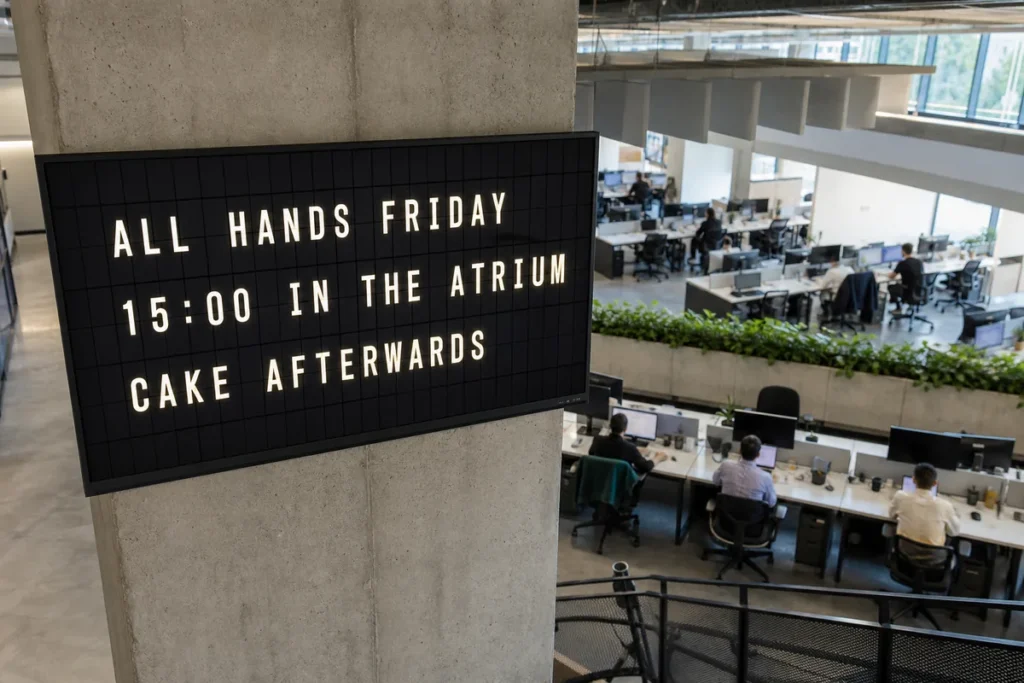
The office bulletin board usually tells on itself. Curling paper. Outdated printouts. A meeting notice hiding under last week’s potluck sign. If you want communication to feel intentional, a split flap style display for office announcements changes the tone immediately. It turns routine updates into something people actually notice – and it does it without adding more work to your day.
That appeal is not just nostalgia talking. Split-flap boards earned their place in airports and train stations because they were clear, public, and hard to ignore. The rhythm, the movement, the crisp typography – all of it signaled that information mattered. Bringing that visual language into an office gives everyday announcements more presence, while modern screen-based control makes the whole thing far more practical than the original mechanical boards ever were.
Why a split flap style display for office announcements works
Office communication has a predictable problem: people stop seeing it. Standard posters blend into the wall, email gets buried, and generic office screens often feel like background wallpaper. A split flap style display for office announcements interrupts that pattern in a more elegant way.
The format is mostly text-forward, which is exactly why it works so well for announcements. Instead of fighting for attention with busy graphics, it presents short messages with authority. Team schedules, visitor welcomes, room changes, Wi-Fi details, event reminders, safety notices, and lunch specials in the break room all fit naturally into the style. The familiar click-clack animation gives each update a sense of arrival.
There is also a brand effect here. Offices spend a lot of money trying to look polished, creative, or design-conscious. Then the actual announcements go up on printer paper with tape. That disconnect is hard to ignore once you see it. A split-flap look closes the gap between the space you want people to experience and the way information is actually delivered.
Retro character, modern control
The strongest argument for this style is not that it looks cool, although it absolutely does. It is that it combines visual character with operational simplicity.
Traditional split-flap hardware had theater, but it also had limits. Mechanical systems are expensive to maintain, fixed in layout, and not built for the pace of modern office updates. A digital version keeps the atmosphere people love – the motion, the timing, the disciplined layout, the old-school transit-board charm – while removing the friction.
That means office managers and admin teams can update content from an app instead of climbing ladders, replacing paper, or editing clunky presentation slides. They can schedule announcements ahead of time, rotate messages by daypart, and keep multiple screens consistent across different parts of the office. It feels classic, but it behaves like a contemporary signage system.
That distinction matters. This is not trying to compete with flashy, image-heavy digital signage. It serves a different purpose. A split-flap style display is deliberately restrained, with a focus on concise text communication and visual rhythm. For office announcements, that is often the smarter choice.
Related reading: Why Split Flap Style Screens Still Work
Where it fits best in an office
The most effective placements are usually the spaces where people are already in transition. Reception areas are an obvious fit because they set the first impression for visitors and candidates. A welcome message, meeting room direction, or company announcement instantly feels more curated on a split-flap display than on a standard screen.
Break rooms are another strong use case. They are ideal for HR reminders, menu updates, shift notes, upcoming celebrations, internal events, and practical details people often ask about repeatedly. Because the display style is distinctive, the message has a better chance of being seen while people wait for coffee or lunch.
Elevator lobbies, hallways near conference rooms, and shared workspace hubs also make sense. These are places where attention naturally flickers for a few seconds. The slight motion of a board changing copy gives people a reason to look up.
Not every office needs one in every room. In fact, the style tends to work best when used intentionally. One well-placed display can do more than a dozen scattered paper notices.
What to show on a split-flap office display
The format rewards brevity. If your office announcements are usually too long, that is not really a drawback – it is useful discipline.
Short messages perform best because they match the visual logic of the board. Think visitor greetings, daily schedules, conference room changes, office hours, team shout-outs, event countdowns, building notices, and rotating reminders. If your office has a hybrid schedule or shared desks, simple location and attendance messaging can also work well.
The smartest content is often the information people ask for over and over. Where is the meeting? Which floor is the event on? What is today’s lunch perk? Is the office closed early on Friday? A good display removes friction before someone has to ask.
There is room for personality too. A split-flap board can carry a bit of wit without losing professionalism. That is part of its charm. It feels more alive than a static sign, but more refined than a whiteboard scribble.
The trade-offs to consider
This style is not right for every communication need, and that is worth saying plainly.
If your goal is to show dashboards, detailed charts, full-slide presentations, or image-heavy campaigns, a split-flap look is not the best fit. It is strongest when the message is short, timely, and public-facing. Trying to force too much information into the layout can weaken the effect.
There is also a pacing consideration. The animation is part of the appeal, but in a very high-volume information environment, you need to think about timing. Messages should rotate clearly enough to be read without feeling frantic. In a quieter office, that is easy. In a fast-moving reception area, you may want fewer messages shown more deliberately.
And then there is style fit. If an office has a very sterile corporate environment with no appetite for visual character, this may feel too expressive. But for brands that care about atmosphere, hospitality, and design, that expressiveness is usually the point.
Making the display feel premium, not gimmicky
The difference comes down to restraint.
A split-flap aesthetic has strong personality, so the best office setups use it with purpose. Keep the copy concise. Use clean layouts. Let the motion do the work instead of overloading the board with too many pages or too much visual noise. When the content is disciplined, the display feels elegant. When it tries to become everything at once, it can tip into novelty.
That is why customization matters. Being able to control rows, columns, page timing, colors, and transitions lets the display fit the office rather than forcing the office to fit the display. A law office might want a quieter palette and a reception-focused layout. A creative studio might lean into bold messaging and playful staff updates. A boutique hotel office might use it behind the desk for internal coordination and guest-facing notes. Same visual language, different execution.
Why offices are moving away from paper notices
Paper feels cheap because it is cheap – but the hidden cost is the constant maintenance. Someone has to type it, print it, trim it, tape it up, remove the old version, and notice when it is no longer accurate. Multiply that across recurring announcements, schedule changes, guest welcomes, and internal events, and the process becomes a low-level drain on time.
Digital control fixes that, but generic screens often lose the human feel. This is where a platform like Split Flap TV lands in a sweet spot. It keeps the ritual and charm of the old boards while making updates instant and cloud-managed. You buy a screen, download the app, publish your content, and the office suddenly has a cleaner system that people actually pay attention to.
For office teams, that means less manual work. For leadership, it means a sharper environment. For visitors, it means the space feels considered. And for employees, it means key information shows up where they can see it, not buried in another inbox.
Audit Your Announcements Before You Automate Them
The most common mistake when moving off paper is digitizing clutter instead of removing it. Before building any layouts, list the messages your current board carries and sort them by audience and urgency. A lobby display may need visitor greetings, room directions, office hours, and a short brand line. A staff-area screen can focus on shift notes, deadlines, and team celebrations. A display outside meeting rooms should be narrower still: room status, the next booking, and simple wayfinding.
It helps to think in four categories, each with a clear place in the rotation:
- Always-on details such as Wi-Fi or office hours, which can stay visible all day.
- Scheduled content such as weekly meetings or lunch service, which follows a predictable pattern.
- Time-sensitive updates such as a room change, which need to go live immediately.
- Culture-building messages such as birthdays or recognition, which add warmth without crowding out the essentials.
If a message does not help someone make a decision, find a location, or feel welcome, it probably does not need a slot. Dense policy documents and long instructions belong elsewhere; edit those down first, then put on screen only what deserves attention.
Build a Small Layout Library and Let Old Messages Expire
Designing every announcement from scratch is where the workload creeps back in. Instead, set up a handful of reusable layouts: one with a large welcome line and a smaller directional line, one for time, date, and room details, and one reserved for urgent operational updates. The aim is recognition rather than variety. When people know where on the board to look for the next meeting or a visitor greeting, the display earns its place.
Scheduling handles the predictable changes, but it is not a substitute for responsiveness. A delayed client or a moved training session still needs to reach the screen right away, which is why being able to publish from anywhere matters. For anything tied to a date, set an expiry. A message about a Wednesday workshop should vanish after Wednesday. Once employees spot stale information more than once, they stop looking at the board altogether.
Sound deserves a deliberate choice too. The click-clack can be a memorable moment in a lobby or café-style office, but it may not suit a quiet legal practice, a clinic, or a focused work area. Let the acoustics and culture of each space decide.
Decide Who Publishes, Then Roll Out One Screen at a Time
Simple technology still needs clear responsibility. Decide who can publish routine messages, who approves sensitive announcements, and who reviews the schedule each week. In a small office, one office manager may own the whole thing. In a larger workplace, reception, facilities, HR, and marketing might each contribute. Avoid making every employee an editor; broad access leads to conflicting messages and a board that feels like the old corkboard in digital form. Let people submit updates through whatever process your office already uses, and keep publishing to a small group.
A useful house rule is that every message should be readable in about three seconds. Put the key fact first and include one action if needed. “TRAINING MOVED TO STUDIO B” beats a paragraph explaining why.
For the rollout itself, start with the highest-maintenance board, often the one at reception because it serves both staff and visitors. Run it for a couple of weeks and watch what people still ask about. If guests keep asking where to go, make directions larger. If staff overlook event reminders, change when they appear. Expand to other locations once the editorial routine is working, because that routine, more than the installation, is what keeps the information accurate.
The real value is attention with taste
A lot of office signage either disappears or shouts. The beauty of split-flap style is that it does neither. It catches the eye through motion, rhythm, and familiarity, then delivers the message with discipline.
That combination is rare. It gives office announcements a sense of ceremony without making them theatrical. It adds personality without creating clutter. And it helps a workspace communicate like it cares how things look and how things run.
If your office announcements still live on taped paper and forgotten bulletin boards, that is probably not a communication problem. It is a presentation problem. A better display does more than tidy up the message. It makes the office feel like the message belongs there.