
How to Update Bar Menus Instantly
May 22, 2026 · Captain
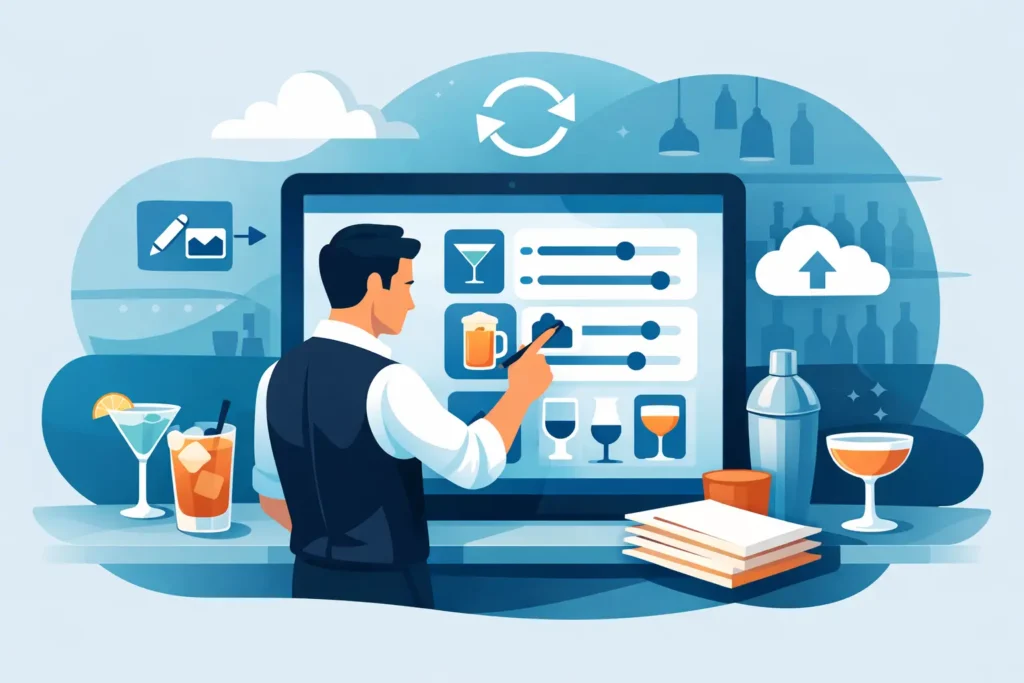
Friday at 7:12 p.m., your IPA kicks faster than expected, the seasonal cocktail needs a price change, and the bartender is still answering the same question for the tenth time: “What’s on happy hour?” If you’re figuring out how to update bar menus instantly, the real issue usually isn’t design. It’s speed, accuracy, and having a system that can keep up with a live room.
A bar menu is not a static asset. It changes with inventory, staff decisions, distributor availability, crowd patterns, and the rhythm of service. Printed menus look polished until they’re wrong. Chalkboards have charm until they’re half-erased, inconsistent, or impossible to update during a rush. Taped notices solve one problem and create three more.
What works better is a menu setup that feels intentional in the room and practical behind the scenes. For bars, that often means moving menu communication onto a display you can control from an app, so edits happen in seconds instead of the next time someone finds a marker.
How to update bar menus instantly without slowing service
The fastest way to update a bar menu instantly is to separate the display from the editing process. In other words, your staff should not need to climb on a chair, swap paper inserts, erase a board, or rebuild a layout from scratch every time something changes. They should be able to open an app, edit the text, publish, and move on.
That sounds simple, but the setup matters. A good system gives you fixed templates for recurring sections like beer, wine, cocktails, happy hour, and house notes. When the structure is already there, your team only changes the content. This is where many bars lose time. They don’t need more screen features. They need fewer steps between “86 the lager” and “guests can see it.”
A split-flap style display adds another advantage. Text-led boards are incredibly clear at a distance, and the click-clack motion naturally draws the eye without feeling like a sports bar TV wall. For venues that care about atmosphere, that matters. You want attention, not visual clutter.
Why old menu methods break down so fast
Most bars don’t stick with handwritten or printed menus because they love the process. They stick with them because they seem easy. At first, they are. Then the operational cracks show up.
Printed menus create lag. If your pricing shifts, a batch runs out, or you’re rotating through limited pours, the physical menu becomes outdated the moment service changes. You either live with inaccurate information or reprint constantly. Neither option is great.
Chalkboards feel flexible, but flexibility depends on who is updating them, how readable their handwriting is, whether spacing still works, and whether anyone has the time to rewrite the whole thing mid-shift. They can look beautifully analog in the right space, but they rarely scale well once your menu changes often.
Static digital slides are better than paper, but only if they’re easy to manage. If every update requires a designer, a laptop in the office, or a complicated media player workflow, you still haven’t solved the real problem. You’ve just moved it.
The system that actually makes instant updates possible
If you want bar menus to update instantly, build around three things: centralized control, repeatable layouts, and fast publishing.
Centralized control means one person can update the menu from anywhere instead of physically standing in front of the display. That matters for owners managing multiple locations, managers working the floor, and teams that want fewer interruptions during service.
Repeatable layouts mean your menu always looks like your menu. The sections stay consistent, the spacing stays clean, and the display still feels premium even when content changes ten times in a day. This is especially useful for bars with rotating taps or time-based offers.
Fast publishing is the final piece. If your team hesitates to make small updates because the process feels annoying, the menu drifts out of date. Instant publishing removes that friction. You update the text, push it live, and the room stays accurate.
That is the practical value behind retro-modern signage. The display has character, but the workflow is built for speed.
How to set up a menu you can change in seconds
Start with the content categories you change most often. For most bars, that means drafts, featured cocktails, happy hour pricing, sold-out items, event promos, and house notices like Wi-Fi or last call timing. Build these into dedicated sections rather than treating every update as a one-off.
Next, decide what should stay fixed and what should rotate. Your core cocktail list may remain stable for weeks, while your beer board might change every night. If you separate those layers, you avoid editing the entire menu every time one keg blows.
Then think about readability from where guests actually stand. A text-first display works best when the message is short, clear, and organized by category. This is not the place for dense descriptions or tiny type. If a guest has to step forward and squint, the menu is doing too much.
Finally, choose a display format that fits the space. Behind the bar, near the ordering point, or in a waiting area can all work, but each placement changes how people use the information. A board behind the bar supports ordering decisions. A board near the entrance can answer questions before guests even reach the host stand.
How split-flap style displays fit bar operations
Bars are visual environments, but not every screen belongs in one. Bright, glossy displays can feel out of place in rooms built around mood, texture, and conversation. A split-flap style board solves a different problem. It carries the nostalgia of classic public signage while staying disciplined enough for daily operations.
That’s why this format works so well for menus and service messages. It is motion with restraint. The click-clack transition catches attention, then gets out of the way. You can show specials, timing, featured pours, and updates in a format that feels intentional rather than generic.
For operators, the appeal is more practical than sentimental. You get a display that looks premium, handles frequent updates, and cuts down on staff explaining the same information over and over. For guests, it simply feels memorable.
It depends on your bar’s pace and complexity
Not every bar needs the same setup. A neighborhood wine bar with a stable by-the-glass list may only need occasional edits and event messaging. A high-volume taproom with constant rotation needs a system that can handle multiple updates in a single night. A cocktail bar may care more about presentation and scheduled transitions from dinner to late-night service.
This is where scheduling becomes useful. Instead of manually switching from daytime offers to happy hour to late-night messaging, you can plan those changes in advance. Your menu evolves with the shift, even if your staff is busy doing something more important.
There are trade-offs, of course. Instant updates are only valuable if someone owns the content. If nobody is responsible for accuracy, even the best display becomes decorative. And if your menu is overloaded with too much text, digital control will not fix weak communication. The system works best when the message is concise and the editing process is clear.
What a smarter update workflow looks like
A strong workflow is boring in the best possible way. The manager notices a change, opens the app, edits the relevant line, publishes, and the screen updates. No printing. No tape. No crossing out. No apologizing to guests because the menu says one thing and the bar says another.
That consistency does more than save time. It sharpens the feel of the room. When your menu is accurate and elegantly presented, guests trust it. Staff rely on it. The whole operation feels more composed.
For bars that care about atmosphere, this is the sweet spot: a display that feels like part of the experience, not a bolt-on piece of tech. Split Flap TV was built around exactly that balance – retro charm up front, instant control behind the scenes.
The best bar menu is not the one that never changes. It’s the one that changes fast, stays beautiful, and never makes your staff work harder than they need to.