
Can a TV Replace Lobby Signage?
June 25, 2026 · Captain
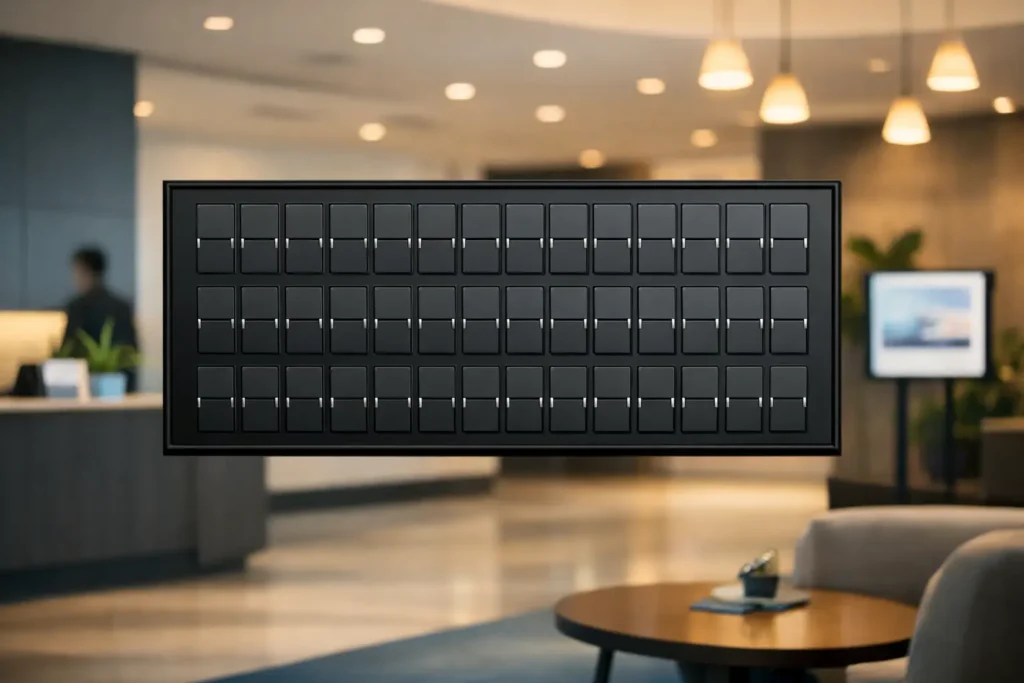
A lobby sign starts working before anyone speaks to the front desk. It tells guests where to go, reassures them they’re in the right place, and quietly answers the questions people ask over and over. So can a TV replace lobby signage? Yes, but only if you treat it like signage instead of just hanging a screen on the wall and hoping for the best.
That distinction matters. A consumer TV can absolutely display messages, schedules, directions, and branding. But a good lobby sign does more than show content. It sets a tone. It organizes attention. It reduces friction in the first few seconds of arrival. If the screen looks like an afterthought, the whole entrance can feel that way too.
Can a TV replace lobby signage in a real lobby?
In many spaces, yes. A TV can handle the core jobs of lobby signage remarkably well: welcome messaging, visitor instructions, event schedules, wayfinding, announcements, hours, Wi-Fi details, and branded visual atmosphere. For offices, boutique hotels, restaurants, bars, and retail spaces, that covers most of what a traditional lobby sign is there to do.
Where a TV often wins is flexibility. Printed boards, acrylic signs, easels, and handwritten notices freeze a message in time. The second your information changes, someone has to reprint, rewrite, tape over, or explain the correction in person. A screen turns that into a simple content update. If your happy hour shifts, your check-in instructions change, or a private event moves rooms, the sign can change with it.
That said, not every TV setup is a true replacement. If your lobby requires permanent architectural branding, such as a fixed logo wall or a code-compliant directory, a screen may support that system rather than replace it completely. Static signage still has strengths when you need a durable, always-on identity marker with zero dependence on power, software, or connectivity.
What a TV does better than traditional lobby signage
The biggest advantage is speed. Information changes fast in customer-facing spaces, and the front desk usually pays the price when signage falls behind. A screen lets you publish updates in minutes instead of rebuilding a sign by hand.
It also improves consistency. Many lobbies end up with one formal sign, three paper notices, a taped QR code, and a whiteboard near the entrance. Functionally, that works. Aesthetically, it rarely does. A single digital display can pull those messages into one controlled format so the space feels intentional rather than patched together.
Then there’s visibility. Motion catches the eye in a way static paper does not, even when the content is simple. This is especially true with split-flap style displays, where the familiar click-clack rhythm and mechanical look create a little moment of theater. It is not flashy in the modern billboard sense. It is text-forward, nostalgic, and disciplined. That restraint can be a strength in lobbies that want character without visual noise.
There is also the question of staffing. Every time a guest asks, “Where do I check in?” or “Is the conference on the second floor?” that is time your team spends repeating information that could have been presented clearly at the entrance. Better signage does not replace hospitality. It gives your staff more room to practice it.
Where a TV falls short
A TV is not automatically better just because it is digital. In fact, a poorly deployed screen can be worse than a simple printed sign.
Glare is a common problem. If the screen sits across from bright windows or under harsh lobby lighting, your message may become unreadable at the exact moment people need it. Size is another issue. A small TV with dense text mounted too high becomes background decoration, not signage.
There is also the temptation to overdesign. Lobby signage should clarify, not perform acrobatics. Busy animations, tiny fonts, and overloaded layouts can make a screen feel more like an ad than a useful arrival tool. This is one reason split-flap inspired content works so well in public spaces. It naturally favors short messages, bold hierarchy, and clean pacing.
Reliability matters too. If the setup depends on a USB stick, a borrowed remote, and someone remembering how to change inputs, it will eventually fail at the worst moment. A lobby sign needs to behave like infrastructure, not a side project.
The real question: consumer TV or signage system?
This is where many businesses get tripped up. They ask whether a TV can replace lobby signage, when the better question is whether a TV can become a signage system.
The screen itself is only one piece. You also need a simple way to control content, schedule updates, maintain the display, and design messages that fit the environment. Without that layer, a TV is just hardware.
For some businesses, a standard TV paired with the right signage software is enough. That setup can be practical, affordable, and visually strong if it is planned properly. For others, especially spaces that care deeply about atmosphere, the content style matters just as much as the content itself. A generic slideshow may communicate information, but it will not always elevate the room.
That is where a split-flap approach earns its place. Instead of trying to imitate flashy modern signage, it revives the public-display charm people already recognize from classic transit boards and departure halls. The result is less visual clutter and more presence. It feels premium because it is deliberate.
How to tell if a TV can replace your lobby signage
Start with the job your current signage is doing. If your lobby sign mostly shares changing information, a screen is usually a strong fit. If it needs to display schedules, rotating messages, hours, promotions, room assignments, or temporary instructions, digital wins on convenience alone.
Next, look at how often your team updates information. If you are printing fresh notices every week, crossing things out by hand, or fielding repeated questions that a sign should answer, you are already paying the cost of outdated signage. You are just paying in staff time, visual clutter, and small moments of customer confusion.
Then consider brand experience. For a boutique hotel, stylish office, restaurant entrance, or retail lobby, the sign is part of the room. It should feel designed, not improvised. A TV can absolutely deliver that, but only if the layout, motion, typography, and placement are considered together.
Finally, think about ownership. Who will update it? How fast can they make a change? Can they do it during a busy shift without needing technical help? The best signage system is the one your team will actually use.
What makes a TV-based lobby sign work
Placement comes first. Put the display where people naturally pause, not where it competes with every other surface in the room. Height, angle, and distance affect readability more than most businesses expect.
Content should be brief and structured. A lobby is not the place for paragraphs. Use short lines, clear headings, and obvious sequencing. If there are three things a visitor needs to know, show those three things cleanly.
Design should match the space. In polished interiors, generic templates can look cheap fast. A display with retro-modern styling often works well because it adds personality without feeling loud. Split-flap visuals are especially effective when you want something memorable that still respects the architecture around it.
Operational control is the final piece. Cloud-based scheduling, reusable layouts, and quick edits turn signage from a recurring chore into a manageable system. Buy a screen, download the app, publish your message – that is the level of simplicity most teams actually need.
So, can a TV replace lobby signage?
Yes, when the goal is clear communication with the freedom to update quickly. No, if you expect the screen alone to solve design, workflow, and visibility problems by itself.
The best TV-based signage does not try to be a living room television in a commercial space. It behaves like a well-designed sign: readable, reliable, on-brand, and easy to manage. And when it carries a little character – the click-clack rhythm, the old-school split-flap look, the sense that information can still have style – it does more than replace a sign. It makes the lobby feel alive.
If your entrance still relies on taped paper, static boards, or handwritten updates, a screen is not just a tech upgrade. It is a chance to make your first impression cleaner, calmer, and far more intentional.