
Digital Signage vs Printed Signs: Which Fits?
June 17, 2026 · Captain
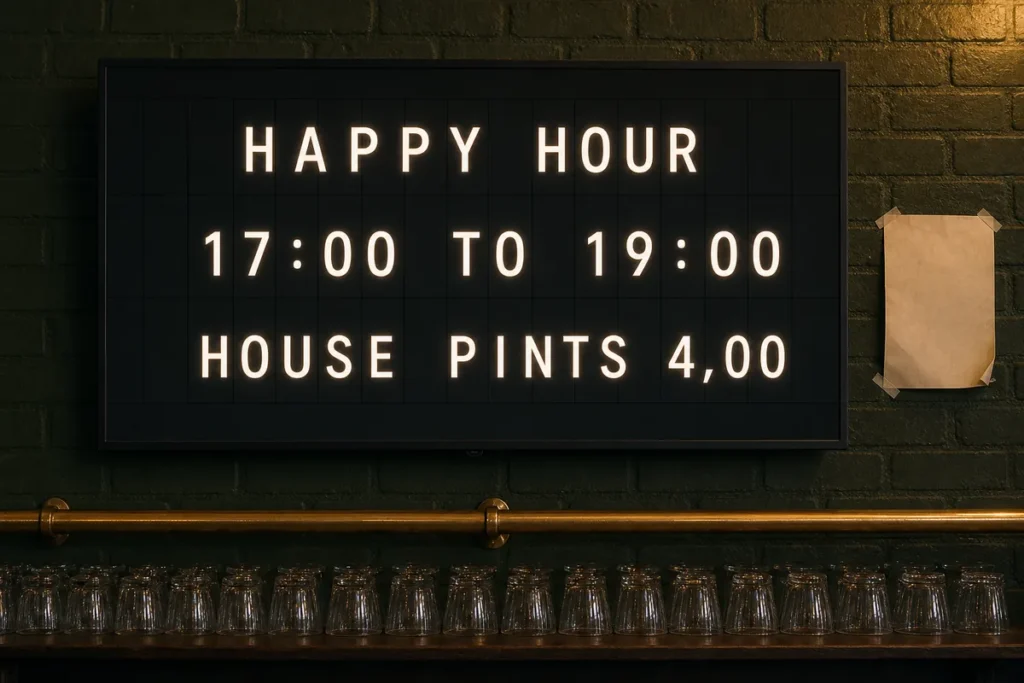
A lunch rush is the worst time to realize your printed sign is wrong. The soup changed, happy hour starts later, the Wi-Fi password was updated, and now someone is crossing out details with a marker while customers squint from the line. That is where the real difference in digital signage vs printed signs shows up – not in theory, but in the middle of a busy day when accuracy, speed, and presentation all matter at once.
For shop owners, restaurant teams, boutique hotels, and office managers, signage is not decoration. It answers questions before staff have to. It nudges people toward specials, directs foot traffic, sets the tone of the space, and keeps daily operations from slipping into chaos. The format you choose affects all of that.
Digital signage vs printed signs: the real trade-off
Printed signs still have a place. They are simple, familiar, and useful when the message is fixed for a long time. A permanent safety notice, a branded window decal, or a packaged promotional poster can do the job perfectly well. You print it, place it, and move on.
The trouble starts when the information changes often. Menus change. Events shift. Room assignments move. Store policies get updated. Seasonal promotions come and go. The more frequently your message changes, the more printed signage starts to create friction. Someone has to edit the file, send it to print, wait, replace it, and throw the old one away. If the update is urgent, the polished sign often turns into a taped-over correction.
Digital signage flips that equation. Instead of treating every content update like a small production project, it turns updates into a routine task. Change the message in an app, schedule it for later, publish it across one screen or several, and the display stays current without reprinting anything.
That convenience is not just operational. It changes how your brand feels in the room. A space with accurate, well-designed signage feels intentional. A space with outdated posters and handwritten fixes feels like it is catching up.
Related reading: Cloud Signage vs Static Posters: What Wins?
Where printed signs still make sense
This does not have to be a winner-take-all conversation. Printed signs are often the right tool for static communication. If a message will not change for months, print can be practical. It works well for compliance notices, long-term branding graphics, and one-time pieces where texture or material is part of the experience.
Print can also be effective when you need a very low-tech solution in a spot with no power, no screen, or no reason to update content. Not every wall needs to glow.
But the hidden cost of print is usually not the sign itself. It is the repetition. Reordering seasonal menus. Replacing damaged posters. Correcting outdated hours. Making a quick sign at the front desk because the polished version is no longer right. That cycle eats time, creates clutter, and slowly chips away at consistency.
Why digital signage wins in fast-moving spaces
If your business changes anything weekly, daily, or hourly, digital signage has a clear advantage. Restaurants updating specials, bars rotating events, hotels sharing welcome messages, retailers promoting limited inventory, and offices managing visitor information all benefit from content control that keeps pace with real life.
The biggest advantage is immediacy. You are not stuck with yesterday’s message because new materials have not arrived yet. You can update content before opening, during a shift, or automatically based on time of day.
The second advantage is consistency. When information lives in one system, you reduce the chance that the sign near the entrance says one thing while the sign at the register says another. For multi-screen setups, that matters even more.
The third advantage is visual presence. Not all digital signage needs to look like a bright ad wall. In fact, for design-conscious spaces, the best digital signage often feels curated rather than loud. A well-designed text-first display can be more elegant than a generic slideshow and far more polished than paper taped to a counter.
Digital signage vs printed signs for customer experience
Customers notice more than business owners think. They notice when a menu board looks outdated. They notice when the event schedule appears improvised. They notice when pricing is crossed out and corrected by hand.
That does not mean they are judging every sign like a designer. It means signage quietly shapes trust. Clean, current messaging makes a business feel organized. If the signage feels deliberate, customers assume the operation behind it is deliberate too.
This is where a split-flap style display earns its keep. Unlike modern digital signage built around motion graphics and high-impact visuals, split-flap displays are more restrained and text-led. That is a strength, not a limitation, when the goal is clarity with character. The familiar click-clack rhythm and transport-board aesthetic catch attention without overwhelming the room. It feels cinematic, but still useful.
For spaces that care about atmosphere, that matters. A boutique hotel lobby, café, wine bar, or office reception area may not want a conventional screen shouting for attention. A retro-modern split-flap display lands differently. It feels like part of the environment, while still doing the practical work of sharing changing information.
The maintenance question nobody loves
Printed signs seem low-maintenance until they are not. They curl, fade, tear, get moved, and become outdated at inconvenient moments. Then someone on the team has to stop what they are doing and fix it.
Digital signage has its own upkeep, of course. Screens need power. Content needs management. Someone has to decide what gets shown and when. But once the system is in place, the ongoing process is usually lighter than constantly producing and replacing physical signs.
That is especially true for businesses without an in-house design team. A system with ready-made layouts, scheduling, and remote control removes a lot of friction. It gives non-technical teams a way to keep communication sharp without turning every change into a project.
Choosing based on how your business actually runs
The better question is not which format is universally better. It is which one matches your pace.
If your messaging is mostly fixed, print is still useful. If your messaging changes often, digital signage saves time and keeps the customer-facing experience cleaner. If your space depends on a strong visual identity, the style of the display matters just as much as the delivery method.
That last point gets overlooked. Many businesses switch to digital because they need flexibility, then end up with a display that feels generic. The screen solves the update problem but creates a new atmosphere problem. For design-led spaces, that is a real trade-off.
A split-flap-inspired system offers a different path. It keeps the instant update advantage of digital signage, but presents information in a way that feels tactile, nostalgic, and memorable. You are not choosing between convenience and charm. You are combining them.
For businesses tired of handwritten signs, taped notices, and last-minute print fixes, that combination is powerful. It lets the signage work harder without making the space feel colder.
When a hybrid approach works best
Some of the smartest signage setups use both. Printed materials can handle permanent branding and static notices, while digital displays handle the information that changes most. That gives you stability where you need it and flexibility where you need it most.
A restaurant might keep printed brand elements in the window while using a digital board for specials and service updates. A hotel might use print for wayfinding plaques but digital displays for welcome messages and event schedules. A retail store might rely on printed packaging graphics while shifting promotional messaging to screens.
That is usually the most realistic answer in the digital signage vs printed signs debate. You do not need to replace every printed piece in your space. You need to identify which messages are draining time, creating inconsistency, or making the business look less polished than it actually is.
If a sign changes often, gets corrected by hand, or regularly sends staff back to the printer, it is probably asking to go digital. And if that digital experience can bring a bit of theater back into the room – a little click-clack, a little movement, a little old-school public display magic – it does more than share information. It gives people something worth looking up for.