
Best Hotel Lobby Message Displays That Get Seen
May 12, 2026 · Captain
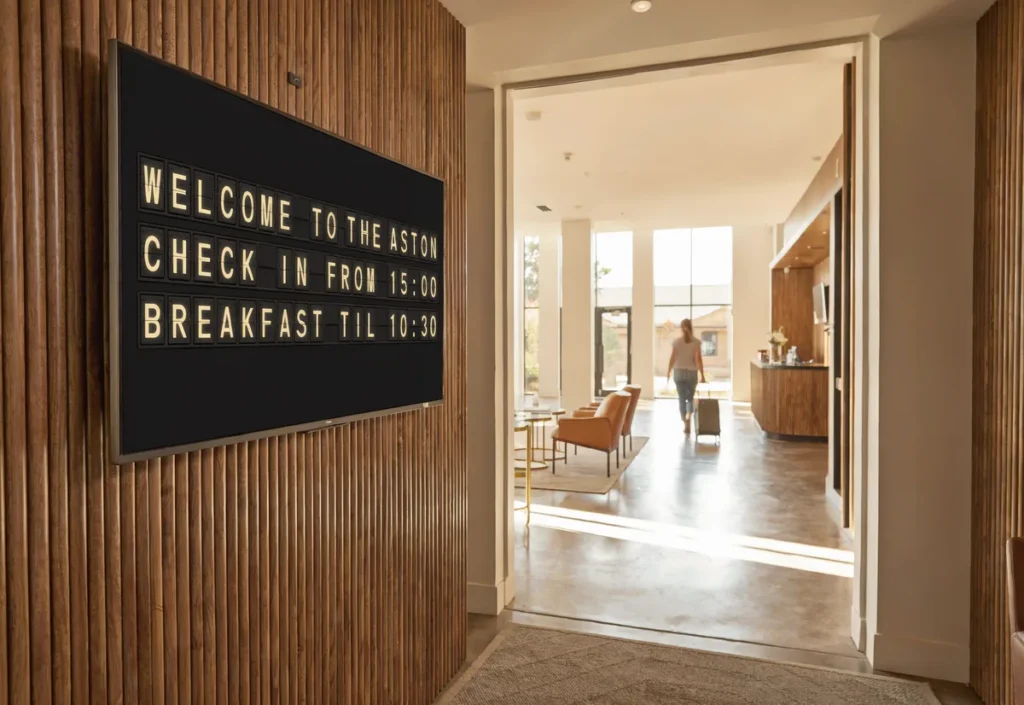
A hotel lobby has about three seconds to make sense. Guests walk in carrying bags, scanning for check-in, Wi-Fi details, breakfast hours, elevators, events, and anything that tells them they are in the right place. That is why the best hotel lobby message displays do more than fill a wall. They reduce friction, set the tone, and make information feel like part of the experience instead of an apology taped to the front desk.
For hotels, the challenge is not just showing information. It is showing the right information in a way that feels intentional. A luxury boutique property should not look like a conference room. A design-forward independent hotel should not rely on laminated signs curling at the corners. And a busy front desk team should not have to rewrite the same details five times a day.
What makes the best hotel lobby message displays work
The strongest lobby displays sit at the intersection of visibility, usefulness, and atmosphere. If a display is bright but generic, it may be easy to read and still feel out of place. If it is beautiful but hard to update, it quickly becomes stale. The best systems balance both.
In practice, that means guests should be able to absorb a message while walking, not stop and decode a cluttered screen. Text has to be concise. Layout matters. Content should rotate with purpose, not because the software can. A good lobby display tells guests what they need now, then supports the rest of the stay with timely updates.
There is also a brand question here. Hotels spend heavily on scent, lighting, furniture, and materials because atmosphere shapes memory. Messaging deserves the same standard. A screen is never just a screen in a lobby. It either supports the design language or breaks it.
Best hotel lobby message displays by use case
Different hotels need different display styles. A large full-motion promotional screen can make sense in some settings, but many properties benefit more from text-first displays that communicate clearly without overpowering the room.
Split-flap style displays for boutique and design-led hotels
If your lobby leans warm, curated, and memorable, split-flap style messaging has a rare advantage. It feels like hospitality. The old airport-and-station rhythm, the click-clack movement, the mechanical theater of letters changing in public – that visual language carries history, motion, and attention without demanding a giant glowing panel.
For hotel lobbies, that matters. A split-flap display can show check-in times, breakfast hours, bar specials, event schedules, shuttle updates, Wi-Fi prompts, or a welcome message in a format that feels elegant instead of corporate. It is especially effective in boutique hotels, historic properties, hospitality groups with a strong design point of view, and spaces where generic digital signage would look too slick for the room.
The practical advantage is that modern split-flap-style systems are still digital underneath. Staff can update content instantly, schedule messages by time of day, and keep communication centralized. So you get the visual charm of classic public information boards without the maintenance burden of mechanical hardware or the mess of manual signs.
Simple text displays for operational clarity
Some hotel lobbies need pure utility. Think airport-adjacent properties, business hotels, or high-traffic urban locations where guests want answers fast. In those settings, a text-led message display often outperforms image-heavy content.
Why? Because most lobby communication is functional. Breakfast hours. Late checkout reminders. Meeting room directions. Happy hour times. Weather alerts. Shuttle departures. Guests do not need animation for every message. They need legibility and confidence that the information is current.
This is where a restrained display format wins. Clean typography, high contrast, and a predictable layout reduce the mental load on guests and the update burden on staff.
Large-format branded displays for event-heavy properties
If your property hosts weddings, conferences, live music, or rotating public programming, you may need a display that can handle more than one type of content. Larger boards near the entrance or concierge desk can present event schedules, directional messages, and branded welcomes throughout the day.
Still, there is a trade-off. The more a display tries to do, the easier it is to lose clarity. A screen filled with logos, motion graphics, social feeds, and promotional panels may technically communicate more, but guests often retain less. Event-heavy hotels should favor hierarchy over volume. Put the most useful information first and let everything else support it.
Why text-first lobby messaging often performs better
Hotels sometimes assume a better display means more visuals. In reality, many lobby messages are strongest when they stay focused on text. A guest who wants to know whether breakfast ends at 10:00 or 10:30 does not benefit from a full-screen lifestyle image.
Text-first displays are often the best hotel lobby message displays because they fit the actual job. They answer repeated guest questions before those questions reach the desk. They help multilingual or distracted guests catch the essentials. And they keep the lobby from feeling like an ad channel.
There is also a style advantage. A well-designed text display can feel more premium than a generic promotional screen, especially in hospitality environments that care about texture, mood, and restraint. Done right, text becomes architectural. It belongs in the space.
What to show on a hotel lobby display
The best content is rarely complicated. What matters is timing and relevance.
In the morning, guests need breakfast hours, coffee service, weather, and local transit or shuttle information. In the afternoon, you might switch to check-in details, restaurant hours, rooftop or bar messaging, and meeting room directions. In the evening, valet notes, event schedules, and late-night dining options make more sense.
This is where scheduling matters. A static sign can only say one thing well. A managed digital display can rotate through useful messages by hour, day, or event schedule without creating clutter. That keeps the content fresh while reducing the temptation to tape extra notices around the lobby.
The sweet spot is a curated set of recurring messages with room for live updates. If a private event changes a restaurant entrance, guests should see it immediately. If a storm affects transportation, the message should be updated before the line forms at the desk.
How to choose the right display for your hotel
Start with the room, not the hardware. A display has to fit the lobby’s character. In a polished, quiet space, a loud commercial-style screen can feel wrong even if it is technically impressive. In a busy, modern property, a smaller understated display may disappear when it needs to lead.
Then think about who updates it. If the system requires too many steps, your team will avoid it. The right setup should let staff change a message quickly during a shift, schedule content in advance, and maintain consistency without design training.
Placement matters just as much. A beautiful display tucked behind a plant does nothing. The best positions are near natural pauses – entrance sightlines, check-in approach, elevator waiting zones, and bar or concierge adjacencies. Guests notice displays when they have a second to look, not while they are navigating luggage around furniture.
Finally, be honest about content discipline. If your team has a clear message strategy, a flexible display becomes a real operational tool. If everyone adds one more notice, even the best system turns noisy.
Where split-flap style displays stand out
Split-flap style displays are especially strong when a hotel wants communication to feel like part of the brand experience. They are not trying to imitate modern ad screens. That is the point. They create a different kind of attention – slower, warmer, more tactile, even on digital screens.
For hospitality, that difference can be powerful. Guests remember what feels specific. A classic split-flap board showing welcome messages, amenities, or evening programming does not read like generic signage. It feels chosen.
That does not mean it fits every property. If your hotel relies on photo-heavy promotional content or needs highly visual wayfinding maps, a text-led split-flap format may be too restrained. But if your messaging is mostly operational and your brand values atmosphere, character, and clarity, it can be one of the smartest choices in the lobby.
Modern systems also remove the usual friction. With a platform like Split Flap TV, hotels can keep the retro charm and signature click-clack effect while updating content instantly from an app, scheduling messages across the day, and avoiding the cycle of printed signs, handwritten notes, and last-minute replacements.
A lobby display should earn its place. It should calm the arrival, answer questions before they are asked, and make the space feel more considered. When that happens, guests may not comment on the signage itself. They just feel that the hotel has its act together – and that is usually the first impression worth designing for.
Give each screen one job in the guest journey
One large board in the lobby helps, but several small, well-placed screens often communicate better than a single overloaded one. The trick is to match each screen to what guests need at that exact point in their stay, and to keep its content to that job.
- Front desk: Wi-Fi network details, checkout time, luggage storage, valet timing, and where to find coffee. A smaller screen supports the welcome from staff instead of competing with it, and it saves the team from rewriting a chalkboard every time a password changes.
- Elevator landings: guests wait here, so it is a good spot for one thought at a time, such as happy hour, a gallery opening, a yoga class, or a checkout reminder. Shift the message with the day, from coffee in the morning to evening plans later on.
- Restaurant, bar, or breakfast room: service hours, a sold-out item, a live music start time, or a menu change. A split-flap board handles words and timing, not food photography, so leave the full menu to print and staff.
- Event and meeting areas: welcome a group by name, show the day’s agenda, and update a room change instantly. Scheduled pages can move from setup notes to the welcome to the next session without anyone having to remember each switch.
An arrivals board layout that works
For properties that want an arrivals board, a simple split-flap structure works well. Use the top row for the hotel name or a short line such as WELCOME ARRIVALS TODAY. Below it, set out a few columns: guest or group name, arrival time, room status, and a short note such as CHECK IN AT DESK, WELCOME BACK, BAG HOLD OK, or EVENT CHECK-IN.
Consistency is what makes it look high-end. Pick a small set of status terms and stick to them. If one row says READY and another says ROOM READY NOW, the board starts to look improvised. Resist adding checkout details, restaurant hours, and weather to the same screen; rotate pages or give those messages to another display.
Think carefully about personal details. Showing full surnames with room-specific notes can feel thoughtful, but it raises privacy and staffing concerns. Many hotels are better served by first names, group names, or a general arrival status. Make sure someone, usually front desk leadership or operations, owns the board, because an arrivals list that falls behind works against you.
Readability comes before screen size
Bigger is not automatically better. Choose the screen size for the viewing distance, the scale of the wall, and the number of characters you plan to show. A board read from across the lobby needs larger letters and fewer words, while one beside an elevator can be smaller because people stand closer to it.
Light matters as much as dimensions. A screen facing bright street windows can wash out at exactly the moment guests need it, and an overly bright screen can spoil a dim cocktail bar. Test the spot at the time of day guests will actually use it. Wide layouts suit schedules and welcome lines; tall formats fit tight walls but tempt teams to stack too much text. Keep time formats consistent across screens too. If the property uses AM and PM, do not switch one display to 24-hour time because it looks tidier.
Treat the click-clack sound as a choice for each space. It can add energy to a lively lobby or social breakfast room, while silent animation usually suits a quiet property, areas near guest rooms, or early-morning service. Every message should still work with the audio off.
Schedule the routine, keep control of the exceptions
Much of hotel communication repeats and can be automated. Breakfast is a good example: set a weekday schedule once, create a weekend version, and prepare holiday pages in advance, so the display moves from weekday to weekend hours without anyone touching it. Automation should never make the board rigid, though. When the kitchen pauses service, a private event takes over a room, or weather changes outdoor plans, an authorized manager needs to publish the change straight away from wherever they are.
Split the ownership the same way. Give one person or role the standard schedule, and let a small group make urgent changes. Agree on wording for recurring situations, and write for someone who has just arrived: “Breakfast 7-11 AM, Garden Room” beats “Breakfast Service,” and “The terrace is closed due to rain” beats internal jargon. Before publishing, ask three questions. Can a guest read this from several feet away? Does it answer a question staff hear again and again? Is it still accurate if this is the only page someone sees?
Keep some traditional signage too. A TV or tablet can carry the changing layer of hotel information, but emergency instructions, legal notices, code-compliant directories, and detailed wayfinding often still need permanent formats. The screen should also run like infrastructure, not a side project. A setup that depends on a USB stick and someone remembering which input to pick will eventually fail at a bad moment.