
Why Retro Digital Signage Still Works
March 16, 2026 · Captain
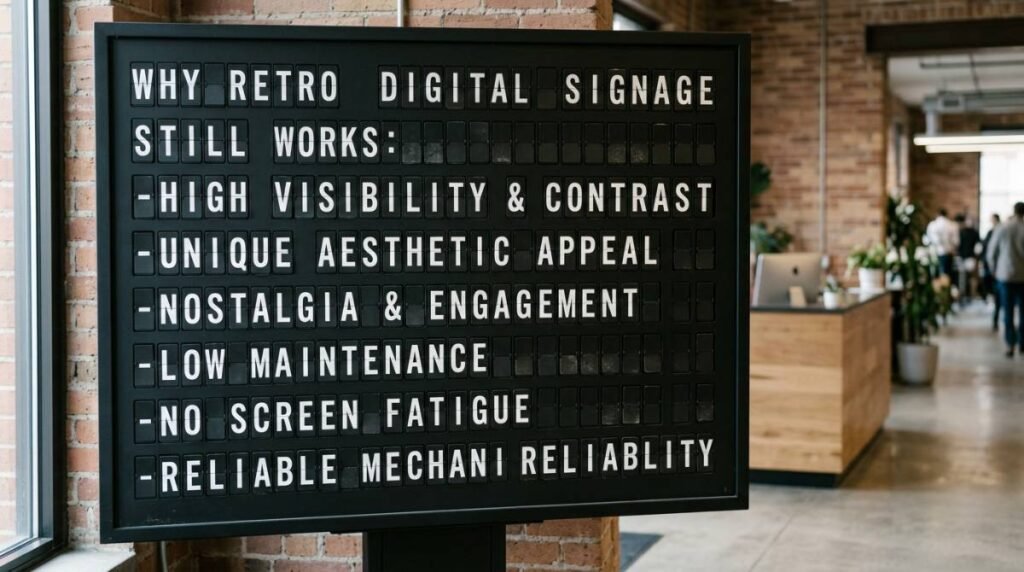
A handwritten specials board can have charm for about five minutes. After that, it starts collecting smudges, crossed-out prices, and the same customer questions your staff answered all morning.
That is where retro digital signage earns its place. Not by trying to look like every glossy screen in every chain store, but by bringing back a format people actually notice – the split-flap board. The familiar click-clack rhythm, the disciplined rows of text, the feeling of movement before the message lands. It feels cinematic, but it solves a very practical problem: how to keep information current without turning your space into a cluttered patchwork of paper signs.
What retro digital signage actually means
Retro digital signage is not just any screen with a vintage font. In the most compelling version, it recreates the look and pacing of classic split-flap displays using modern screens and software. That means you get the visual character of old transportation boards and hotel message displays, but without the mechanical upkeep or the limits of fixed hardware.
This distinction matters. If you are running a cafe, bar, boutique hotel, or office lobby, you are not shopping for a nostalgia prop. You need a working signage system that updates quickly, stays legible, and fits the tone of the room. A retro-styled split-flap display does that by narrowing the visual language down to what people need most: clear text, strong structure, and motion that earns attention rather than demanding it.
In other words, this is not “modern digital signage with a retro skin.” It is its own category. More restrained, more text-driven, and often more elegant in environments where giant animations and bright promotional graphics would feel out of place.
Why retro digital signage stands out in public spaces
Most digital screens compete by getting louder. More color. More movement. More layers. That can work in high-volume retail, but in many customer-facing spaces it creates visual fatigue. People stop looking because everything is trying too hard.
Retro digital signage works differently. It uses anticipation. The flip animation slows the moment just enough to make people glance up. Then the message arrives in a clean, organized format that feels intentional. For businesses, that translates into better visibility for information that usually gets ignored when printed on a taped sheet near the register.
There is also an emotional component that standard displays rarely achieve. Split-flap visuals carry memory. Airports, train halls, old hotels, civic spaces – these displays were once part of the public rhythm of daily life. Bringing that feeling into a modern venue gives your signage more presence. It feels designed, not improvised.
That can shape how customers read your business. A sharp split-flap display suggests care, order, and taste. It tells people you thought about the experience, not just the message.
Where retro digital signage makes the most sense
This style is especially strong in spaces where atmosphere matters as much as information. Restaurants and bars can use it for rotating specials, happy hour prompts, event nights, and pickup instructions. Boutique hotels can use it in lobbies for welcome messages, local tips, breakfast hours, and wayfinding. Retail shops can feature store hours, promotions, fitting room policies, or simple brand statements without adding visual noise.
Offices are another smart fit. A split-flap style display in a reception area can show visitor greetings, meeting schedules, Wi-Fi details, internal announcements, or room status in a way that feels far more polished than a laminated sign on a desk.
The common thread is that these businesses need to change information often, but they do not want the space to feel temporary or chaotic.
The practical advantage behind the nostalgia
The appeal starts with the look, but the real value comes from the workflow.
Traditional signs create hidden labor. Someone has to rewrite the board, print the notice, tape it up straight, remember to take it down, and repeat the process every time details change. During a busy shift, that task either gets skipped or done fast, which usually means the sign looks rushed.
With a modern split-flap system, updates can be made from an app with far less friction. You can change a menu item, update a promotion, post a private event notice, or schedule tomorrow morning’s message before you leave for the night. That is a meaningful operational improvement, especially for small teams.
There is also a consistency benefit. When every message runs through the same layout and visual logic, your communication looks more considered. Even simple text like “Kitchen closes at 9” or “Ask about seasonal cocktails” feels part of the brand rather than an interruption to it.
That said, retro digital signage is not the right tool for everything. If you need heavy video content, detailed product grids, or image-led advertising, a standard high-impact display may be a better fit. Split-flap style signage is strongest when the message is short, timely, and text-first. Knowing that helps businesses use it where it performs best instead of asking it to do every job in the building.
Retro digital signage and the split-flap effect
The split-flap effect is what gives this format its edge. It is not just decorative movement. It creates a tiny moment of theater around a message.
When a line flips into place, people tend to wait for the result. That pause is useful. It draws attention to updates that would otherwise disappear into the background. A static paper sign saying “Now serving brunch” can be missed for hours. A split-flap transition announcing the same thing gives the message presence.
There is a sensory dimension too. The optional click-clack sound adds familiarity and atmosphere when it suits the environment. In some spaces, that audible cue becomes part of the brand experience. In others, silent mode is better. That flexibility matters because the right signage should support the room, not overpower it.
Good retro digital signage respects that balance. It keeps the display engaging without making it feel gimmicky.
What to look for in a system
If you are considering this style for your business, focus less on novelty and more on control. The best setup should let you manage layouts, rows and columns, page timing, colors, scheduling, and live content with very little training. That is what turns a beautiful display into a useful one.
Installation should be simple too. For many businesses, the sweet spot is a plug-and-play screen or tablet setup that does not require specialized AV planning. If your team can unbox the display, connect it, and start publishing messages quickly, the system has a much better chance of becoming part of daily operations.
It also helps to think about placement early. Split-flap style signage performs best where customers naturally pause – at the host stand, behind the bar, near the entrance, in a lobby, or at reception. Because the format is more text-led than image-led, sightlines and reading distance matter. A well-placed smaller display can outperform a larger one stuck in the wrong corner.
For businesses that want a refined version of this experience, Split Flap TV brings the classic Solari-style feel to modern screens with cloud-based control, customizable layouts, and the signature click-clack effect that makes people look twice.
Why this format keeps getting shared
Some signage gets seen. Some signage gets remembered. Retro digital signage often does both.
It photographs well because it has a point of view. It feels distinct in social posts, inside design-forward interiors, and in customer videos shot on the fly. That matters for brands that want their physical space to do more than relay information. A good display can become part of the setting people associate with your business.
But the reason it lasts is not social media. It lasts because it solves a real communication problem with more grace than paper signs and more personality than generic screens.
If your space needs to communicate changing information every day, the best sign is not always the flashiest one. Often, it is the one people actually stop to read – and the one your team can update before the next rush without thinking twice.
That is the quiet power of retro digital signage. It brings back a beloved public display language, then makes it useful again for the way businesses actually run now. And that combination of charm and control is hard to ignore.