
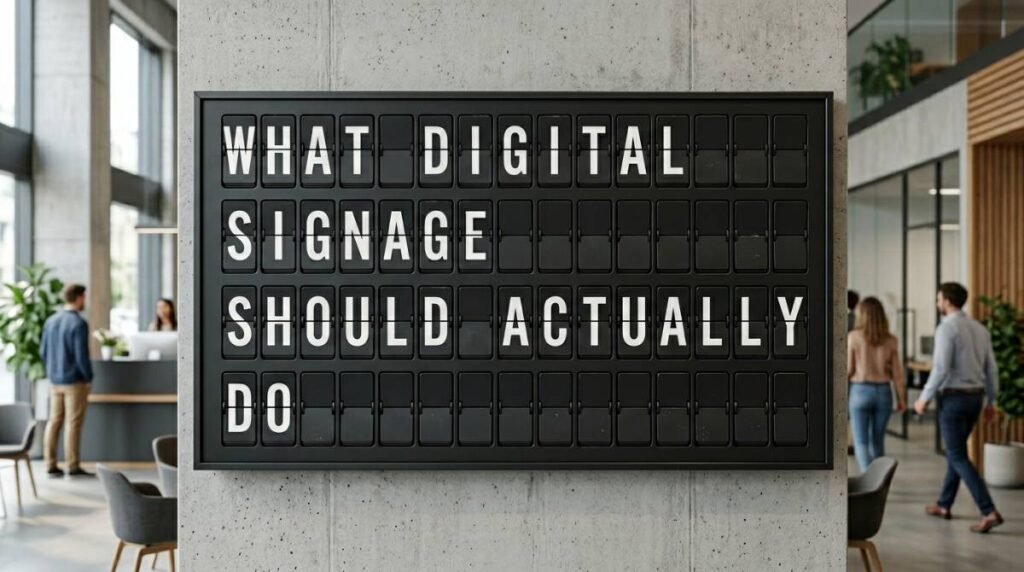
What Digital Signage Should Actually Do
March 10, 2026 · Captain
A taped-up paper sign tells customers one thing before they even read it: this message was added in a rush.
That might be fine for a back room. It is not fine at a host stand, above a bar, beside a hotel check-in desk, or in a shop that has worked hard to get every other visual detail right. The problem is not just appearance. Static signs go out of date, get ignored, and create extra work for staff who are already juggling service, questions, and constant changes.
That is where digital signage earns its place. Not as decoration, and not as a giant slideshow bolted to the wall. Good signage should reduce friction, keep information current, and make a space feel more intentional the moment someone walks in.
What digital signage is really for
At its best, digital signage is a communication system disguised as part of the environment. It helps businesses publish the right message in the right place at the right time, without printing, handwriting, taping, or explaining the same thing all day.
For a cafe, that might mean rotating specials between breakfast and lunch. For a boutique hotel, it might mean sharing check-in notes, event times, or Wi-Fi details without crowding the front desk with placards. For an office manager, it could be meeting room schedules, visitor messaging, or internal announcements that need to change fast.
The value is practical first. Staff spend less time updating signs manually. Customers get clearer information. Spaces look cleaner. But there is also a brand layer to it. The way information appears affects how people read the business itself. A polished display suggests the operation behind it is equally organized.
Why most digital signage gets ignored
A lot of screens fail because they behave like bad TV. They are too bright, too busy, too generic, or too stuffed with content. Movement alone does not create attention. In fact, constant motion can train people to tune a display out.
The better approach is restraint. Show one message clearly. Use timing that feels deliberate. Make the layout fit the room and the use case. If customers need to glance up and understand something in two seconds, the display should be built for that reality, not for a marketing team trying to cram in every idea at once.
This is where style matters more than many businesses expect. Familiar visual formats are easier to process. Displays inspired by classic split-flap boards work especially well because the format was built for public readability. Rows, columns, structured information, and rhythmic transitions all help people notice the update without feeling bombarded by it.
There is a reason those old departure boards still live in people’s memory. The click-clack, the anticipation, the brief pause before the next reveal – it turns information into a moment. When that feeling is revived on modern screens, you get the charm without the mechanical upkeep.
Digital signage works best when it solves a real operational problem
If you are considering signage for your business, start with the recurring headache, not the hardware.
Do customers keep asking for the Wi-Fi password? Are staff rewriting menu items during every shift? Do prices, hours, room assignments, events, or announcements change often enough that printed signs are always lagging behind? Those are strong signals that the old system is costing more than it seems.
The hidden cost of analog signage is not just paper or printing. It is inconsistency. One sign says one thing, another sign says something slightly different, and staff have to fill the gaps. That creates confusion for customers and friction for employees.
Digital signage gives you a single source of truth. Update the message once, publish it, and move on. If your platform includes scheduling, templates, and remote control, the benefit compounds. You can change breakfast to dinner messaging automatically, swap event details for the weekend, or push seasonal content across multiple displays without touching each screen.
That matters most during busy hours, when nobody has time to find a marker, fix a typo, or reprint a sign that changed an hour ago.
The format changes the feeling
Not all displays say the same thing about a business.
A generic screen with stock templates can feel clinical, even when the information is useful. For some environments, that is fine. In others, it works against the atmosphere. Restaurants, bars, boutiques, hospitality spaces, and design-conscious offices need communication tools that belong in the room.
That is why the split-flap style has staying power. It carries history, but it does not feel stuck in the past. Done well, it reads as both nostalgic and current – a rare combination. It catches attention because it feels tactile, even on a modern TV or tablet. It is digital signage with character.
That character is not just aesthetic. It can become part of the customer experience. A specials board that flips to the next item feels more memorable than a static slide. A lobby display with changing event information feels curated rather than improvised. The screen is doing a job, but it is also adding atmosphere.
For brands that care how a space feels, that difference is not minor. It is the difference between information that blends into the background and information people actually notice.
What to look for in a digital signage setup
Ease of use should be near the top of the list. If updating content requires an AV specialist, the system will eventually sit stale. The best setups are simple enough for a manager to change from a phone or laptop between other tasks.
Flexibility matters too. A display should not lock you into one rigid format. You may need one board for menus, another for welcome messaging, and another for schedules or promotions. Layout options, page controls, color choices, timing controls, and live content feeds make the system more useful over time.
There is also a trade-off worth acknowledging. Highly customized signage can look better and fit the space more naturally, but it should not become complicated to maintain. The sweet spot is a platform that feels designed, not fussy. Plug-and-play hardware with app-based control usually gets businesses closer to that balance.
For many operators, this is the appeal of solutions like Split Flap TV. You get the signature split-flap look and sound, but on modern screens that are easier to install, easier to manage, and easier to update from anywhere.
Where digital signage has the biggest payoff
Hospitality is an obvious fit because information changes constantly and first impressions matter. A hotel lobby, cafe counter, wine bar, or bakery all benefit from signage that can shift with the day while still looking polished.
Retail works well too, especially when messaging changes with inventory, promotions, events, or seasonal campaigns. A strong display can answer common questions before customers ask them, while also reinforcing the store’s visual identity.
Offices and shared spaces are another smart use case. Meeting schedules, guest greetings, announcements, and wayfinding often end up on paper because they change too often for permanent signage and too quickly for design teams to handle manually. A cloud-managed display bridges that gap.
The common thread is simple: digital signage pays off fastest in places where information changes often and presentation matters.
The best screen is the one people trust
Customers notice when a sign is wrong. They also notice when a display consistently gives them what they need. That reliability builds trust in small, quiet ways.
If your menu board is always current, people stop double-checking. If your event schedule updates on time, guests follow it. If your welcome display is clear and elegant, the whole arrival feels smoother. Good signage reduces uncertainty, which makes service feel better even before a staff member says hello.
That is the real standard to use. Not whether a screen is flashy, but whether it makes the space clearer, calmer, and more distinct.
A well-designed sign should feel like part of your business at its best: current, thoughtful, and easy to understand. If it happens to arrive with a little retro click-clack charm, all the better.
Related reading: Digital Signage vs Printed Signs: Which Fits?