
Digital Menu Boards Price: 2026 Cost Guide for Restaurants
March 26, 2026 · Captain
Digital Menu Boards Price: 2026 Cost Guide for Restaurants
If you’re considering switching from paper menus to digital boards, you’re probably wondering what this technology actually costs. The short answer: digital menu boards price ranges from under $500 for a bare-bones single-screen setup to $10,000+ for a multi-screen commercial installation with enterprise software and professional support.
This guide is designed for restaurant owners and managers who want to understand the full cost breakdown of digital menu boards and make informed budgeting decisions. The cost of digital menu boards can vary greatly depending on the type of display, hardware, and content management system used.
This guide breaks down exactly what you’ll pay in 2026, from hardware and software to installation and ongoing maintenance, so you can budget accurately for your restaurant.
Introduction to Digital Menu Boards
Digital menu boards are transforming the way restaurants, cafes, and food service businesses present their offerings. Unlike traditional paper menus, digital menu boards use digital signage technology to display menu items, prices, and promotions on vibrant screens. This modern approach allows for real-time updates, so you can instantly adjust prices, swap out menu items, or highlight daily specials with just a few clicks.
Related reading: What Are Digital Menu Boards
To set up a digital menu board, you’ll need a TV, a digital signage solution, and a digital signage player. The type of signage software you choose factors into digital menu board pricing and affects the overall setup.
With digital signage software, managing your digital menu becomes simple and efficient—whether you’re updating a single board or coordinating displays across multiple locations. The flexibility of digital menu boards means you can easily tailor your content to match the time of day, season, or special events, enhancing the overall customer experience.
Several factors influence the cost and setup of digital menu boards, including the type and size of display, the software and hardware you choose, and the level of interactivity you want to offer. Whether you’re looking to boost sales, streamline operations, or simply modernize your restaurant’s look, digital menu boards are a great solution that can be installed and managed to fit your unique business needs.
Benefits of Digital Menu Boards
Increase Sales and Engagement
Digital menu boards offer a host of benefits that can make a real difference to your restaurant’s bottom line. One of the biggest advantages is their ability to drive sales and increase customer engagement. By showcasing high-quality images and videos of your menu items, or using eye-catching split-flap price displays, digital menu boards can entice customers to try new dishes or add on extras, leading to higher average tickets.
Improve Customer Experience
Another key benefit is the improved customer experience. Digital menu boards provide real-time updates, so customers always see accurate prices, current promotions, and available menu items—reducing confusion and wait times. This dynamic approach also allows you to quickly respond to changes, such as updating prices or swapping out sold-out items, without the hassle and expense of reprinting paper menus.
Reduce Costs
Over the long run, digital menu boards are a cost-effective solution. They eliminate ongoing printing costs and reduce waste, while giving you the flexibility to update your menu as often as needed. With the ability to display engaging content, run time-limited promotions, and keep your menu fresh, digital menu boards help you stay competitive and relevant in a fast-changing industry.
Digital Menu Boards Price Overview (Answer the Question Fast)
For indoor digital menu boards in North America during 2026, expect to pay anywhere from $500 for an inexpensive, basic DIY single-screen setup to $4,000–$10,000+ for multi-screen commercial-grade systems with professional installation and enterprise content management software. A complete digital menu board solution can cost between $500 and $2,000+, depending on the TV and service provider. Interactive digital menu boards can cost between $3,000 to $10,000 per unit, depending on features and hardware.
Here’s what real-world packages typically look like:
- A single 43” TV paired with entry-level digital signage software and a low-cost media player runs approximately $600–$900 total (hardware only, self-installed).
- A three-screen 55” commercial menu wall with a mid-tier CMS, professional mounts, and installation typically costs $5,000–$8,000.
Digital menu boards can be configured in portrait, landscape, or video wall formats to suit different restaurant needs.
Most independent cafés and quick service restaurants spend around $1,200–$3,000 per location for a reliable indoor setup that includes decent screens, players, basic software, and professional or semi-professional installation.
Your total digital menu boards cost depends on four main drivers:
- Display screens (consumer TVs or commercial panels)
- Media players or System-on-Chip displays
- Digital signage software subscriptions
- Installation, mounting, and maintenance
The rest of this guide unpacks each of these factors with specific 2026 pricing so you can plan your budget accurately.
What Makes Up the Cost of a Digital Menu Board?
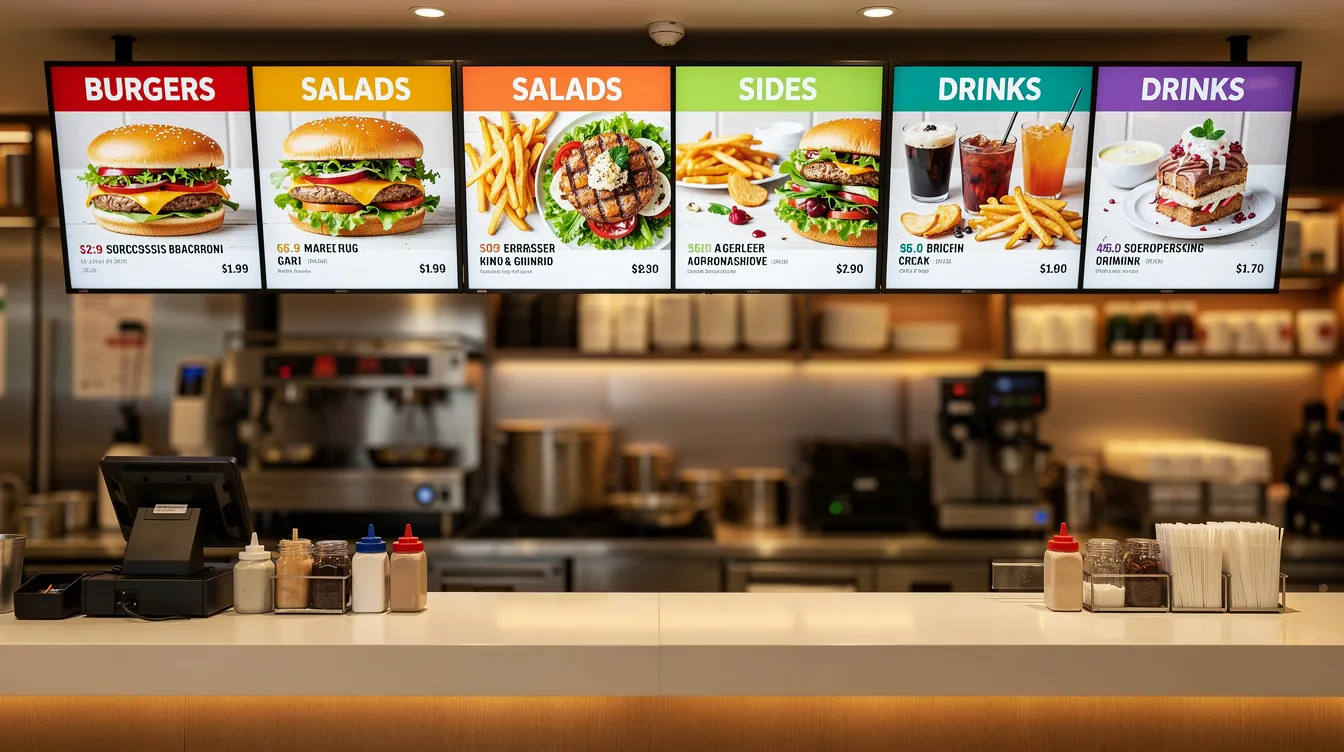
Digital menu board pricing breaks into two categories: one-time upfront costs (hardware, installation) and recurring operational costs (software licensing, content updates, occasional replacements).
Understanding this distinction helps you forecast both your initial investment and your ongoing monthly expenses.
Key Components of Digital Menu Board Pricing
The four key components are:
- Display Screens – Consumer TVs or commercial digital signage panels. One-time purchase.
- Media Players – External devices or built-in SoC chips that run your menu content. One-time purchase.
- Digital Signage Software/CMS – Cloud-based content management system for scheduling and updates. Recurring monthly or annual subscription.
- Mounting and Installation – Brackets, labor, cabling, configuration. Mostly one-time, with minor ongoing maintenance.
Display Screens
Realistic 2026 breakdown for a small fast-casual restaurant (per screen):
|
Component |
Typical Cost Range |
|---|---|
|
Display screen |
$400–$900 |
Media Players
|
Component |
Typical Cost Range |
|---|---|
|
Media player |
$80–$350 |
Digital Signage Software/CMS
|
Component |
Typical Cost Range |
|---|---|
|
Software/CMS |
$8–$40/month |
Mounting and Installation
|
Component |
Typical Cost Range |
|---|---|
|
Installation |
$250–$800 |
Additional costs can include professional menu design, network upgrades (routers, switches, access points), cabling and conduit, and extended warranties. Budget an extra $200–$600 per location for these incidentals if you want a polished, code-compliant installation, especially if you’re deploying a managed digital signage solution like Split Flap TV’s screen and app bundle.
Digital Menu Board Hardware: TVs, Commercial Displays, and LEDs
The display hardware typically represents your largest upfront expense. Screen size, brightness rating, and durability determine how much you’ll pay. There are different types of TV technology used for digital menu boards, including LED screens, Fine Pixel Pitch LEDs, and professional digital signage displays, each offering unique features and price points.
Consumer TVs
- Work well for small businesses with limited budgets.
- Affordable but designed for home use (4–8 hours daily), so running them 12–16 hours in a restaurant shortens their lifespan.
- Best for small cafés, coffee shops, or food trucks.
- LED-LCD digital boards in this category use LCD screens as the background to generate light that produces high-quality images.
Commercial Digital Signage Displays
- Built for public spaces with 16/7 or 24/7 operation ratings, higher brightness (400–700 nits), robust cooling, and 3-year warranties.
- Standard for quick service restaurants and fast-casual chains.
- LED-LCD digital boards here also use LCD screens as the background to generate light that produces high-quality images.
LED Panel/Video Wall Systems
- Use modular tiles to create seamless, high-brightness menu walls.
- Typically reserved for flagship locations, mall food courts, and large QSR brands due to significantly higher costs.
2026 consumer TV price ranges for menu boards:
- 40–43” Full HD/4K TV: roughly $260–$450
- 49–50” TV: roughly $360–$550
- 55” TV: roughly $450–$800
- 65” TV: roughly $650–$1,100
Commercial display price ranges:
- 43” commercial signage display: approximately $700–$1,200
- 49”/50” commercial display: approximately $800–$1,300
- 55” commercial display: approximately $900–$1,600
- 65” commercial display: approximately $1,300–$2,000+
Brightness matters. LCD screens with 500+ nits handle window-facing installations and bright interiors much better than standard 300-nit consumer panels. Higher brightness costs more but prevents washed-out images during peak daylight hours.
Fine-pitch indoor LED menu walls (1.8–2.5 mm pixel pitch) run approximately $2,500–$6,000+ for an assembled menu-wall-size area. These deliver stunning visuals and no bezels, but the price point limits them to larger brands.
In 2026, many QSR chains standardize around triple-screen 49” or 55” landscape configurations. Hardware costs for displays and mounts in these setups typically land at $3,000–$5,000 before adding players and installation.
System-on-Chip (SoC) displays are also popular, as they have built-in media players, reducing the need for external devices. Similarly, Smart TVs can serve as all-in-one digital signage displays with integrated media players, simplifying setup and reducing costs for digital menu boards.
Digital Signage Players and System-on-Chip (SoC) Displays
A digital signage player is the device (or integrated chip) that decodes and displays your menu content. Think of it as a small computer dedicated to running your digital menu.
2026 player price ranges:
- Basic HDMI stick players (Android-based, entry-level): approximately $70–$150
- Mid-range dedicated media players (quad-core, 4K support): roughly $150–$350
- High-end industrial players (video walls, 24/7 rugged use): $400–$900+
System-on-Chip (SoC) displays integrate the player directly into the screen. Samsung Tizen and LG webOS commercial panels include built-in computing that runs CMS apps natively. SoC displays typically cost $150–$400 more than comparable non-smart panels but eliminate external media players entirely.
Reliable digital menu boards should be able to continue displaying content even if the internet connection is temporarily lost, ensuring uninterrupted operation.
For small restaurants, typical setup choices include:
- One player per screen – Simpler to manage, easier to replace individual units, but more devices and potentially more software licenses.
- One player driving multiple screens – Uses HDMI splitters or video wall-capable players, reduces hardware count, but creates a single point of failure.
Many SaaS providers certify specific players and sometimes subsidize hardware with annual subscription commitments. Yodeck, for example, offers players free or at reduced cost with annual plans, and specialized ecosystems like the Split-Flap TV App Marketplace add integrations and automation tools that keep content fresh with less manual work.
Digital Signage Software Cost and Features
Your content management system controls menu scheduling, content updates, and device monitoring. Monthly per-screen pricing is where ongoing costs accumulate.
Software Pricing Tiers
2026 software pricing tiers:
|
Tier |
Monthly Cost (per screen) |
Features |
|---|---|---|
|
Entry-level |
$8–$15 |
Basic playlists, images, videos, simple templates |
|
Mid-tier |
$20–$40 |
Day-parting, multi-location control, POS integration |
|
Enterprise |
$50–$120+ |
Analytics, data integrations, advanced user roles, kiosk support |
|
Annual prepayment typically saves 10–20%. Multi-year contracts can lock in 2025 pricing through 2026 and beyond. |
|
|
Must-Have Features for Restaurant Use
- Easy menu editing without needing a designer
- Scheduled menus (automatic breakfast/lunch/dinner switching)
- Price syncing with your POS system
- Remote updates across multiple locations
- User permissions separating corporate and store-level control
Factor in your screen count carefully. Three screens at $20/month each means $60/month per location. For a 10-location chain, that’s $600/month in software alone.
Free or freemium options exist (often limited to one screen or watermarked), which can work for testing or very small operations. Expect limited support and reliability compared to paid plans.
Ongoing Content Design and Update Costs
Software pricing is predictable, but many restaurants underestimate the time and money required to keep menu content current. Graphic design services or DIY graphic creation tools can be used to create visually appealing digital menu boards. Digital menu boards also allow for real-time updates of menu items and prices, ensuring that customers always see the most current offerings. Dynamic content only delivers value if it stays accurate.
2026 design cost examples:
- Freelance designer creating a full digital menu set (3–4 screens): typically $250–$800 for initial design
- Monthly design retainer for ongoing updates: approximately $100–$400 depending on frequency
DIY approaches using Canva, Adobe Express, or Figma cost $0–$60/month in software subscriptions. The trade-off is staff time and design skill requirements.
Budget at least a few hours per month for menu upkeep, whether in-house or outsourced. Accurate pricing, updated photos, and current promotions ensure your digital investment actually pays off. Neglected screens with outdated prices undermine customer experience and staff efficiency.
Installation, Mounting, and Hidden Costs
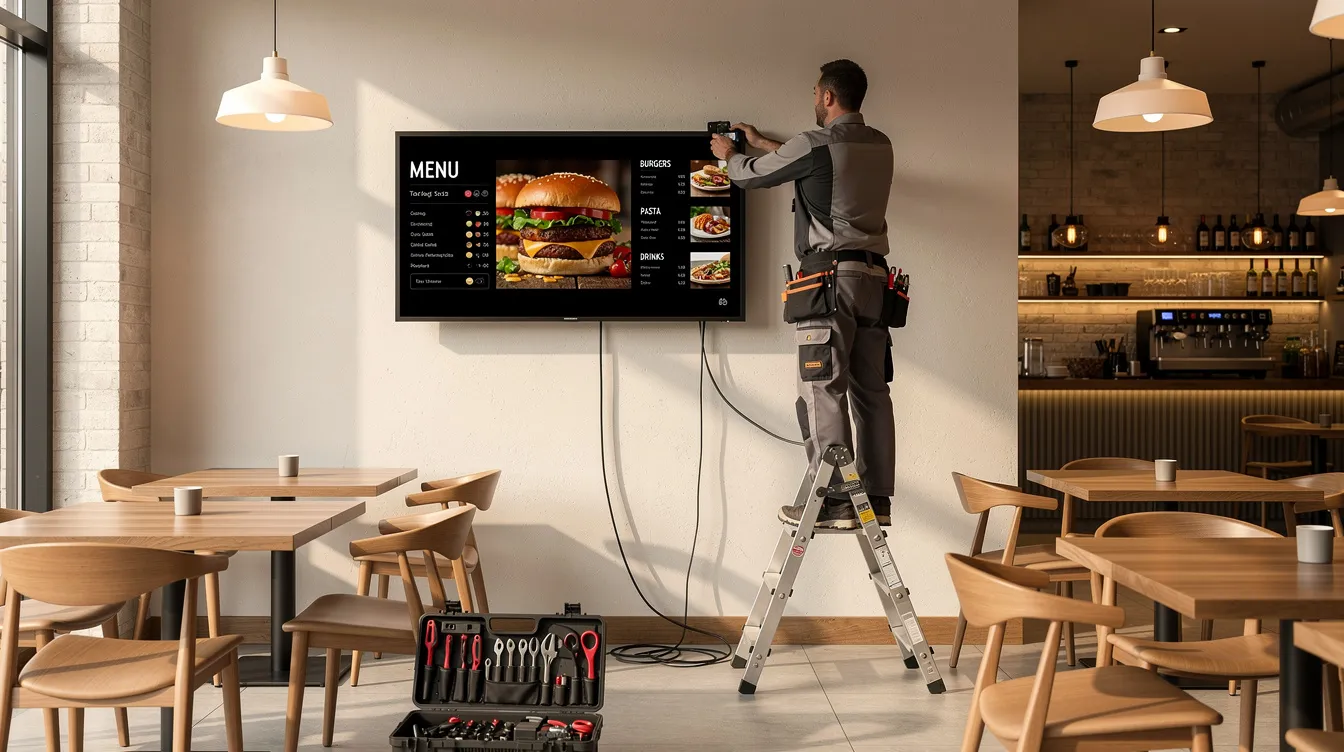
Installation complexity varies dramatically. A simple wall mount near existing power takes an hour. A multi-screen architectural installation in an older building can take days and require structural work.
Typical Installation Cost Ranges
|
Scenario |
Estimated Cost |
|---|---|
|
Simple single-screen wall mount |
$200–$400 |
|
Three-screen indoor menu wall |
$700–$1,500 |
|
Complex ceiling-hung or retrofit installs |
$1,500–$4,000+ |
Common Hidden Costs to Anticipate
- In-wall electrical work by a licensed electrician ($200–$500+)
- Conduit and cable management for clean runs
- Additional outlets or circuit upgrades
- Network switches or access points for wired connections
- Permit and inspection fees in some municipalities
Many vendors now offer turnkey packages bundling hardware, software, and installation into a single quote. This simplifies budgeting but may cost slightly more than sourcing components separately.
Real-world scenario: A 1,000 sq ft café installing two 50” menu boards above the counter with mid-range consumer TVs ($400 each), two media players ($200 each), mounts ($120 each), and professional installation with minor electrical work ($600–$900 total) ends up paying approximately $2,200–$2,500 plus ongoing software fees. Coffee-focused concepts can also consider digital split-flap café displays that blend menu content with ambient messaging.
Always request line-item quotes separating screens, players, mounts, labor, and travel charges. This lets you compare vendor offers accurately.
Maintenance, Warranties, and Lifespan
Total cost of ownership depends heavily on how long your hardware lasts.
Typical lifespan under restaurant conditions:
- Consumer TVs: 3–5 years under near-continuous use
- Commercial signage displays: 5–7+ years when run 16–24 hours daily
Warranty expectations in 2026:
|
Display Type |
Standard Warranty |
Extended Options |
|---|---|---|
|
Consumer TV |
1 year |
+2–3 years for $50–$200 |
|
Commercial display |
3 years |
+2 years available |
|
Note that many consumer TV warranties explicitly exclude commercial use. A claim may be denied if the manufacturer determines the TV was running 16 hours daily in a restaurant. |
|
|
Out-of-warranty replacement costs:
- Consumer 43”–55” TVs: $350–$600
- Commercial 43”–55” displays: $700–$1,500+
Minor ongoing maintenance includes periodic cleaning, occasional cable replacement, and re-imaging media players. Budget tens to low hundreds of dollars annually per location for routine upkeep.
For multi-location QSR brands, consider service-level agreements that guarantee response times and include spare inventory. Downtime during lunch rush costs real revenue.
Interactive Digital Menu Boards
Interactive digital menu boards take customer engagement to the next level by allowing guests to interact directly with your menu using touch screens and other advanced features. These interactive boards can let customers browse menu items, customize their orders, view nutritional information, and even pay—all from the screen itself, or you can opt for retro-inspired interactive concepts like Split-Flap TV digital menu displays that mimic classic flip-board signage.
For quick service restaurants, coffee shops, and food trucks, interactive digital menu boards are a great solution to speed up the ordering process and reduce lines. They also provide a more personalized experience, as customers can explore menu options at their own pace. With content management software, it’s easy to update and manage these interactive boards, ensuring your menu stays current and your promotions are always front and center.
Beyond improving the customer experience, interactive digital menu boards can collect valuable data on customer preferences and ordering habits. This insight helps you refine your menu, optimize pricing, and tailor promotions to boost sales. Whether you’re a small café or a busy food truck, or a higher-traffic venue looking at Split-Flap TV for business signage, interactive digital menu boards offer powerful features that can help your business stand out.
Specialized Applications for Digital Menu Boards
Digital menu boards are incredibly versatile and can be adapted for a wide range of specialized applications.
Indoor and Outdoor Applications
- Indoor digital menu boards are ideal for restaurants, cafes, and fast-casual eateries, providing a sleek and modern way to display menu items and promotions.
- Outdoor settings, such as drive-thru lanes or food trucks, benefit from weatherproof digital menu boards that ensure your menu is always visible and up-to-date, no matter the conditions.
Large Venues and Integration
- Used in stadiums, arenas, and other large venues to manage high volumes of customers efficiently.
- Can display not only menu items but also nutritional information, ingredient lists, and allergen warnings, helping customers make informed choices, and there are many innovative split-flap and digital signage ideas you can draw on for these environments.
Integration with mobile apps and online ordering systems allows customers to view menus, place orders, and pay remotely, streamlining the entire dining experience. With digital signage players and external media players, businesses can easily manage and update content across multiple locations, making digital menu boards a great solution for growing brands and franchises.
Example Digital Menu Board Budgets for Different Restaurant Types
Prices vary significantly by concept and scale. These 2026 scenarios illustrate what different operators typically spend.
Small Café or Food Truck
- Setup: Single 43” consumer TV, basic HDMI stick player, entry-level CMS, self-install or minimal professional help.
- Initial cost: $500–$1,000
- Ongoing software: $8–$20/month
- Included: Screen, player, mount, basic software
- Excluded: Professional design, photography, POS integration
This minimum viable setup gets you off paper menus without breaking your budget. Perfect for testing whether digital boards work for your concept before investing more.
Single-Location Fast-Casual Restaurant
- Setup: 2–3 x 49” or 55” displays (consumer or commercial), mid-range dedicated players, mid-tier CMS with day-parting, professional installation.
- Initial cost: $2,000–$5,000
- Ongoing software: $40–$120/month
- Included: Screens, players, mounts, professional installation, software
- Excluded: Custom photography, POS integration fees, extensive electrical work
This represents the sweet spot for most independent restaurants wanting reliable, good-looking menu boards without enterprise complexity.
Multi-Location QSR Chain (5+ Locations)
- Setup: Standardized triple-screen 55” commercial displays per store, SoC or certified players, enterprise CMS with analytics and multi-site management, professional rollout.
- Initial cost: $6,000–$12,000 per location
- Ongoing software: $60–$120+/month per location
- Included: Commercial screens, players, mounts, professional installation, training, enterprise software
- Excluded: Photography, menu design, headquarters analytics dashboards (often additional)
Chains benefit from volume discounts on hardware and installation. Standardized templates across locations reduce design costs and enable rapid price updates, especially in hospitality concepts like bars and pubs that can leverage customizable split-flap displays for promos and menus.
Minimum Viable vs. Fully Optimized Systems
The gap between these approaches isn’t just visual quality.
- A minimum viable system (single TV screen, basic player, cheap software, DIY install) might cost $400–$700.
- A fully optimized setup with commercial displays, enterprise CMS, professional design, and data-driven menu optimization can run $4,000–$10,000+ per location.
The difference shows up in reliability, update speed, and ability to run targeted promotions. A minimum setup proves the concept works. A fully optimized system drives measurable revenue increases.
Indoor vs. Outdoor Digital Menu Board Pricing
Outdoor digital menu boards for drive-thru lanes cost significantly more than indoor equivalents. Weatherproofing, high brightness, and rugged enclosures drive the premium.
2026 outdoor pricing:
|
Configuration |
Typical Cost |
|---|---|
|
Outdoor-rated 46”–55” high-brightness display with enclosure |
$2,500–$7,000 per screen |
|
Drive-thru digital menu board system (pedestal, enclosure, audio, payment integration) |
$8,000–$20,000+ per lane |
|
Outdoor displays require 2,000–3,000+ nits brightness (versus 400–700 nits for indoor), vandal-resistant glass, integrated heating/cooling, and IP-rated enclosures. All of this pushes costs 3–5x higher than comparable indoor screens. |
|
Software licensing for outdoor boards typically matches indoor per-screen pricing, though you’ll likely need separate content channels and scheduling for drive-thru versus in-store menus.
For smaller operators, the smart move is starting with indoor digital menu boards first. Prove ROI there before committing $15,000+ to a drive-thru installation.
ROI: How Digital Menu Board Prices Compare to Paper Menus
The financial case for digital menu boards compares upfront investment against ongoing printing costs and potential revenue increases.
Static Menu Costs Add Up
A typical restaurant reprinting static boards quarterly or semi-annually easily spends $300–$1,000+ per year on design and printing. Factor in rush jobs when prices change unexpectedly, and costs climb higher, which is why many venues move to split-flap-style digital menu screens to cut printing costs.
Digital Payback Timeline
A digital system in the $1,500–$3,000 range often pays for itself in 1–3 years through:
- Eliminated printing and rush reprint costs
- Faster price updates (no waiting for new boards)
- Sales lift from dynamic content and upselling
Industry data suggests many QSRs see 3–8% average ticket increases when using digital menu boards effectively. The lift comes from highlighting big ticket items, running timed promotions, and displaying vivid food images that trigger impulse purchases.
Simple payback example:
If digital boards increase daily revenue by $40–$80 through slightly higher average tickets, a $2,000 system recoups its cost in under one to two years. Even conservative 3% uplift estimates often justify the investment.
Digital menu boards also enable:
- Instant price adjustments when ingredient costs spike
- Automated day-parting (breakfast transitions to lunch automatically)
- Testing different layouts and promotions in real time
The cost effective long run calculation typically favors digital, especially for restaurants that update prices more than twice yearly or run regular promotions.
How to Control and Optimize Your Digital Menu Board Budget
Smart budgeting focuses on matching investment to actual needs rather than buying everything at once.
Practical Cost Control Steps
- Start with 1–2 screens instead of a full video wall. Test whether customers engage before scaling.
- Choose reliable mid-range hardware. The cheapest TVs fail early; ultra-premium commercial panels may exceed your needs.
- Avoid overbuying software features. Entry or mid-tier CMS at $8–$20/screen handles most independent restaurant requirements. Upgrade later if you need advanced features.
- Pilot before scaling. Install in a single location during 2025, gather sales and operational data for 3–6 months, then expand in 2026 if ROI is clear.
Negotiation Opportunities
- Multi-year software contracts often unlock 15–25% discounts
- Bulk hardware orders across locations yield per-unit savings
- Some vendors subsidize players in exchange for longer CMS commitments
Standardize templates for multi-location brands. Creating a master menu layout once and replicating it across stores dramatically reduces per-location design costs and speeds updates.
The “right” digital menu boards price isn’t necessarily the lowest. It’s the investment level that reliably supports your brand, enables the operational agility you need, and delivers returns over a 3–5 year horizon. Start small, prove value, then scale with confidence.
Conclusion
In summary, digital menu boards are a great solution for any business aiming to enhance customer experience and drive sales. Their dynamic display capabilities and easy content management make them a cost-effective investment over the long run. Whether you choose a traditional digital menu board or opt for an interactive digital menu board with advanced features, there’s a solution to fit every budget and business model.
By carefully considering hardware costs, content management needs, and the frequency of software updates, you can select a digital menu board system that aligns with your goals and resources. With the right combination of digital signage software and hardware, you can create a digital menu board that not only looks great but also delivers measurable results for your business. Investing in digital menu boards is a smart move for staying competitive and meeting the evolving expectations of today’s customers.