
The Split-Flap Click-Clack: Sound That Sells
March 4, 2026 · Captain
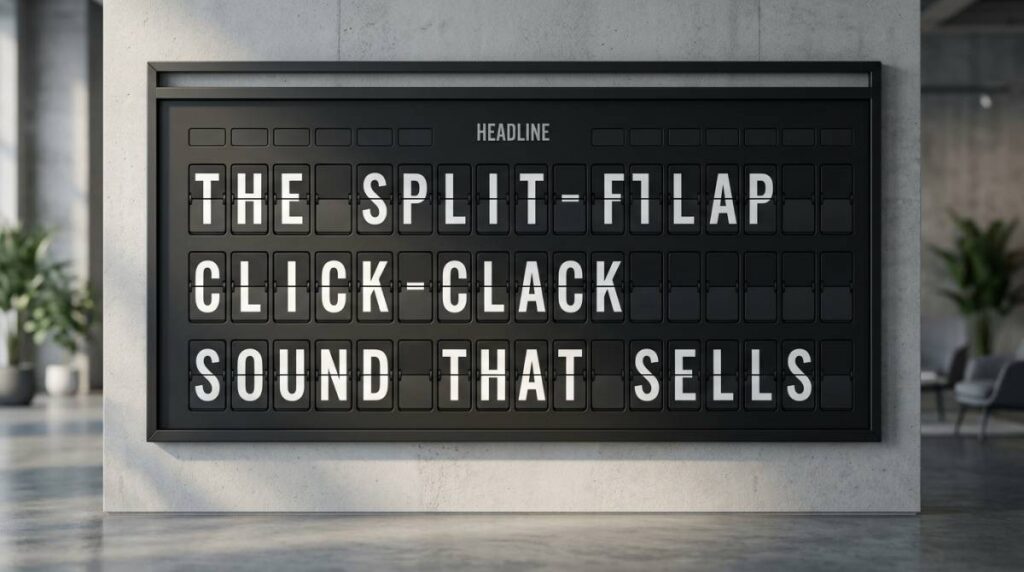
The first time a split-flap board “speaks,” it does not use words. It uses rhythm.
That click-clack is the moment people look up from a phone, stop mid-conversation, and orient toward the message like they just heard a train schedule change. For customer-facing spaces – cafes, boutique hotels, bars, lobbies, studios, offices – the split flap display sound effect is not just nostalgia. It is an attention cue that feels oddly trustworthy, like information is being “published” in real time.
Used well, it turns a piece of digital signage into a little bit of public theater. Used poorly, it is a distraction you end up apologizing for.
What the split flap display sound effect actually does
A split-flap board has always been a performance. You do not simply read it – you watch it arrive. The sound is a big part of that arrival.
A classic mechanical board makes noise for practical reasons: motors, gears, and physical flaps striking stops. But the effect it creates is psychological. It tells the room, “Update happening now.” That matters because most digital screens are silent and visually slippery. A screen changes, and people miss it.
The split flap display sound effect fixes that with three benefits that map cleanly to business outcomes.
First, it creates a gentle interrupt. Not an alarm, not a notification ping – something more analog and human. You get attention without shouting.
Second, it adds perceived authenticity. Customers associate the click-clack with transit halls, old hotels, and real-world scheduling. When your hours, Wi‑Fi, daily special, or next event shows up with that familiar cadence, it feels official.
Third, it sets expectations for motion. Split-flap animation is busy by design. The sound gives the motion a reason, which makes the movement feel intentional rather than gimmicky.
Why it works on people (even if they are not nostalgic)
You do not have to be a retro enthusiast to respond to this sound. Two things are happening.
One is pattern recognition. The click-clack is structured – a burst of small impacts that starts, peaks, and resolves. Our brains treat that like a “system event,” the way we notice a printer starting up or a door latch closing. It signals that something changed.
The second is social proof in audio form. If something in a room makes a familiar public-space sound, people assume it is worth checking. It is the same reason a bell at a service counter works. A sound that implies coordination nudges attention in a way a silent screen rarely can.
That said, sound always comes with trade-offs. A sign that gets noticed is great. A sign that becomes the loudest personality in the room is not.
When the click-clack helps – and when it hurts
The best rule is simple: use sound when updates matter to people nearby, and keep it quiet or off when the room’s main product is calm.
In a bar or quick-service restaurant, the click-clack can be a feature. Rotating specials, happy hour timing, game-day messaging, and last-call reminders benefit from a cue that cuts through chatter. In these spaces, sound is already part of the environment.
In a boutique hotel lobby, it depends. The sound can add charm during daytime check-ins and create a signature moment when the day’s welcome message flips in. Late at night, the same sound can feel intrusive. Scheduling the sound – or lowering it after certain hours – is often the right move.
In an office, consider the culture. A creative studio might love the playful tactility. A quiet clinic or therapy practice likely will not. If your team has headphones on all day, they may experience the click-clack as “one more thing.”
Even in louder venues, frequency matters. If the sign updates every minute and clicks every time, it stops being charming. The effect is strongest when it feels occasional and purposeful.
Getting the sound right: realism vs. comfort
People often assume “more realistic” is always better. With a split flap display sound effect, realism can be a trap.
True mechanical boards can be surprisingly loud and sharp up close. In a modern space, especially one with hard surfaces (tile, glass, concrete), that sharpness reflects. What reads as “authentic” in your head can read as “clattery” in the room.
A good digital version should keep the character without copying every harsh edge. That usually means a warmer click with less high-frequency snap, and a slightly shorter decay so it does not smear into background noise.
Volume also has to match distance. If your display is behind the counter and customers stand six feet away, you can keep it subtle and still get the effect. If the display is in a large lobby, the sound might need a touch more presence – but not enough to compete with music.
Timing matters more than volume
Most people judge the click-clack experience by timing, not loudness.
If the sound triggers late, it feels fake. If it triggers too early, it feels disconnected from the visual flip. The sweet spot is tight synchronization – the audio should ride the animation so your eye and ear agree on what is happening.
Timing also includes pacing. A rapid-fire click can feel frantic if your message is calm and premium. A slightly slower cadence can feel more deliberate, like a composed announcement rather than a machine rattling.
This is where split-flap style becomes part of brand voice. A cocktail bar might want a crisp, snappy cadence that feels like energy. A high-end retail boutique may prefer a restrained, measured flip that signals elegance.
Designing with sound: how to keep it from becoming “noise”
A split flap display sound effect is most effective when it is treated like part of your environment, not a default setting.
Start with intent. Ask what the sound is supposed to do in your space: pull attention to a time-sensitive change, reinforce the retro-modern vibe, or add a memorable moment when someone walks in.
Then limit when it fires. If your display cycles through multiple pages, consider using sound only on the first page, or only when a specific field changes (like “NOW SERVING” or “NEXT EVENT”). If everything clicks all the time, nothing feels special.
Next, respect your staff. They live with the sign more than customers do. If your team is within a few feet of the display for hours, their tolerance sets the real limit. Many venues land on a lower volume during service and a higher volume for brief “moments” – like opening, happy hour, or a scheduled announcement.
Finally, match sound to layout. A tightly packed board with many characters flipping can create a dense wall of motion. Sound can make that feel richer, but it can also make it feel chaotic. If you run a big flip, reduce volume. If you run a minimal flip, sound can be a little more present.
Use cases where the sound earns its keep
The click-clack is not just for vibes. It can reduce repeated questions and make information feel current.
Menus and specials are a natural fit because they change often and customers look for “what’s new.” A flip with sound makes the change feel intentional, which can boost confidence that the info is accurate.
Schedules and wayfinding are another. When a meeting room name flips or an event start time updates, the sound acts like a miniature announcement – without needing a staff member to say anything.
Welcome messages work because the sound creates a moment of arrival. If someone steps into your space and the display flips to “WELCOME” or “TODAY’S HOURS,” it feels like the room noticed them.
If you are using a modern split-flap experience on TVs or tablets, you can also treat sound as an optional layer. For example, Split Flap TV offers an authentic split-flap aesthetic with optional sound, so the same display can run quietly in some contexts and click-clack in others without changing your content strategy.
Common mistakes (and how to avoid them)
The biggest mistake is leaving sound on for every micro-update. If you pull live content feeds or frequently changing data, you may unintentionally create a constant clicking loop. The fix is to set rules: batch updates, schedule refresh windows, or limit sound to major changes.
Another mistake is treating the sound like a novelty button. If it is too loud, guests stop hearing “charming” and start hearing “trying too hard.” The click-clack should feel like it belongs to the room.
A third is ignoring acoustics. A minimalist space with hard surfaces amplifies sharp sounds. If the click-clack feels harsh, lowering volume helps, but changing placement and speaker direction can matter just as much.
A quick reality check: some spaces should stay silent
There is no shame in turning it off.
If your venue’s promise is calm – a spa-like lobby, a clinic waiting room, an intimate tasting room – the best design choice might be silent motion. You can still get the visual magic of split-flap animation and keep the atmosphere intact.
And if you do want sound, consider using it only at specific times. Let the sign click-clack during morning setup, the lunch rush, or a scheduled “announcement,” then go quiet during slower, more intimate hours.
The point is not to force a gimmick. It is to use a distinctive sensory cue to make communication feel alive.
Where the sound comes from: a short history of the click-clack
Before split-flap boards, public information was updated by hand. Stationmasters chalked arrivals onto boards and airport staff physically swapped the text on signs. It was slow, error-prone, and every delay meant someone had to erase and rewrite while travelers waited.
The split-flap display replaced that routine in the mid-20th century. Each character module held a set of printed flaps, one for every letter, number and symbol, rotating around a central spindle. An electrical signal started a small motor, the flaps turned until the right character appeared, and the whole board could be updated remotely in seconds instead of minutes.
The clatter was a byproduct of flaps falling into place, but it quickly became a signal in its own right. From the 1960s through the 1990s these boards were the information hubs of airports and railway stations, so the sound became tied to departures, arrivals and the start of a trip. The same technology showed up on stock exchange floors, where the noise matched the energy of trading, and on television game shows, where answers and scores were revealed one character at a time. That association has lasted: the Massachusetts Bay Transportation Authority, for example, uses a generated flapping noise to cue passengers to important changes.
The sound as sonic branding
A consistent, recognizable sound works a lot like a logo you hear instead of see. When the same click-clack accompanies every meaningful update in your space, it stops being a generic notification and becomes part of how customers remember you.
It also lands differently now because of digital fatigue. People are worn down by constant pings, pop-ups and endless scrolling, and they have learned to tune silent screens out. A deliberate mechanical-sounding flip turns a piece of data into a small physical event. The message feels earned rather than passively pushed at you, and in a shop, cafe or hotel lobby that is often what gets someone to stop, watch, and ask about the board.
What makes the sound feel real: the anatomy of a flip
The split-flap noise is not one sound. It is several mechanical actions overlapping, and a convincing recreation needs all of them.
- Motor engagement: a low hum or faint whine as the motor starts. It is usually buried under the clacks, but it adds weight.
- Release and friction: a brief, high-frequency scrape as the top flap slides against its catch just before it drops.
- Impact: the main event, a sharp transient as the flap hits the stack. Material matters here. Metal flaps ring slightly, while PVC gives the classic deadened clack.
- The cascade: dozens of modules update at once but never finish at the same millisecond, producing a staggered wave of sound. This organic randomness is the most important part to get right.
Sound designers who build the effect from scratch often record stand-ins such as stiff playing cards thumbed near a microphone, plastic picks snapped against a hollow wooden box, or clicky mechanical keyboard switches. In a DAW they layer a hard plastic snap with a softer paper flutter, boost the 2 kHz to 5 kHz range to bring out the click, and roll off everything below 100 Hz to avoid mud. Two details separate good work from bad: never place clicks on a perfect grid, and shift the pitch of each click randomly by around 50 cents in either direction. Skip those and you get a “machine gun” effect where the same sample obviously repeats.
Building a physical board gets you the genuine sound, but it means hundreds of hours of design, printing and assembly, microcontroller code to manage motor timing, and ongoing repairs for jammed flaps and worn motors. Software that generates the cascade automatically for each update, synchronized to the animation, is the practical route for most businesses.
Sound is only half of authenticity
An authentic click-clack effect is not a font plus a sound file. If the visuals are off, the audio cannot save it.
The motion needs to feel mechanical: characters cycle through positions and settle, rather than melting smoothly into place like an app transition. Typography needs discipline, with every character in a consistent cell and rows that line up, because the format was built for public reading at a distance. And the layout should look like signage, not a slideshow. Extra colors, crowded blocks and promotional graphics dilute the character quickly, while rows, columns and a clear hierarchy keep it intact.
Authenticity is operational too. A board that looks right but is hard to update goes stale, and a stale board undermines the whole point of a sound that says “this just changed.”
Closing thought
The click-clack is powerful because it makes information feel physical again. If you treat the split flap display sound effect like a design material – shaped by timing, frequency, and context – it becomes a signature that customers remember and staff actually enjoy living with.