
Split-Flap Displays That Restaurants Actually Use
February 26, 2026 · Captain
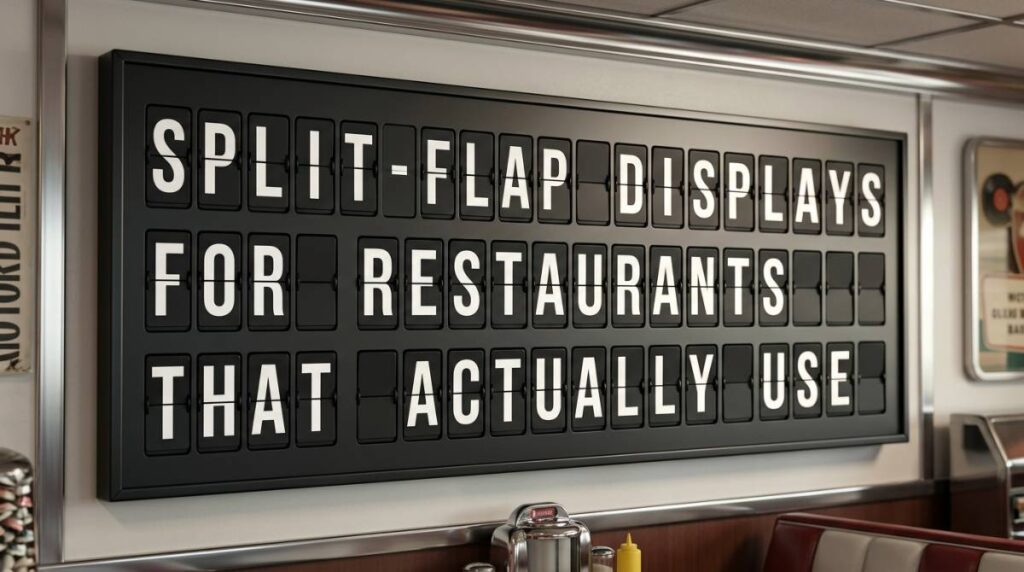
The host stand is already a stage.
It is where first impressions form, where the line either feels calm or chaotic, and where the same questions hit on repeat: What are tonight’s specials? How long is the wait? Is the patio open? Do you have happy hour right now?
Most restaurants answer those questions with a collage of solutions – a printed menu insert that is already outdated, a handwritten sign that looks like it survived a lunch rush, and a TV screen that feels like a sports bar even when you are not.
A split flap display for restaurant use is different. It turns information into theater. The flip, the rhythm, the satisfying click-clack effect – it pulls eyes in the way a generic screen rarely does. And when it is built on modern screens instead of mechanical parts, it also behaves like a serious operations tool: cloud-managed, instantly editable, and consistent every day you are open.
Why split-flap belongs in a dining room
Split-flap boards earned their reputation in places where timing and clarity matter: train stations, airports, big public venues. Restaurants have the same need, just with better lighting and higher expectations.
The visual language is clean and fast. High-contrast letters, tidy rows, and intentional pacing give your message structure. Guests do not have to hunt for the information – the board does the pointing for you.
Then there is the emotional side. A split-flap aesthetic signals taste. It is retro without being kitschy when the layout is handled well. People notice it, talk about it, and often photograph it. That is the part most signage misses: it is not only communicating, it is adding to the room.
And yes, it can be practical. When your menu changes, your hours shift for a holiday weekend, or you decide to run a last-minute cocktail feature, you should not be printing, crossing out, taping over, or apologizing. You should be publishing.
What a modern split-flap display actually is
Traditional split-flap boards are mechanical. They are beautiful, but they also require upkeep, specialty parts, and the kind of tolerance for downtime that most restaurants do not have.
A modern split-flap display recreates that iconic Solari-style look on a TV screen or tablet, controlled by an app. You get the signature flip animation and can often choose whether to include sound, but the content updates like any modern digital system. That combination is the whole point: nostalgia on the outside, control on the inside.
For a restaurant, that means the display can live in the dining room, by the entrance, at the bar, near pickup shelves, or even in back-of-house – while the content can be updated from a phone between tables or from a laptop after service.
Where it earns its keep inside a restaurant
You do not need a split-flap board everywhere. You need it where it reduces friction or increases appetite.
At the entrance, it solves the “what’s happening tonight?” problem. A clean board that cycles through today’s hours, whether the patio is open, and a short list of specials keeps hosts from repeating themselves and keeps guests from feeling lost.
At the bar, it shines for time-bound moments. Happy hour windows, a rotating draft list, a featured spirit, or a nightly cocktail can live in a layout that feels designed, not improvised. Guests look up. They point. They order.
For takeout and pickup, it turns confusion into a simple flow. Order status, pickup instructions, delivery partner notes, or where to wait – all of that is information guests want, but nobody wants to ask for.
In quick-service and fast-casual settings, the split-flap look can replace a “menu TV” that feels like every chain on the highway. You can still show the essentials – top sellers, combo prompts, time-limited offers – without turning your space into a slideshow.
The messages that work best in split-flap format
Split-flap displays are strongest when the content is short, structured, and intentional. Think of it like the best version of a chalkboard: curated, not crowded.
Daily specials are a natural fit because they change and because they benefit from focus. Instead of burying them in a paragraph, you give each one its own line and let the flip animation give it weight.
Wait times and service cues are another win, especially during peak periods. If you have guests hovering near the stand, clarity lowers stress. If you run a waitlist, you can display what you want guests to know without calling out names.
Hours and exceptions matter more than most restaurants want to admit. The number of times a team has had to explain a holiday schedule or a private event is proof that a single source of truth is worth it.
Wi‑Fi, policies, and small-but-critical notes are where messy signage usually shows up. A split-flap display lets you keep those details visible without sacrificing aesthetics.
The trade-off is that split-flap is not designed for dense paragraphs, long disclaimers, or a menu with 80 items. If your goal is to show everything, you will fight the format. If your goal is to show the right thing, at the right moment, it feels effortless.
Designing it so it looks premium, not like a gimmick
Restaurants live and die by cues: typography, lighting, spacing, restraint. A split-flap board should follow the same rules.
First, commit to fewer words. Split-flap layouts look best when each line has a purpose. If you need to explain a dish, do it on the menu. Use the display to prompt interest: the name, a tight descriptor, the price if appropriate.
Second, match the pace to the room. A loud, fast-flipping board can feel electric in a busy bar and distracting in a quiet dining room. Timing matters. If the flip animation is part of the experience, it should feel like it belongs to the soundtrack of the space.
Third, treat it as part of the interior. Placement and scale are everything. A board hung too high becomes decor, not information. A board placed where people naturally pause becomes a tool.
Finally, keep the content consistent with your brand voice. If your restaurant is elegant, the board should not shout. If you are playful, it can. The split-flap style is flexible, but it will amplify whatever you put into it.
Operational reality: who updates it, and when
The romance of a click-clack board fades quickly if updating it becomes a chore.
The ideal setup is simple: one or two people own the content, and the system supports quick edits, templates, and scheduling. In practice, that usually means a manager updates specials before service, a bartender updates the featured cocktail, and someone on the marketing side schedules recurring messages like happy hour or weekend brunch.
Scheduling is where modern split-flap displays pull ahead of analog signage. The best restaurant messaging is predictable: lunch hours, dinner hours, weekly events, seasonal items. If you can pre-build pages and assign them to times and days, the display stops being another daily task.
There is also a real benefit to remote control. If you have multiple locations, or if an operator is off-site, being able to correct a detail without driving in matters. It reduces mistakes that lead to awkward guest interactions.
When it might not be the right fit
Split-flap is not a universal answer.
If your concept depends on showing a full menu with photos, modifiers, and detailed nutrition or allergen panels, a split-flap layout will feel constrained. You can still use it as a highlight board, but not as your only menu.
If your space is extremely minimal and silent, the visual motion might feel like a distraction. Some operators love the optional click-clack sound because it adds personality. Others prefer the look without the audio. It depends on your room and your guests.
If you rarely change anything, the operational value is lower. You might still want the aesthetic, but you will not get the same payoff as a place running daily specials, rotating taps, or frequent event programming.
Getting started without turning it into a tech project
A split-flap display should feel like buying a piece of the room, not adopting a complicated AV system.
Start by choosing one job for the display. Not three. Not ten. Pick the highest-friction communication point: specials, wait time guidance, happy hour, pickup instructions.
Then decide where it will live based on guest behavior. Where do people pause? Where do questions happen? Put the display there.
After that, build a small set of pages that you can rotate. Most restaurants only need a handful: a welcome page, today’s hours, 3-6 specials, and 1-2 utility messages. Once the structure is in place, you will find it easy to swap content without reinventing the layout.
If you want the retro look with modern control, Split Flap TV (https://splitflaptv.com) is designed exactly for that: prepared screens you can mount and run, paired with an app for layouts, scheduling, and quick updates – all while keeping the authentic split-flap aesthetic and that satisfying flip.
The goal is not to add another screen. It is to replace the messy stuff – taped notes, outdated inserts, last-minute print jobs – with something that looks intentional and stays correct.
The real win: fewer questions, better moments
Restaurants cannot eliminate chaos, but they can choreograph it.
A split-flap display for restaurant spaces does two things at once. It answers questions before guests have to ask, and it turns routine information into part of the experience. That is a rare combination: operational clarity that also feels like design.
If you are going to communicate all day anyway, you might as well do it in a way that looks like you meant it – and sounds like it, too, when the room calls for a little click-clack.