
Split Flap Display Boards That Actually Work
February 23, 2026 · Captain
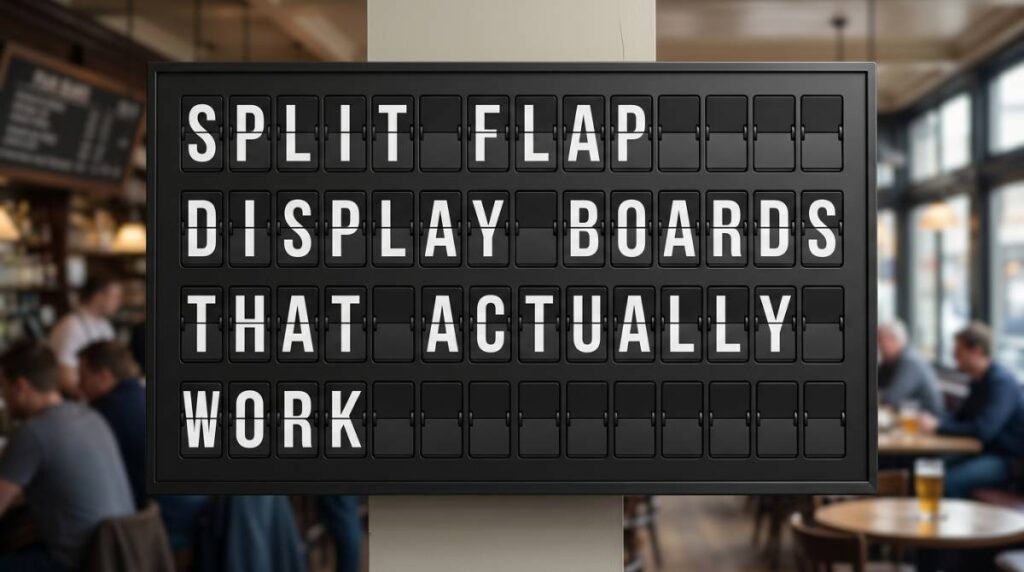
You know the moment: a customer walks in, scans the room, and their eyes land on the one thing that feels alive. Not a poster. Not a TV looping muted promos. A split flap display board – the kind that looks like it belongs in a great train station, yet somehow fits perfectly above your espresso bar.
That attention is the whole point. But for most businesses, the real win is what happens after the glance: fewer repeated questions, faster updates, cleaner counters, and a space that looks intentionally designed instead of “patched together during a rush.”
What a split flap display board is (and why people still stare)
Classic split-flap boards were mechanical information machines. Each character lived on a physical flap, and when the message changed, the board performed a tiny show: flip-flip-flip until everything snapped into place. Airports and rail stations used them because they could update lots of information quickly and from a central system.
We stopped needing the mechanics, but we never stopped loving the theater. The click-clack rhythm, the orderly grid, the typography, the sensation of motion that feels purposeful instead of flashy – it all reads as premium and human at the same time.
In customer-facing spaces, that translates to a simple advantage: people notice it without you begging for attention. A split flap display board feels like information, not advertising. That’s a rare lane.
The real business case: clarity beats clutter
Most signage problems aren’t creative problems. They’re operational. A menu changes. Hours shift for a holiday. Wi‑Fi details need to be visible but not ugly. The “special” changes twice in one day. Somebody tapes a note to the counter, then another note covers it, and suddenly your brand looks like it’s arguing with itself.
A split flap display board is at its best when it becomes your single source of truth in the room. Put the information customers ask for most where it’s unmissable, and keep it correct without printing, handwriting, or apologizing.
You can feel the difference in a busy shift. Staff stops answering the same questions. The line moves. Your counter is clean. And the space looks deliberate, like you meant to do it this way.
Mechanical vs. digital split-flap: what you gain, what you give up
There are two ways to get the split-flap experience today: true mechanical units or digital versions that recreate the look and animation on modern screens.
Mechanical boards are undeniably iconic. They also come with reality: cost, weight, specialized parts, and the kind of maintenance that doesn’t care if your team is already slammed. If you want a huge installation and you have the budget and technical support, mechanical can be worth it as a centerpiece.
Digital split-flap displays trade the physical mechanism for practicality. You can still get the signature flipping animation and that crisp, modular look, but with instant updates, scheduling, and the ability to manage content without a ladder, a toolbox, or a service call.
The trade-off is authenticity in the strictest sense. Purists love real flaps. Most customers just love the vibe – and most operators love not having a mission-critical sign that can jam.
It depends on your goals. If your priority is a museum-grade artifact, go mechanical. If your priority is daily usefulness with the same visual magic, digital wins.
Where a split flap display board fits best
Split-flap style works in more places than people expect, but it shines where information changes and guests look up.
Cafes, bakeries, and quick-service counters
This is the natural habitat. Daily specials, rotating pastries, seasonal drinks, out-of-stock notices that don’t feel messy – all of it benefits from a display that reads cleanly at a glance. The split-flap grid also makes pricing look organized rather than “scribbled in later.”
Restaurants and bars
Happy hour windows, featured cocktails, game-day schedules, live music times, “kitchen closes at” reminders. The format feels like a timetable, which is exactly how guests process these details.
Boutique hotels and lobbies
A split flap display board can replace a whole stack of paper: check-in notes, breakfast hours, Wi‑Fi, local recommendations, shuttle times, meeting room schedules. It looks elevated, not corporate.
Offices and studios
Visitors want directions, not a scavenger hunt. Use split-flap style for “today’s meetings,” welcome messages, room bookings, and internal announcements that still deserve a designed presentation.
What to look for before you buy
Not all split-flap inspired displays are created equal. Some are basically a novelty animation. Others are a real signage system dressed in split-flap clothing.
First, look at layout control. Can you choose the number of rows and columns? Can you build multiple “pages” and control how long each stays on screen? A good system lets you match the board to your space, not force your message into somebody else’s template.
Next, look at content control. Can you update from your phone during a rush? Can you schedule changes so tomorrow’s hours go live automatically? Can multiple staff members manage it without stepping on each other?
Then consider motion and pacing. The flip animation is the charm, but if it’s too fast, it feels like a glitch; too slow, and it becomes a distraction. The best boards let you tune timing so the movement feels intentional.
Finally, consider sound. The click-clack is emotional rocket fuel in the right environment. It’s also not for every space. A quiet hotel lobby at midnight has different needs than a lively bar at 7 p.m. The option to enable, disable, or limit sound by schedule matters.
Designing messages that feel premium (not shouty)
The split-flap look is naturally structured, which is why it’s so effective – but it also exposes sloppy messaging. You can’t hide behind busy graphics.
Write like you’re helping someone. Short lines. Clear labels. Consistent abbreviations. If you’re listing hours, keep the format identical day to day. If you’re naming products, keep capitalization and spacing consistent. The board will make your discipline look stylish.
Also, respect the rhythm of attention. One board can’t carry everything. Use it for the top tier of information: what’s available, what’s happening, what to do next. Leave the rest to menus, table tents, or a QR code if you need depth.
A practical trick: if a guest asks the same question more than five times a day, it belongs on the board.
Installation and day-to-day operation: the part you’ll care about most
The romance gets you interested. Operations makes you a buyer.
A split flap display board should be easy to place and easy to keep correct. Think about sightlines first: where do people naturally pause, and where do they look when they’re waiting? Eye level is great, but “above the crowd” is often better.
Then think about ownership. Who updates it? If it’s “the one manager who knows the password,” it will drift out of date. The best setups treat messaging like a shared tool: staff can make quick edits, while brand or leadership controls templates and scheduling.
If you’re running multiple locations, remote management changes everything. One update can hit every store. Holiday hours can be scheduled once. A sudden closure doesn’t require phone calls to every shift lead.
This is where modern split-flap style shines: it keeps the magic but drops the friction.
Cost, value, and the hidden expense of “cheap” signage
Mechanical split-flap boards can be a major capital expense, and they often bring ongoing maintenance costs. Digital split-flap solutions tend to be far more predictable: hardware plus software.
The bigger question is opportunity cost. How much time do you burn rewriting signs, printing updates, explaining changes, or correcting misinformation that a customer saw on an outdated sheet of paper? How much does a messy counter erode the “premium” feel you’re trying to charge for?
A split flap display board earns its keep when it replaces repetitive labor and raises perceived quality at the same time. That combination is rare.
A modern way to get the split-flap experience without the headache
If you want the split-flap aesthetic with plug-and-play setup, modern screens, and app-based control, that’s exactly what Split Flap TV builds. It delivers the classic flipping look (with optional click-clack) while keeping updates instant, scheduled, and cloud-managed – the part operators actually need. You can see how it’s set up at https://splitflaptv.com.
The moment it becomes part of your brand
The best split flap display board isn’t a gadget. It becomes a habit. Staff trusts it, customers rely on it, and your space feels more intentional because information has a home.
If you’re considering one, don’t start by asking, “What can I put on it?” Start by listening for a week. Every repeated question, every taped note, every last-minute update is your roadmap.
Pick the messages that reduce friction and raise the vibe at the same time – then let that familiar flip do what it has always done: turn simple information into something people can’t help but watch.